

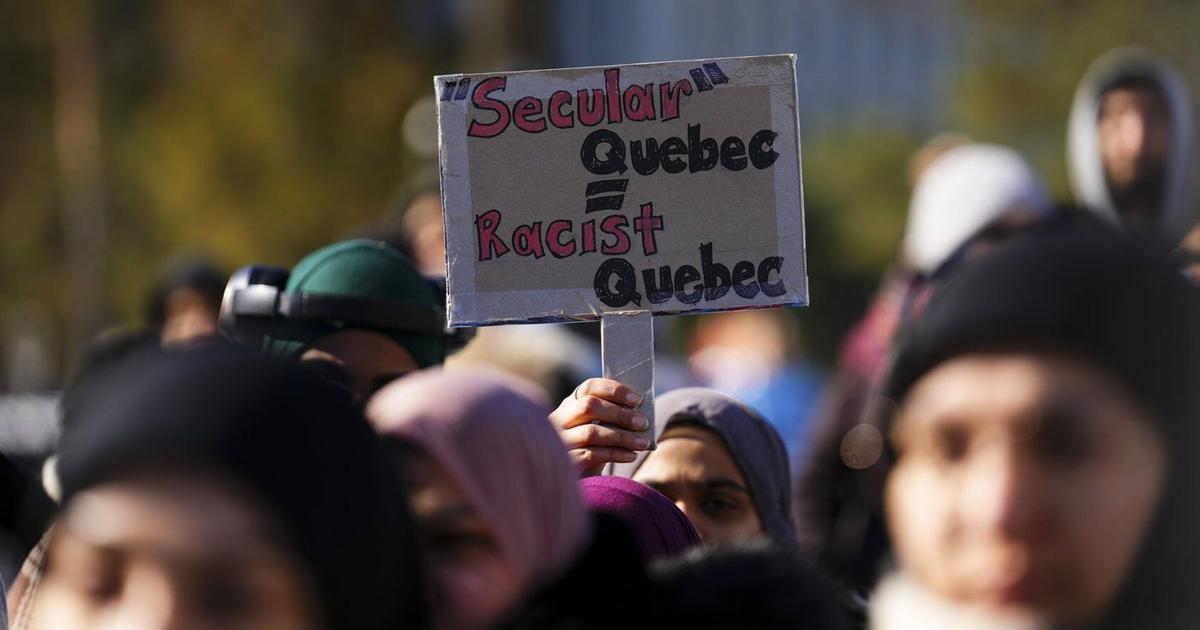
OTTAWA — In a landmark decision, the Supreme Court of Canada has upheld all but one part of Quebec’s controversial secularism law, ruling that the provincial government’s use of the Constitution’s “notwithstanding clause” to impose it was valid.
The ruling delivered Friday morning stands as a victory not only for the Quebec government, but for other provinces that have also invoked Section 33 of the Charter of Rights and Freedoms — the “notwithstanding clause” — to shield controversial bills from court challenges.
Section 33 allows governments to pass legislation that overrides certain — but not all — rights guaranteed by the Charter for renewable periods of five years.
Friday’s ruling landed as a blow for minority rights groups and civil liberties advocates, who warned that the notwithstanding clause is being wielded by Quebec in a way that targeted visible minorities through its law barring the wearing of religious symbols on the job by some public-sector workers.
National Council of Canadian Muslims CEO Stephen Brown said the decision opens the “floodgates for a full attack” on the Charter rights of Canadians.
Brown said the notwithstanding clause was meant to be an “instrument of last resort,” but is now being used by provinces to limit minority rights.
“For years, Canadians believed that we had this amazing Charter that guaranteed our rights and freedoms, and we went through life secure in that belief,” he said.
He called on Prime Minster Mark Carney’s government to “bring the provinces to the table and bring real limits to the use of the notwithstanding clause.”
If that doesn’t work, Brown said, Ottawa should consider measures like “disallowance,” a rarely used constitutional power often described as the “nuclear option” that allows the federal government to invalidate a provincial law.
Bloc Québécois Leader Yves-Francois Blanchet hailed the Supreme Court ruling as a “very important victory” for Quebec’s National Assembly and its ability to pass laws that define and defend the province’s distinct values and francophone identity.
Blanchet also took aim at the federal government, arguing the money it spent on the case revealed a “hostility” to Quebec’s use of the notwithstanding clause.
“That doesn’t prove that Canada is working. It proves that the federal (government) has tried to create what could be defined as a Canada that doesn’t work,” he said.
The Bloc leader also said the legal debate over Bill 21 should now be finished, despite calls for the federal government to consider using its disallowance power to strike it down.
“There’s a line, there is a limit to how the prime minister can claim to be superior,” he said. “The Supreme Court of Canada has ruled.”
Friday’s ruling lands amid fierce debate surrounding its pre-emptive use by provinces like Ontario, Alberta and Saskatchewan in recent years, with the latter jurisdictions using it specifically to pass legislation restricting how schools can use a gender-diverse student’s pronouns.
Civil liberties groups and other opponents have argued it was improper to invoke the constitutional tool before legislation had been challenged in the courts.
The court’s decision rejected that argument. “Making the exercise of the override power subject to a prior judicial decision would upset the delicate balance at the heart of our constitutional model,” it read.
“Section 33’s presence in the Charter and its use clearly remains controversial,” the decision said.
“The constitutional debates surrounding its enactment, the political reaction to recent uses of it, and the court proceedings that have been brought to challenge the exercise of the override power created by it attest to this.”
However, the decision added, “it is not for courts to judge the wisdom or relevance of the political choices underlying its existence and use.”
For Quebec residents, the ruling means the provincial government can continue to bar certain public-sector workers — including teachers and police officers — from wearing religious symbols like turbans and hijabs.
Writing on social media, Alberta Premier Danielle Smith said the decision “confirms what Alberta has long maintained: the notwithstanding clause is a legitimate and essential part of our Constitution. Alberta was proud to intervene in this case to defend that principle.”
The justices also ruled that courts can make declarations regarding whether rights have been infringed when the notwithstanding clause used (although it decided against doing so in this case). Manitoba Premier Wab Kinew, whose government was one of 51 interveners in the case, called that part of the decision a victory.
Section 33 may stand, Kinew said, “but we now have a tool to get out the vote so democracy prevails over legislated discrimination.”
The only part of the Quebec law that the court found improperly infringed on Charter rights was a section pertaining to voting rights and the right for every Canadian to run for public office, as it applies to members of its National Assembly.
With files from Alex Ballingall and Mark Ramzy
Error! Sorry, there was an error processing your request.
There was a problem with the recaptcha. Please try again.
You may unsubscribe at any time. By signing up, you agree to our terms of use and privacy policy. This site is protected by reCAPTCHA and the Google privacy policy and terms of service apply.
Want more of the latest from us? Sign up for more at our newsletter page.