

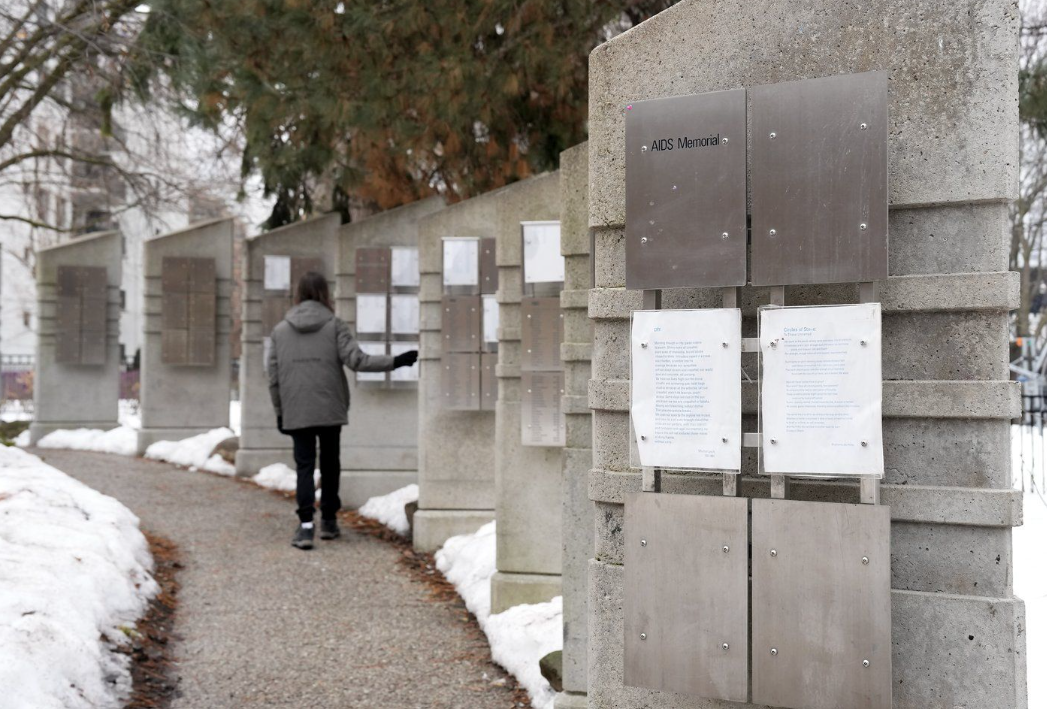
At a downtown Toronto park, 14 unassuming concrete pillars stand in a semicircle between an off-leash dog area, a splash pad and a walking path. Each pillar has a plaque engraved with hundreds of names. A couple of them have been vandalized.
This is one of the biggest AIDS memorials in Canada. But many people who walk through Barbara Hall Park wouldn’t know it due to its deteriorating condition after years of neglect, says David, a member of the city’s HIV-positive community.
“I would say today, the memorial in many ways doesn’t even feel like a memorial to some folks who might not have a connection to it. I’ve definitely interacted with people in the park who aren’t aware that it’s a memorial,” says David, who asked to only be identified by his first name so that his HIV status remains private.
That’s part of the reason why he’s leading a grassroots effort to restore the memorial alongside members of the community, as the city proposes redesign plans that David argues diminish the memorial’s prominence and lack meaningful feedback from people living with HIV.
“It should have more gravitas to it. It should feel like it’s a very important space,” he says.
The Echoes project, spearheaded by David and created pro bono by design firm Norm Li, seeks to expand and enhance the existing memorial by incorporating elements suggested by community members. It comes as the city begins to finalize plans for the park’s redesign, with construction projected for 2030.
The memorial was first established in 1988 and was made permanent in 1993, according to the 519, a Toronto-based LGBTQ+ organization that manages the memorial’s annual name engravings. Names of people from across Canada who lost their lives to AIDS can be added to the site on an ongoing basis, beyond a set time period.
“For the first I would say 20 years, it was fairly lush, beautiful. You’d come by, and they had rose bushes as a large feature of it,” David says. “The city has really stopped maintaining the memorial in any way. It’s frequently vandalized. Most of the vegetation around it, that provided more of a buffer, has been removed or trampled.”
In 2023, the city initiated plans to improve the park and held consultations and online surveys that included HIV-positive people and residents in the neighbourhood. Feedback from those sessions included suggestions to make the memorial more prominent in the park and to create elements that explain its history and importance, such as additional signage, according to the city.
But when the city released its three proposed designs last September, David says he and other members of the community felt disappointed. The plans reduce the memorial to an afterthought, he suggests, and inadequately incorporate the community’s suggestions.
Breklyn Bertozzi, executive director of the Canadian AIDS Society, describes the city’s proposed redesign as “very lacking.”
Bertozzi, who lives with HIV, says the city didn’t do enough to consult with members of the community on the memorial.
“It was a setback to our progress and an insult to the meaning of this space for us,” she says. “It takes away from what is already there, in my opinion, and it wasn’t enough to begin with.”
For instance, the city’s proposed redesigns do little to differentiate the memorial from the rest of the park, leaving it as an open space rather than a distinct sanctuary, says David. They also don’t incorporate elements to explain the history of the HIV community, he says.
“There didn’t seem to be any intentional approach to considering that the memorial is the back quarter of the park. The designs seem to minimize it into an art feature,” he says.
That pushed David to create his own design, which he says involved months of historical research into the local HIV-positive community and the park’s development, conversations with long-term HIV survivors and consultations with neighbourhood groups.
The Echoes redesign would include a buffer of forest grove to distinguish the memorial from the rest of the park, and include new pillars that would list the biographies of HIV community members and display panels explaining the history and impact of the epidemic, David suggests. The trans memorial, which is also located in the park, would have additional seating and be further designed following input from the transgender community, he says.
His proposed design of the AIDS memorial has been endorsed by dozens of HIV and AIDS organizations, including the Canadian AIDS Society, the Ontario AIDS Network and local AIDS committees across the province, he says.
“If the memorial doesn’t explain to the broader public why it’s here, it then faces a risk of further diminishment and removal in the long run,” says David. “I’m hoping that when people come here, they see a beautiful space that they want to engage with.”
He adds he’d like the city to use Echoes as the baseline for the redesign. He has provided the design to city officials, and says he’s been asked to do a presentation at an advisory committee later this month, before the final design is officially chosen. He plans to participate in further consultations with the city, but says he remains wary.
Meanwhile, Ed Jackson, who co-founded the AIDS Committee of Toronto in 1983, calls the city’s proposed redesigns a “half-effort.”
“It just didn’t capture what I feel is important, which is a community-based response to AIDS and HIV,” he says. “It just was basically a kind of revamping of things around the pillars, and that was it.”
Jackson says he supports the Echoes project because it reflects the ongoing impact of AIDS and HIV over time, and it would provide a “quiet, contemplative area” for people to reflect.
“It adds places for remembering the work of the community, the organizations in terms of both resistance and survival,” says Jackson.
“I think if (the city) really wants community input, this is one that has really worked hard to come up with community input. So I’m hoping that the parks department and the city will be responsive to this one and be able to incorporate a lot of the designs into the final look.”
The memorial is a particularly important place for Jade Elektra, an HIV activist and ambassador for the Canadian Foundation for AIDS Research. Elektra, who lives with HIV, became one of the first drag queens to perform at the memorial during the city’s annual AIDS vigil in 2019.
“I’ve looked at what the city is planning on doing and it just seemed very minimal,” says Elektra. “We have a way now to make sure that people know why this memorial stands, why these names have been put there.”
When asked about the Echoes project, city spokesperson Jas Baweja said officials are “exploring elements of the proposal that can be incorporated into the existing plan in the context of the park’s overall design, accessibility, maintenance, and safety requirements,” noting that no decisions have been made at this time.
“The current draft design aims to retain and enhance the AIDS memorial, preserve key elements such as the triangular stage and pillars, and enhance accessibility while integrating the memorial into broader park improvements,” Baweja said in an emailed statement.
Baweja added that ensuring the memorial “remains legible, recognizable and respected” is a top priority for the city. This summer, the city is planning additional consultation “to ensure diverse voices within HIV and AIDS communities continue to shape the design,” Baweja said.
“The project team has worked hard to balance the needs of the many diverse stakeholders with interests in the park, and has approached community conversations with care, recognizing the need to build trust, which is part of the reason why the process has unfolded slowly over the last three years.”
David says the project is called Echoes because it reflects the reverberating memory of those who have died from AIDS, including whole families, couples and friend groups in the community.
“There are some people in that memorial for whom there’s probably not a single person alive today that remembers them,” says David. “So their echo is getting more and more distant, it’s fading. The goal of this is to be a resonance chamber to amplify that echo again so they’re no longer forgotten in the long run.”
For Elektra, the memorial is symbolic of something bigger than just a physical site. She says she supports the Echoes project because it’s “a road map of where we were and how far we’ve come.”
“The memorial has a special place with me because I know, hopefully, my name will be added one day when I’m gone,” says Elektra. “I want people to remember that I was here.”

