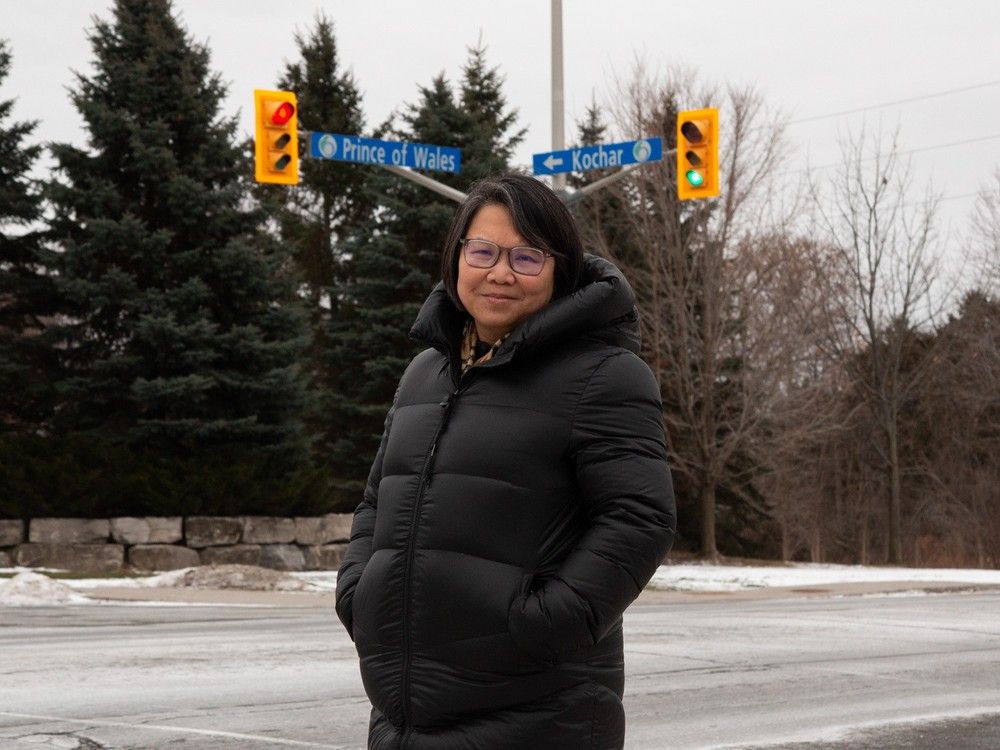
Viola Hoo can point out the exact data point on Open Ottawa’s map that shows where she got into a car accident in 2024.
Last December, Hoo’s red Toyota minivan was T-boned while trying to cross Prince of Wales Drive to return home. She said the car that struck her ran the red light, throwing her minivan into a spin and causing all the airbags to pop.
“The impact was so strong I got a brain bleed from it,” Hoo said. “I still have dizziness issues. I can’t move forward, look over my shoulder and talk to someone at the same time.”
Hoo said this led her to pay more attention to road safety in her Moffatt Farm community that borders the intersection where she got into her accident. This summer, the city added temporary flex stakes to calm the popular Kochar Drive.
The stakes have since been removed for winter, but it is an initiative Hoo wants back in the new year because of speeding concerns in the neighbourhood.
Flyers from River ward Coun. Riley Brockington’s office made its way to the doorsteps of Moffatt Farm residents, asking for feedback about the seasonal safety measure. While Brockington said it’s a usual end-of-year survey he puts out to newly changed communities, Hoo said it feels like a signal that the flex stakes won’t be reinstalled in 2026.
Hoo said some neighbours want the stakes removed, adding she’s heard complaints about curb appeal and lack of evidence supporting their initial implementation.
“We don’t get things like signage and flex stakes put into our neighbourhood without there being considerable evidence,” Hoo said. “I think that the safety measures outweigh the frustrations of people’s parking issues, let alone their curb appeal.”
Brockington said he went door-to-door when first thinking about erecting the stakes. He added that they’re among the cheapest and easiest road safety tools to implement, and one of his defaults when constituents want quick traffic-calming.
“Seasonal traffic-calming does not go through the same rigour and analytic review that permanent speed bumps or speed tables go through,” Brockington said.
Councillors get about $75,000 they can allocate to temporary traffic-calming measures in their ward.
Brockington said whether or not the stakes get put up again next year on a part of Kochar Drive is up to what residents tell him on the survey. “I’ll use that to inform my decision making in 2026,” he said. “These aren’t initiatives I just ram through a community against people’s wishes.”
The north side of the crescent Kochar Drive used to have flex stakes as well, but after some pushback from residents, Brockington said he removed them. He said he’s using the survey to again consult the south side of the road on what to do next year.
“I’m not going to fight my residents; I’m going to serve them.”
Ottawa is facing a changing landscape in road safety and traffic enforcement after the provincial speed camera ban took effect in November. Brockington said road safety and speeding are an “epidemic” in Ottawa.
There used to be a speed camera near Moffatt Farm that monitored activity outside Carleton Heights Public School. That camera is now defunct.
While cameras were the “most effective tool,” Brockington said, he’s going to continue working with the city to explore all options, like increased signage and on-the-ground police enforcement.
“It’s so expensive to keep an officer there and the city just doesn’t have the resources to have an officer at every problematic location,” Brockington said.
The city recently rolled out new Ottawa Police Service traffic units to address high-risk areas and community concerns.
Brockington recommends residents report incidents directly to the police so they can have robust data to support allocating the right number of resources to different areas.
Hoo said she would consider all options, like a red-light camera at the intersection, alongside re-erecting the flex stakes in her neighbourhood.
She just wants any initiative to be “safety first” and backed by evidence.
“This area has been flagged as a problem, and I’m not the only person that’s been really inconvenienced by speeding issues that are happening.”