

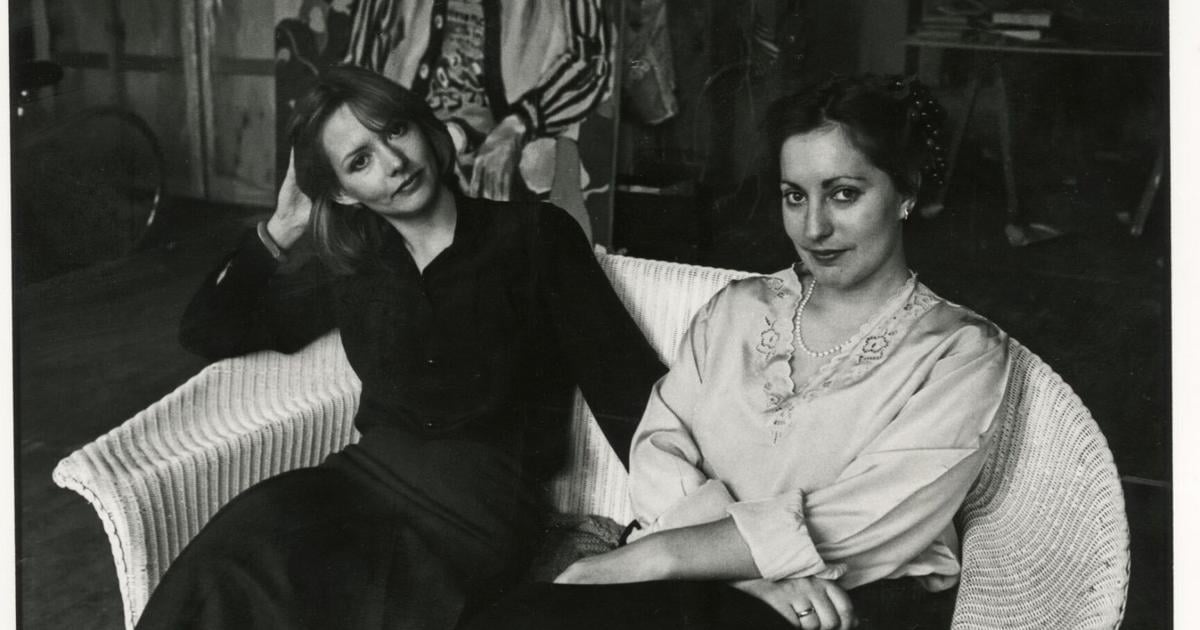
When an artist dies, their story is supposed to get clearer: the work can be arranged, the life interpreted, the contradictions smoothed over. But the Toronto painter Lynn Donoghue’s death in 2003 did not simplify anything — it only threatened to erase her.
Donoghue was a painter of uncommon intensity. Beginning in the late 1960s, she painted massive, wall-spanning portraits of friends and lovers with tenderness and unsparing honesty. What is most astonishing about her paintings is how revealing they are — not only of the sitter, but of the woman behind the easel.
Her life, however, was marked by poverty. Donoghue often bartered her work for goods and services, which meant that a significant portion of her paintings were never logged or documented.
After she died by suicide, the responsibility of preserving what remained fell to her sister, Barbara Donoghue, and her cousin, Virginia Yule. Together, they established the Lynn Donoghue Estate.
In the weeks following the artist’s death, Donoghue and Yule transported dozens of paintings to a barn on Yule’s property, where many remain stored today. But as they began to take stock, it became clear that hundreds of works had been scattered across the city, if not lost altogether.
Nearly two decades later, after a successful career as a banker in London, England, Barbara Donoghue enrolled at the Courtauld Institute of Art to pursue a master’s degree.
Around that time, she received a phone call from a curator in Toronto interested in organizing a retrospective of Lynn’s work. The curator, however, was coming up empty: she could locate few paintings and found little written material.
It was then, Barbara told me, that she decided to begin searching for the work her sister had dedicated her life to.
‘A duck out of water’
Lynn Donoghue was born in Red Lake, Ont., in 1953. Her family moved to Meaford when she was young, and later to London, Ont., where she attended high school.
“Lynn was a duck out of water,” Barbara recalled. “She was a creative person from the earliest time I remember.”
Recognizing her interests, her mother sent her to an arts camp. Another formative experience was visiting Montreal during Expo 67.
“I saw the Matisse Dance with Nasturtiums from the Hermitage at Expo,” she said in a 2001 interview. “It’s kind of cute to say my life was changed. But I think, in a way, it was. I went, ‘This is why you’re alive.’”
In Toronto in the early 1970s, Donoghue quickly became a fixture of the arts community. Indeed, everyone I spoke to emphasized how social she was.
The artist June Clark met Donoghue in the mid-70s, when they were both working at the David Mirvish Gallery.
“She became my best friend,” Clark said, “but if you print that, a million people will say she was their best friend.”
Donoghue’s interest in people and in community is reflected in her portraits. Take, for example, her 1979 painting of the Toronto artist Eric Gamble.
Gamble lounges in an armchair, legs loosely crossed, a cigarette held with ease. He wears a saturated red sweater emblazoned with the word UNIQUE. It’s a fitting thesis for Donoghue’s project as a portraitist: her ability to capture the infinite variety of human life.
Virginia Yule recalls seeing a portrait Donoghue made of her and asking, “Why did you make me look like that?”
“‘Well,’ she replied, ‘when you were talking while I was painting, that’s what I saw.’ She painted who you were, not who you wanted to be.”
Clark, whose portrait by Donoghue is now in the Art Gallery of Ontario’s collection, recalls that sitting for her was never formal. “She’d be working and talking the whole time. That was Lynn: talking and painting.” For Donoghue, talking came naturally and painting happened alongside it.
‘A voyage of rediscovery’
In 2023, after her conversation with the curator, Barbara began calling Canadian museums to see which ones held her sister’s work. The results surprised her.
Donoghue’s paintings were held in 25 public collections at institutions across Canada. Digging through archival records, Barbara also discovered that her sister had mounted more than 70 exhibitions in her lifetime.
Since Barbara lived on another continent during Lynn’s working life, she was not aware of her prolificacy.
“I remember thinking, ‘Hold on.’ She was much more important in her era than I ever realized.”
Barbara enlisted Jillian Bernstein, a classmate at the Courtauld — and, coincidentally, a Toronto native — to help locate the missing paintings. Within months, they launched an Instagram account and a website dedicated to finding Lynn’s work.
Their efforts have proven successful. Dozens of paintings have already been recovered. Social media, they say, “has been instrumental in uncovering key pieces of information about some of her most important series.”
A few weeks ago, for example, they received an Instagram message from the son of Donoghue’s optometrist, who acquired a painting in exchange for medical services.
For Yule, the process “has kept the connection with Lynn alive.”
Barbara tries to maintain a degree of objectivity, but admits that it’s been a “voyage of rediscovery”: of her sister, of her family, and of memories that have lain dormant for 40 years.
‘She was swimming upstream’
In the 1990s and early 2000s, Donoghue lived commission to commission.
“Sometimes she needed money and would call and say she’d like to paint me,” Yule said. “I always knew what that meant, but of course I’d go sit for her.”
By then, Donoghue’s figurative painting, along with her bold, expressive use of colour, had fallen out of fashion. Mounting exhibitions became more and more difficult.
“The view Jillian and I took is that it was exhausting,” Barbara said. “She was swimming upstream, not only against the art world, but against social mores more broadly.”
One of the final works Donoghue completed was “The Last Supper,” an installation consisting of 13 portraits of bar patrons arranged around a central panel on which she painted a long table with a white cloth on it.
The work feels like a summation of her interests, inviting viewers to consider the relationships between figures — and between those figures and the painter herself.
Yet there is nothing grandiose or abstract about it. What stands out instead is a specificity of place: the hazy, intimate atmosphere of a dive bar.
At a time when colourist, figurative styles are once again in vogue, Donoghue’s work feels both ahead of its time and resonant.
But when considering the vagaries of taste and the ever shifting idea of what counts as relevance, I think back to a piece of advice Donoghue once gave June Clark.
“Lynn always said to me, ‘Beware of being flavour of the month. Just keep painting. That’s all you can do.’”
Error! Sorry, there was an error processing your request.
There was a problem with the recaptcha. Please try again.
You may unsubscribe at any time. By signing up, you agree to our terms of use and privacy policy. This site is protected by reCAPTCHA and the Google privacy policy and terms of service apply.
Want more of the latest from us? Sign up for more at our newsletter page.

