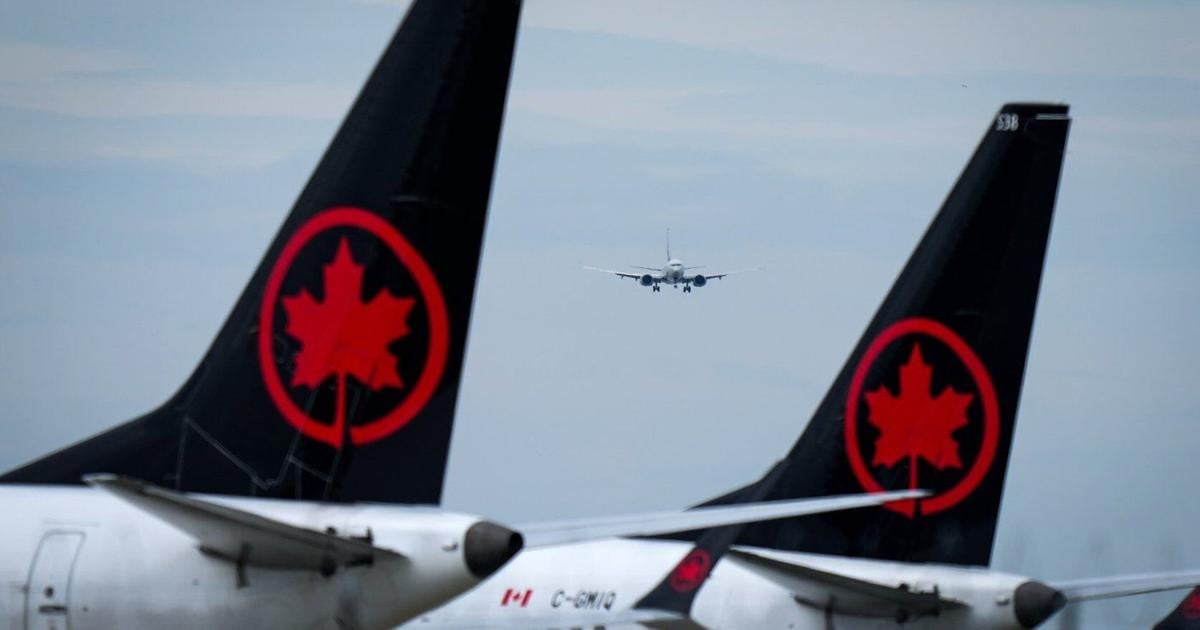
Air Canada says its efforts to diversify into new markets are paying off, as it said it’s seeing strong momentum in bookings for this year.
Chief commercial officer Mark Galardo said the airline’s rejigged flight capacity to focus on domestic and international routes, which have seen demand surge, is “fully mitigating the impact of reduced Canada-U.S. demand.”
The country’s largest airline ramped up flights at home and in Europe, the Caribbean and Latin America in response to travellers’ renewed interest in domestic and overseas trips.
This year, Galardo said demand for travel between the U.S. and Canada is expected to be status quo after a tumultuous drop in travel to south of the border.
“We don’t expect it to get any worse; we are not expecting it to get better,” he told analysts on a fourth-quarter earnings call on Friday.
The first half of this year is showing strong bookings for travel to international destinations, Galardo said. The airline is also adding seven destinations ahead of the summer and reintroducing non-stop flights to China from Toronto, while extending year-round flights to Bangkok.
Air Canada also saw growth in corporate travel to Europe as Canadian businesses look for new trade partners.
“We’ve seen almost a 30 per cent increase in the amount of corporate traffic going to Europe and the Pacific, and we attribute part of that to the fact that Canada is looking to diversify trade corridors,” said Galardo.
Meanwhile, the company is keeping its eyes peeled on goings-on in Cuba as the country faces a worsening energy crisis amid a U.S. blockade of oil.
Air Canada suspended its service to Cuba earlier this week and “moved capacity to other sun markets with a minimal financial impact expected from the shift,” Galardo said.
The airline dispatched empty flights southbound to pick up about 3,000 travellers to bring them home.
Air Canada reported $296 million in net income for its fourth quarter on Thursday night, compared with a loss of $644 million during the same period a year earlier. Its diluted earnings per share amounted to $1.00 during the period, compared with a loss per share of $1.81 last year.
The Montreal-based airline says its operating revenue came in at a record $5.8 billion during the period ended Dec. 31, up year-over-year from $5.4 billion.
Galardo said the airline is expecting to grow capacity between 3.5 per cent and 5.5 per cent this year from 2025.
As Air Canada plans to add at least 35 aircraft to its fleet this year, chief executive Michael Rousseau said 2026 will be a “transitional year.”
He said the decision to expand the fleet will help strengthen the airline for years to come.
Earlier this week, Air Canada announced it’s ordering eight Airbus A350-1000 wide-body aircraft as it plans to expand its non-stop flights from Canada to the Indian subcontinent, Southeast Asia and Australia.
Galardo said bringing on an additional eight aircraft would offer a lot of “flexibility” with range capability and open new markets to grow into.
The delivery of the aircraft is expected to begin in 2030, he said.
This report by The Canadian Press was first published Feb. 13, 2026.
Companies in this story: (TSX: AC)