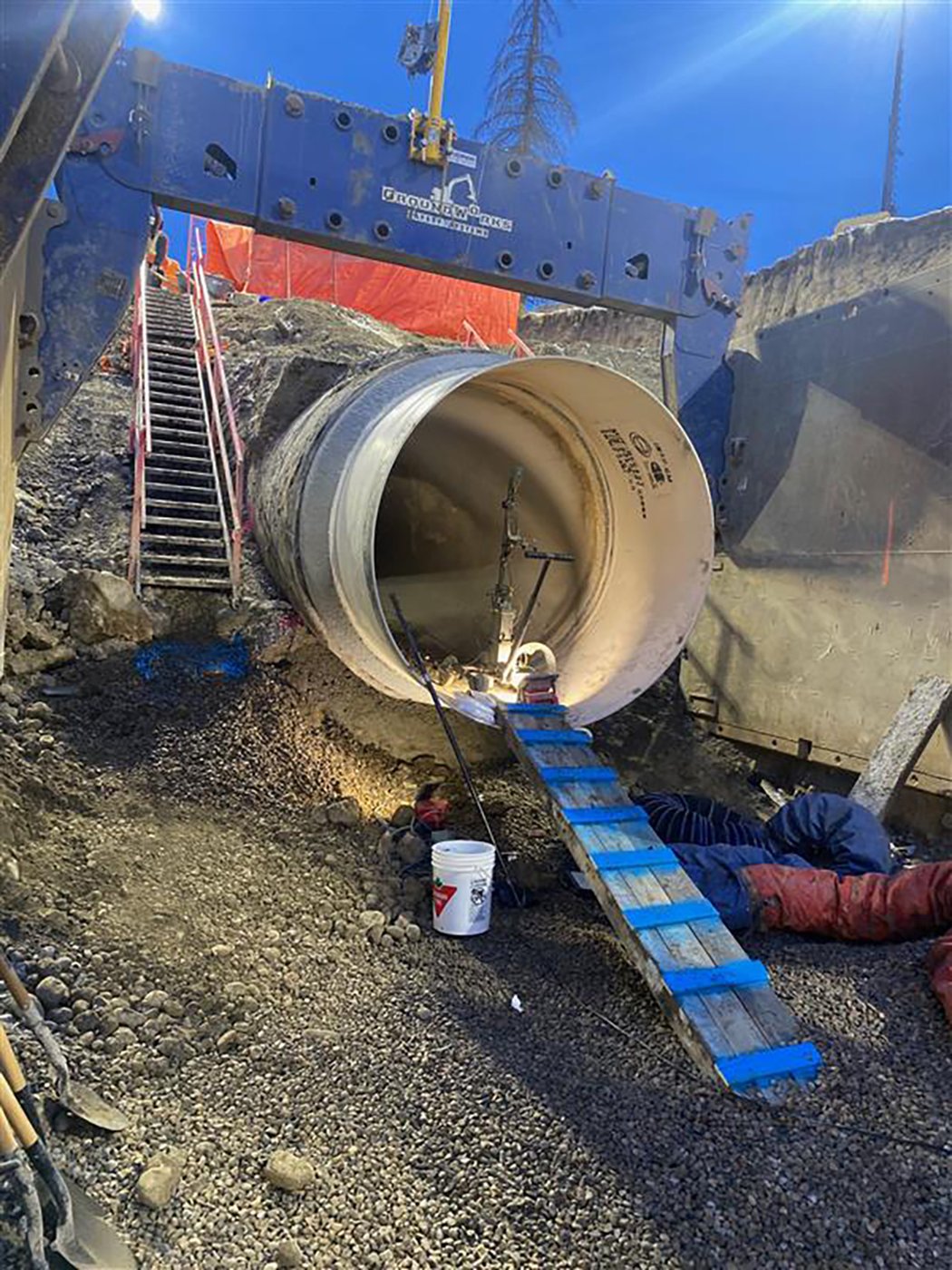
CALGARY — Calgary officials say water security is just three fewer toilet flushes away as repairs continue on a fragile feeder main that failed last week, plunging the city into a conservation crisis.
Emergency Management Agency chief Sue Henry held up a plastic refillable jug during a news conference on Thursday, similar to the type used with water coolers, to illustrate just how much each resident of the city needs to save.
“This bottle holds 20 litres of water. Thirty litres of water is one and a half of these bottles. When you look at it in this perspective, this is not a lot of water,” Henry said.
“Just flushing the toilet three less times in a day will save the 30 litres right there. Every minute you save in the shower uses eight litres of water and running your dishwashers and washing machines only when full will continue to save water.”
She said those targets will ensure enough water for emergencies like firefighting while the pipe is fixed.
Calgarians have been using more water than can be replenished in its reservoirs for almost every day since the Bearspaw South Feeder Main, which carries 60 per cent of the city’s treated water, ruptured on Dec. 30.
The line is expected to be up and running as early as next week. The city is also speeding ahead with plans to replace the pipe, which dates to the 1970s.
“While we are still dealing with a very sick pipe, the end of this immediate repair is in sight,” Mayor Jeromy Farkas told the news conference.
“We are turning a corner. But I want to be very clear, we are not in the clear yet.”
On Wednesday, an emergency alert was issued for Calgary, saying water usage across the city had hit an unsustainable level and residents and businesses were called on to immediately conserve water.
It was the third straight day that city officials said water usage was far above desired amounts.
The same water main also suffered a catastrophic failure in 2024, leading to months of water restrictions. A report into that failure, compiled by an independent panel and released Wednesday, blamed two decades of underinvestment and insufficient knowledge of the risk of pipe failures.
In case the feeder main fails again before it is replaced, Henry said, measures are underway to make sure the deluge reaches the Bow River instead of flooding neighbourhoods.
The measures include removing segments of a flood barrier on the Bow, which normally keeps floodwater from entering the community.
That decision was made with support from the more than 60 members a part of the emergency management agency working tirelessly from the brain hive in the downstairs of Calgary’s Emergency Operations Centre, says Henry.
The fracturing of the Bearspaw water line has been “incredibly stressful” for those workers, she said. In some cases, staff don’t head home for the night, as was the case the first night the line broke, using agency-supplied toothbrushes if needed.
“The entire city of Calgary is relying on you to get this job done and to get whatever problem is in front of you fixed. There’s a weight to that when you know the citizens depend on you,” said Henry in an interview.
As reporters filed out of the operations centre after Thursday’s news briefing, volunteers with a dog therapy program under the Pet Access League Society entered. In this case, volunteers bring in their pets to play with and cheer up workers, even for a short time.
In the past nine days, the emergency team has been visited by some group of canines most days. With their busy schedule, workers often get a minute or less with them, said Henry, but it seems to level heads.
“I’ve worked a number of incidents across Canada and every time a dog comes into the room you can see everyone’s shoulders drop a little bit,” said Henry.
Henry said the team is among several in the city on top of the breakage since water first raced down the roadway on 16th Avenue NW near Sarcee Trail, northwest of downtown and near the site of Canada Olympic Park, when the water main failed on Dec. 30.
The water was swirling and occasionally gushing in small plumes and geysers as crews used inflatable rafts in some cases to rescue some trapped drivers.
No one was injured.
“Removing these sections of the berm will allow the water to flow into the river and help protect the surrounding area,” Henry said.
“We will be working on backup plans to quickly replace these sections as needed during flood season.”
The report that was released Wednesday noted that Calgary isn’t alone in struggling to keep up with necessary maintenance for water infrastructure, citing Statistics Canada figures showing more than a quarter of water mains across the country are due for repair.
This report by The Canadian Press was first published Jan. 8, 2026.
Dayne Patterson, The Canadian Press