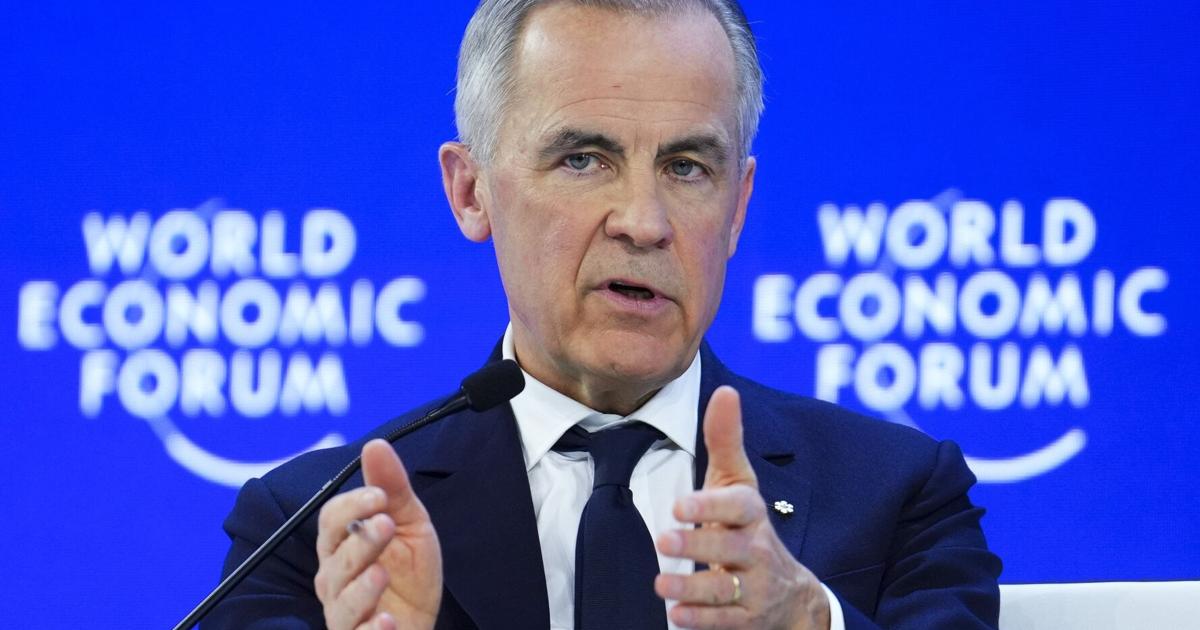
Finding new trading partners is vital for Canada’s economy, but we can’t replace the U.S., say Canadian business leaders who gave a qualified thumbs-up to Prime Minister Mark Carney’s speech in Switzerland this week.
Carney’s speech, which drew a standing ovation from the world’s financial and political elite, was simply acknowledging the reality that the U.S. under President Donald Trump is no longer the dependable trading partner it once was, said Matthew Holmes, head of public policy at the Canadian Chamber of Commerce.
Finding new partners, said Holmes, is more urgent than ever.
“If the U.S. isn’t calling, are we going to sit by the phone, or try to stay busy in the meantime?” said Holmes. “If businesses had their druthers, they’d just want it to go back to the way it was … The Prime Minister is just telling people that it might not come back.”
Still, said Holmes, keeping a vibrant trade relationship with the U.S. is also crucial for Canadian businesses, Holmes said.
“Of course we need our trade with the U.S.,” said Holmes. “This is our number one customer and this is our number one trade deal,” Holmes said, referring to the Canada-U.S.-Mexico agreement on trade.
On Thursday, U.S. Commerce Secretary Howard Lutnick slammed Carney’s speech as “political noise” and criticized Canada’s recent deal on electric vehicles, canola and seafood with China.
“Give me a break,” Lutnick said on Bloomberg TV. “They have the second best deal in the world and all I got to do is listen to this guy whine and complain.”
The challenge of finding new export markets is particularly fraught for Canadian manufacturers, said Dennis Darby, CEO of Canadian Manufacturers and Exporters.
“The reality is that almost 80 per cent of our manufactured goods are going to the U.S.,” said Darby. “Diversification has always been difficult, and will continue to be difficult.”
Part of the issue, he added, is that some goods simply make more economic sense to ship next door.
“A commodity like canola or oil, you can easily put in a large container ship and send across an ocean. For manufactured goods, it’s more difficult,” said Darby. Those manufactured goods, he says, are a vital part of Canada’s economy.
“We are hewers of wood and drawers of water, and that’s great … but we have to also make sure we’re competitive on those value added goods.”
Darby said finding new partners is easier said than done, thanks largely to the decades-long trend of increasing integration between the U.S. and Canadian (and more recently, Mexican) economies.
“Our manufacturing supply chains work on a relatively short distance,” he said. “We’ve built a system that’s designed for North America.”
The head of the association representing Canada’s automotive parts suppliers agreed.
“It’s not necessarily a positive message for manufacturers, but you have to get your head out of the sand,” said Flavio Volpe, CEO of the Automotive Parts Manufacturers Association. “The Prime Minister didn’t cause a moment of rupture as much as he encouraged everybody to see it for what it is.”
The bedrock assumptions of the automotive industry — and the Canadian economy — for most of the last century are simply no longer a reality, said Volpe. What was once a beacon of free trade and an open economic model, no longer is, he added.
“The U.S. has been behaving like a planned economy, certainly for the last year, but also in Trump’s first term. And frankly, even somewhat during Biden’s administration,” Volpe said. “We need to wake up sooner rather than later.”
While much of the focus in the wake of Carney’s speech has been on larger companies and industries, smaller businesses also have plenty of skin in the game, said the head of the industry’s main association.
“He’s sending the right messages to the large business sector, and to the world community, but we’re facing an entrepreneurial drought in Canada, and that has long-term consequences,” said Dan Kelly, CEO of the Canadian Federation of Independent Business. “We were hoping for something eye-opening on the tax and regulatory agenda domestically.”
Replacing the U.S. entirely just isn’t realistic, he argued.
“The market is too big and too wealthy, and it’s right on our doorstep,” Kelly said.
But all in all, the PM’s message was a necessary one, Kelly said.
“It’s an important message to accept the world as it is, as opposed to having high aspirations and living almost divorced from reality.”
With files from Star wire services