Holding a pen, a yellow sticky note and books with her hands, Adona Agcaoili watches her laptop screen intently, while attending a review session for an exam designed to test a nursing applicant’s competency in nursing.
The Toronto resident arrived in Canada in 2014 to work as a nanny and has been a personal support worker in Ontario since 2017.
However, as a nursing graduate in the Philippines, she has always aspired to work as a nurse in Canada.
“It’s very important for me, especially, I know I have the calling,” says Agcaoili. “I believe this is the one I need to pursue.”
She continues to work on requirements for her application to become a registered nurse in the province.
But in January, the College of Nurses of Ontario (CNO) changed the “Evidence of Practice” (EOP) requirement, which now requires applicants to demonstrate experience practicing as a nurse or in nursing education within the last three years.
With CNO’s updates, nursing work outside Ontario must be undertaken through employed or paid roles rather than volunteer practice, with some exceptions – a discouraging change, according to the Integrated Filipino Canadian Nurses Association (IFCNA).
“It’s very unrealistic for us to meet this. I don’t know if this is like, hopefully not, another barrier for us to become a nurse here in Canada,” says Mark Anthony Gravoso, the co-chair of IFCNA’s clinical enhancement program.
“What if, as an IEN, my outstanding requirement is to meet EOP. Do I still need to continue this program? Enroll myself in college or school, then stop working? What about my family?”
‘This changes all of my decisions’
Many internationally educated nurses tell OMNI News they are unsure what to do next, as they originally planned to visit the Philippines to volunteer at a hospital, clinic, or rural health unit.
They say they choose to volunteer in their home country for a month so their responsibilities to their family and jobs in Canada are not at risk.
“I feel hopeless,” says Agcaoili. “I’m waiting [for] this one for a long time, that time I had the courage to really pursue it, and then they suddenly change in a short period of time.”
For some IENs, such as Heidilyn Oroñgan, who works full-time as an unregulated care provider and part-time personal support worker, the changes have disrupted their original plans and led them to seek other avenues to meet their EOP requirement.
“If the CNO wants me to study for a year, I’m not allowed. I’m only allowed to study for less than six months as a work permit holder,” she says. “Our support for our family will also be affected. Technically, it will be hard for us to look for a job in the Philippines that will hire us to work for a month.”
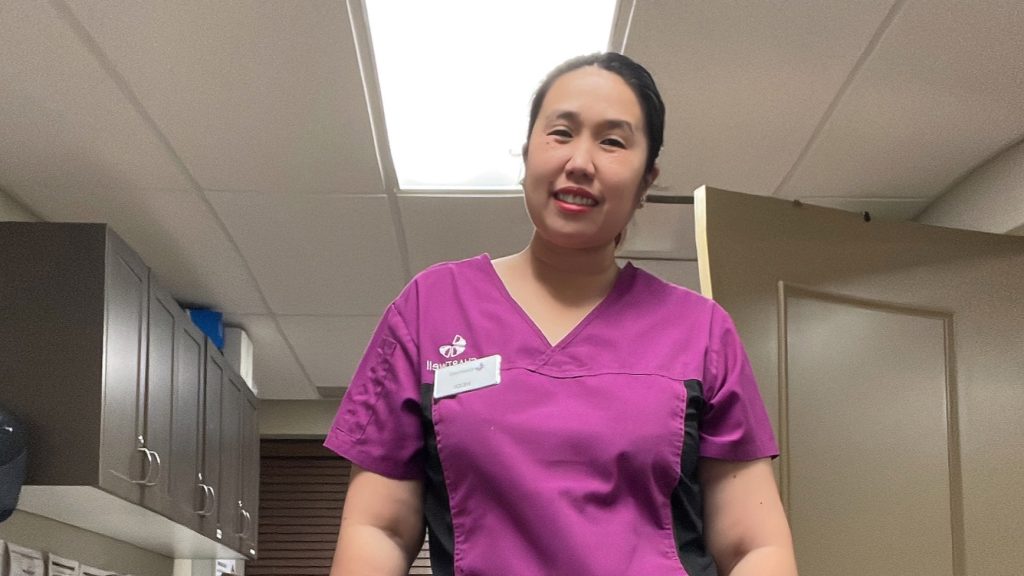
But for some foreign-trained nurses, such as Joenna Mae Pahilanga, the changes made them hesitant to obtain a license in the province.
“This changes all of my decisions,” she says. “It is not easy to go to the Philippines to work and gain one year of experience because I have kids.
Not everything can rely on my husband’s salary. [We] always need two [people] so my family can live here in Canada.”
Pahilanga arrived in Canada in 2024 to work as a home child care provider. She has worked as a nurse in various countries for more than 15 years before coming to Canada.
“I’m at the point where I’m thinking, will I still [pursue] it? Because I’m getting older, and the time it’ll take to study or spend going to the Philippines, it seems difficult,” she says.
Inadequate EOP may pose a risk to public safety: CNO
In a statement to OMNI News, the CNO says many applicants have already applied to CNO with paid EOP, and nurses entering the profession without adequate EOP may “pose a risk to public safety.”
The regulatory body adds that the changes are because the “volunteer settings vary with documentation and standardized oversight, making it difficult to assess whether nursing knowledge, skill and judgment have been recently applied to practice.
“The EOP change allows CNO to quickly verify an applicant’s work history, since paid employment is generally structured. This helps the nursing registration process in Ontario move faster, leading to more nurses practicing in Ontario’s health system.”
The CNO adds they continue to improve their registration processes, and are committed to helping IENs experience a “smooth transition to practice in several different ways.”
The advocacy group IFCNA is calling for fairness and for CNO to recognize “the sacrifices of every IEN in Ontario.”
“I hope they could expand the eligibility criteria for the Supervised Practice Experience program, because safe practice will help evaluate the competency, and yet at the same time, this is a paid practice experience,” says Gravoso.
He also calls on the CNO to offer the Objective Structured Clinical Examination (OSCE) to qualified IENs to assess their competency.
The dream continues
According to IFCNA, CNO reached out to the foreign-educated nurses to inform them about the change.
Despite the new challenges, the nurses say they’ll continue to pursue their dream, hoping to one day support the healthcare system in Ontario.
“It’s one of my greatest goals to practice my profession here in Canada, and it’s one of my unfulfilled promises to my mother, who passed away,” Pahilanga says. “The fire is still there, but there are still lots of things to consider.”
Oroñgan, on the other hand, says, “Those changes are just obstacles I need to pass.”
While Agcaoili says, “During the pandemic, you know, there’s a lot, especially those vulnerable people who really need help. That time, you could see the shortage of staff.”
“That time, it gave me the courage to pursue my nursing.”