

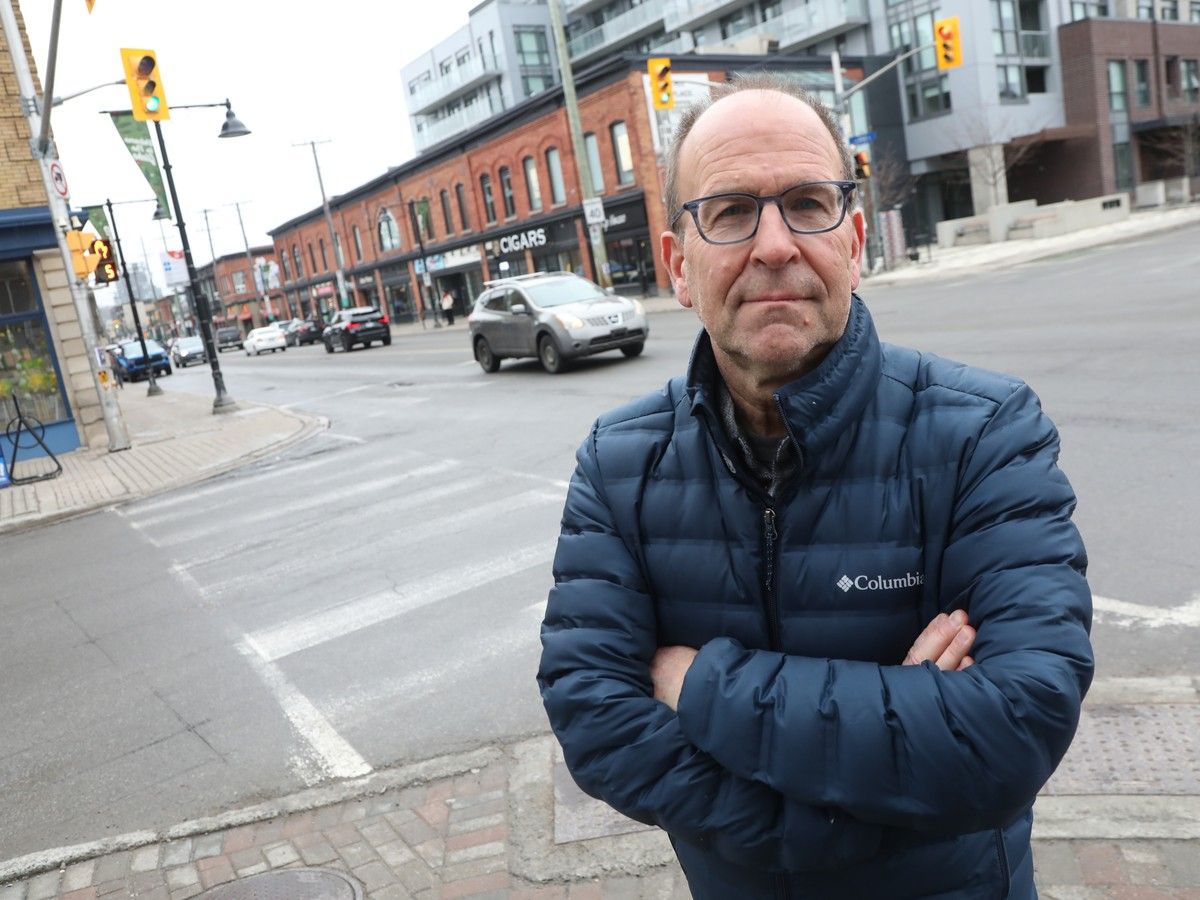
A pilot project that will see bus-only lanes along a busy stretch of Bank Street was approved by committee members Monday after dozens of transit advocates, university students, Glebe residents and business owners lined up to voice their opinions on the contentious project.
The bus-only lanes are set to be implemented in the Glebe during peak periods along Bank Street south of Highway 417 to the Bank Street Bridge. The year-long pilot would launch in the summer of 2027, pending council’s approval, with city staff reporting back on the results and recommendations.
The bus-only lanes would extend existing peak-period parking restrictions by one hour during the morning and afternoon rush hours, establishing bus-only northbound lanes from 7 a.m. to 10 a.m. and southbound lanes from 3 p.m. to 6 p.m.
The public works and infrastructure committee also approved staff recommendations to create four permanent segments of 24-hour bus-only lanes on Bank Street between Regent Street and Fourth Avenue and south of Aylmer Avenue in the northbound lane, and between Fourth and Thornton Avenues and between Holmwood Avenue and Wilton Crescent in the southbound lane.
The pilot would remove 17 on-street parking spaces, and another 146 spaces would be affected by the extended no-parking hours.
Darrell Cox, executive director of the Glebe Business Improvement Area, said the pilot would have a profound and immediate impact on local small businesses, with the lost parking spaces representing hundreds or even thousands of daily visits.
“Bank Street in the Glebe is not simply a transportation corridor. It is a destination for people from all across the region and beyond. People come to spend the day in the Glebe and walk the sidewalks and visit the specialty stores,” Cox said.
“Small business is a fragile ecosystem, and anytime you start making it more difficult for a business it really starts to hurt their bottom line. So anytime somebody says it’s frustrating to come into the Glebe, they’re just going to go elsewhere. They’re going to go to a shopping mall or they’re just going to shop online.”
The pilot would start in summer 2027 and was initially set to run for 15 months.
Capital Coun. Shawn Menard called on City of Ottawa staff to shorten that time frame to 12 months, which would adequately capture data from all four seasons.
“Our concern, though, is that the impact on the business community is immediate,” Cox said.
Another motion from Coun. Sean Devine on Monday called on staff to implement a “transparent and clearly defined approach to monitoring potential local business impacts” and to report back to the committee during the study period rather than submitting the findings at the end of the pilot.
Both of the motions by Menard and Devine were passed by the committee.
The committee session on March 30 heard from a steady stream of public delegates, with a large portion from transit advocates who applauded the pilot plan.
“We have a significant bus cancellation problem with 300 to 600 trips undelivered every day and what we have on the table here is a bus lane project which is going to directly address this bus shortage,” said Ajay Ramachandran of Better Transit Ottawa.
“Bus lanes get a bus moving quickly in a reliable amount of time so they can move on to their next scheduled trip. If there’s a delay on a trip on Bank Street, it causes cascading delays and cancellations all throughout the network,” he said.

On a typical weekday, more than 6,900 transit passengers are estimated to travel through the corridor on bus routes 6 and 7 — two of the highest ridership routes in the city.
Both routes also ranked among OC Transpo’s top three for undelivered trips in recent months, with each route posting a delivery rate just below 93 per cent in February, according to data presented to the transit committee.
Cox says business owners are already operating in a delicate economy and specialty shops rely on convenient access, which includes curbside parking.
“We heard a lot from the transit advocates that bus lanes are fine and that the stores in the Glebe don’t need parking, that there’s parking in the Second Avenue parking garage and at Lansdowne Park,” Cox said. “However, we have people coming from all across the city, all across the region and beyond where people are driving, and they don’t want to be walking from the Lansdowne parking garage or the (Second Avenue) parking garage.”
Along with the impact on businesses, Cox says a number of residents have expressed concern about the potential safety impacts.
“If you remove parking and there is only buses on the outside lane, that becomes a safety and accessibility issue. Our sidewalks are extremely narrow, and, if there was no safety buffer from the cars, that becomes a significant concern, particularly for elderly people, people with walkers or wheelchairs and parents with strollers,” Cox said.
“We all want a main street that serves all stakeholders, residents and businesses, people who live nearby, people coming from further afield and people just passing through,” said June Creelman, vice-president of the Glebe Community Association.
“We need to respect the needs of walkers, cyclists, transit users and drivers, including those who need to park or do deliveries,” Creelman said. “The complexities cannot be reduced to parking versus (bus) lanes. In terms of the transit priority measures, we think a pilot project to assess the impacts is critical, and we would hope to be involved in the assessment.”
Menard applauded city staff and fellow councillors for finding “middle ground” to test the pilot, which first arose from a council motion in 2021.
“It has taken a lot to get to the point we’re at. This is a fairly significant change that is being proposed for Bank Street, but we are confident that these changes will improve the street,” Menard said.
“Bank Street is a relatively narrow street for all the demands placed on it. It’s a commercial district, a residential street, a destination and an important transportation route. There was no single solution that would satisfy everyone, but this is a balanced plan. Importantly, because it is a pilot, the plan will be informed by data, and we will be able to make informed changes and improvements in the future.”
With files from Natasha Baldin

