

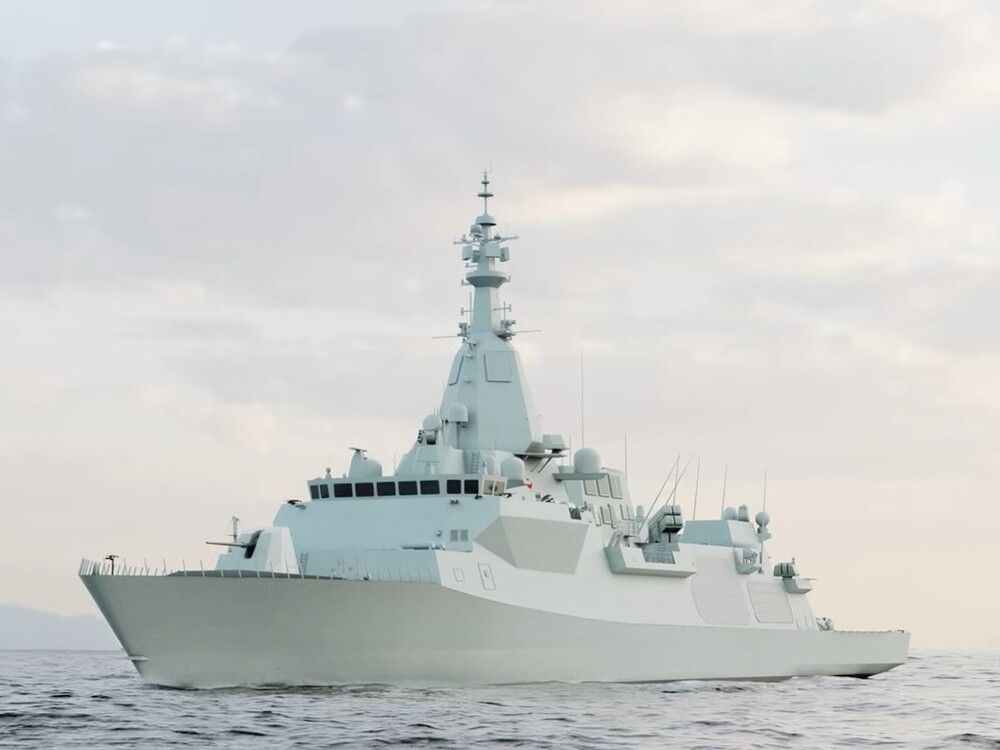
The cost of an initial order of U.S.-supplied equipment for Canada’s new fleet of warships has almost tripled as more American systems are being purchased, according to new information released by the U.S. government.
The order for U.S. systems has increased from $1.25 billion ($900 million U.S.) to $3.6 billion ($2.6 billion U.S.), according to a public notice published by the United States. The equipment is for the Royal Canadian Navy’s River-class ships, which will eventually cost taxpayers more than $80 billion.
The increase in cost is mainly for what is called non-major defence equipment and includes a U.S. navigation system and U.S. command systems. A new torpedo is also being acquired as well as control systems for U.S.-built cruise missiles to be installed on the Canadian ships. The equipment was not part of the initial original order and has been added by Canada. The
order of equipment
is for the first three ships to be built.
The Department of National Defence did not provide comment about the decision to purchase more U.S. equipment for the new ships.
Although, the River-class project is among the most expensive Canadian defence programs since the Second World War, DND, the military and the Canadian government provide few updates. New developments, such as the addition of more American equipment to be installed on board the ships, has come mainly from the U.S. government, which is required by law to publicly inform its politicians about such deals.
During a June 9 speech,
Prime Minister Mark Carney repeated an earlier promise
that Canada would be cutting back on using its defence dollars to purchase U.S. military equipment. The U.S. has become increasingly hostile to Canada, with President Donald Trump continuing with economic efforts to punish Canada and to push for this country to become the 51st state.
But there has been growing frustration among some Canadian defence firms that the Canadian military has ignored Carney’s call to decrease its reliance on U.S. suppliers and instead diversify contracts to focus on Canadian or European companies. Canadian military leaders are
extremely close to their U.S. counterparts
and despite the prime minister’s direction have advocated for increased ties to the Americans.
The Ottawa Citizen reported in December 2020 that Canadian defence industry officials had complained about the lack of Canadian systems on board the River-class, previously known as the Canadian Surface Combatant or CSC. At that time they also warned Jody Thomas, then deputy minister at DND, and Bill Matthews, then deputy minister at the procurement department, about the potential dangers of U.S.-controlled technology. But those concerns were dismissed by DND officials.
The heart of each of the River-class ships is the command management system that controls weapons, radars and other intelligence-gathering equipment. Originally that high-tech system was supposed to be Canadian-made and under full control of the Canadian government.
But that was switched out for made-in-the-U.S. technology called Aegis, allowing the Americans full control. Much of the equipment that will follow for the River-class in the future will be U.S.-supplied because it is needed to connect with Aegis.
But some former navy leaders, such as retired Vice-Admiral Mark Norman, have warned that
such U.S. controlled systems pose a serious risk
, particularly at a time when the U.S. is openly hostile to Canada.
Norman took to social media Feb. 14, 2025, to denounce the move as a “real and serious risk.”
“Even if everything was rosy and there was no risk, we’ve given up any down-stream autonomy in pursuit of a less-capable system,” Norman wrote on X about the U.S.-built system. “Someone needs to answer for this.”
Norman questioned whether Canada should move as soon as possible to using a new command system for the River-class fleet that was not under American control.
But DND and Royal Canadian Navy officials confirmed they had no intention of making any changes.
The River-class project will involve the construction of 15 warships for the Royal Canadian Navy. But the project to replace the current Halifax-class frigates has run into delays and massive cost overruns. It was originally estimated to cost $26 billion, but the Parliamentary Budget Officer now puts that figure at around $80 billion.
When the ship team was unveiled in November 2017, Lockheed Martin Canada, a subsidiary of the U.S. defence giant, highlighted that its proposal included the Canadian-built command and control system known as CMS-330. The firm pointed out that the maximum focus was to get Canadian content on the new warships.
But DND spokesperson Kened Sadiku explained that, shortly after the design selection and contract were awarded for the ship project in 2019, it was only then that discussions began in earnest. It was soon realized that the Canadian-made equipment that had been contracted for was a “suboptimal solution and introduced significant developmental, cost and schedule risk,” according to a DND statement to the Ottawa Citizen.
Further discussions were held with industry and government officials and it was decided to instead use the Aegis system from the U.S., according to DND.
But DND has previously been concerned about U.S. control over key defence technology. In 2010, when the Halifax-class frigates were being modernized, the department insisted on installing the newly developed CMS-330. The development of CMS-330, costing millions of dollars, was financed by Canada, giving it total control over the technology.
The CMS-330 technology was so successful that it was also installed on board Canada’s Arctic and Offshore Patrol Ships, Halifax-class frigates and the new joint supply ships being built. CMS-330 technology is also on Chilean and New Zealand navy ships.
In late November,
Germany announced
it was spending around $1 billion to purchase the Canadian-made CMS-330 for its new surface fleet.
It is unclear why Canada and other nations are still keen to use CMS-330 technology despite DND’s claim that the equipment is “sub-optimal.”
David Pugliese is an award-winning journalist covering Canadian Forces and military issues in Canada. To support his work, including exclusive content for subscribers only, sign up here:
ottawacitizen.com/subscribe
Related
- Federal government issues nearly 70,000 early-retirement notices to public servants
- Ottawa will have a new tallest tower after committee approval

