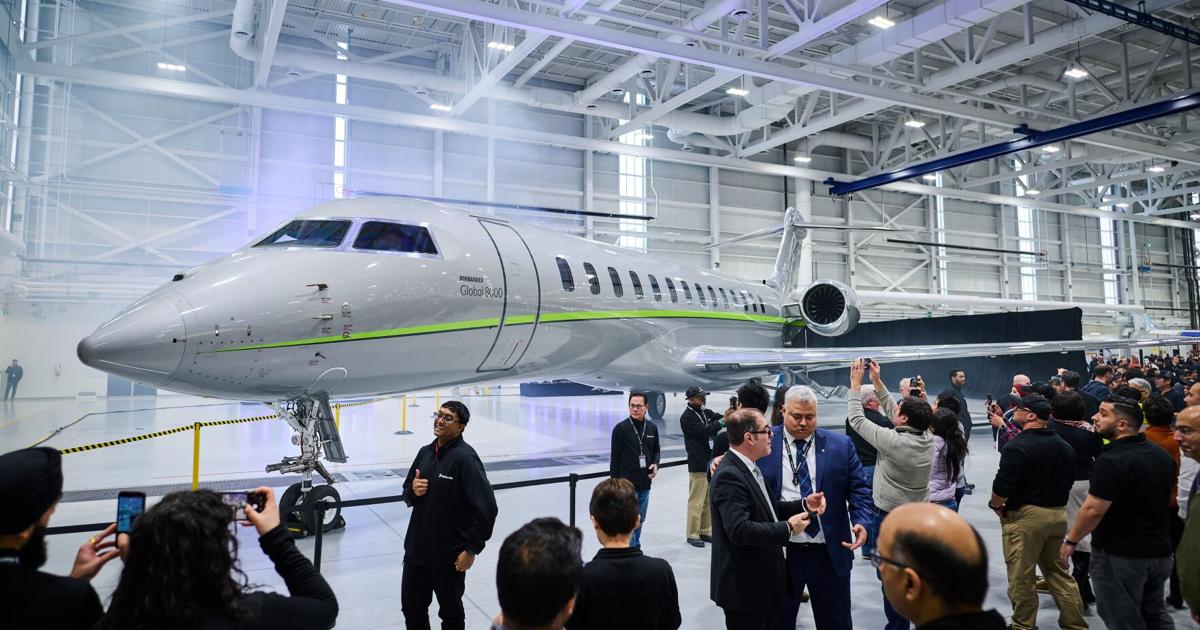
U.S. president Donald Trump’s threat to ”decertify” Bombardier jets and slap a hefty import tariff on Canadian-built planes is nothing more than sour grapes from an American competitor, says a leading industry expert.
The U.S. president made the threats in a Thursday evening post on his Truth social media platform.
“Based on the fact that Canada has wrongfully, illegally and steadfastly refused to certify the Gulfstream 500, 600, 700 and 800 Jets, one of the greatest, most technologically advanced airplanes ever made, we are hereby decertifying their Bombardier Global Expresses, and all Aircraft made in Canada, until such time as Gulfstream, a Great American Company, is fully certified,” Trump wrote.
John Gradek, head of the aviation management program at McGill University, said the real motivation for Trump’s threats is because Gulfstream’s product simply isn’t a match for the latest Bombardier Global Express.
“The Global Express is better in speed, fuel efficiency and roominess. And it’s also cheaper,” said Gradek. “Bombardier is beating the crap out of Gulfstream in the marketplace, and clearly, Gulfstream has the president’s ear.”
The Bombardier Global Express 8000 has a suggested list price of between $70 and $72 million (U.S.), while the Gulfstream 800 is roughly $75 million, Gradek said, adding that he was “flabbergasted” when he saw Trump’s post.
“I just couldn’t believe it,” said Gradek, adding that the main customers for Bombardier’s Global Express are south of the border.
“Their core customer is American billionaires,” Gradek said.
While it’s a niche market, it’s an important one for Quebec-based Bombardier and its CEO Eric Martel, Gradek added.
“Eric Martel has bet the company on these jets. They’ve got a good order book,” Gradek said.
The union representing aerospace workers on both sides of the border slammed Trump’s threat.
“The aerospace industries in Canada and the United States are deeply interconnected,” said David Chartrand, Canadian Vice President for the International Association of Machinists and Aerospace Workers.
“Any attack on Canadian aircraft harms both Canadian and American workers alike. Aircraft certification must remain independent and grounded in safety, not politics. Politically motivated decertification would create instability, threaten thousands of jobs on both sides of the border, and undermine the integrity of the aviation system we all depend on.”
Gulfstream didn’t reply to a request for comment.
In a post on X Friday afternoon, federal transportation minister Steven MacKinnon said he’d been in touch with Bombardier, as well as Gulfstream’s parent company General Dynamics.
“We will remain in close contact. Transport Canada officials are in communication with their U.S. counterparts, and our government is actively working on this situation,” MacKinnon wrote. “Canada’s aviation industry is safe and reliable. We will stand behind it.”
Transport Canada — which is responsible for certifying aircraft in this country — pointed to MacKinnon’s statement when asked to comment.
In a written statement, Bombardier said it was in touch with the Canadian government, and also pointed out that it has manufacturing operations in the U.S. as well as Canada.
“Bombardier is an international company that employs more than 3,000 people in the U.S. across nine major facilities, and creates thousands of U.S. jobs through 2,800 suppliers,” Bombardier said. “Our aircraft, facilities and technicians are fully certified to FAA standards and renowned around the world. We are actively investing in expanding our U.S. operations, including a recent announcement in Fort Wayne, Indiana.”
While Trump’s initial statement appeared to suggest he was considering decertifying planes already in operation, White House officials said Friday that the threat only applied to new planes not yet delivered.
The prospect of decertifying new planes even as identical aircraft already in service retain their airworthiness is a head-scratcher, said one U.S. aviation consultant.
“This is really strange, because certification of aircraft is a very, very long process. It takes years,” said Ross Aimer, CEO of California-based Aero Consulting Experts.
Canada has not certified the Gulfstream G700 or G800 business jets, with de-icing noted as a possible issue.
Canadian regulators typically follow their counterparts in the U.S. and Europe, where the Gulfstream planes have received the green light.
But the U.S. certificate is conditional. Gulfstream has until the end of this year to prove that the two plane models function “properly under the probable operating conditions where ice may form in the fuel system,” according to a temporary exemption granted by the FAA in January 2024.
Aircraft assembled in Canada include Bombardier luxury jets and regional planes, A220 single-aisle jets made by French aerospace giant Airbus, and helicopters from Texas-based Bell Textron. De Havilland Aircraft of Canada also produces the Dash 8-400 turboprop as well as a number of other aircraft.
Historically, aircraft groundings by regulators have related strictly to safety reasons. The Boeing 737 Max 8 was banned from the skies for 20 months during the first Trump administration due to safety issues.
“Threatening action by a safety regulator for political purposes would set a dangerous precedent in the aerospace industry — the FAA may not even have legal authority to ground a plane at the whim of the president,” said National Bank analyst Cameron Doerksen.
Desjardins Securities analyst Benoit Poirier pointed out that a large proportion of parts used in Bombardier’s jets come from American suppliers. He also noted that the U.S. military has already placed an order for several Bombardier jets, and that the aviation industry has been spared from the heaviest tariff hits in other U.S. trade agreements.
“We view this threat as empty and unlikely to be enforceable in practice,” Poirier said.
With files from The Canadian Press