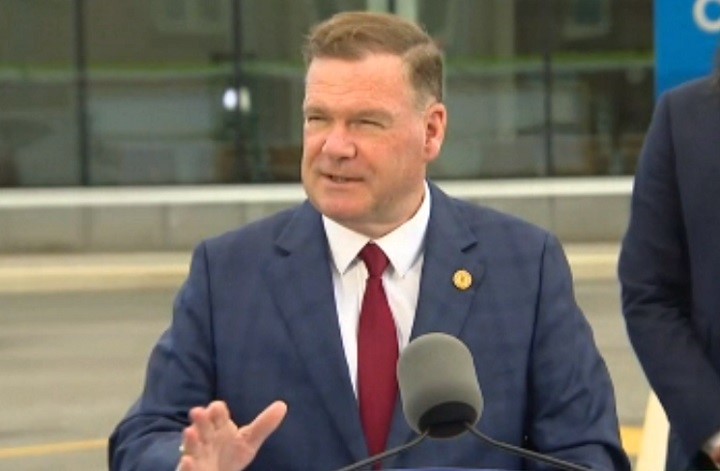
In a dramatic move to bring jets and more flights into Billy Bishop Toronto City Airport, Premier Doug Ford says the province will expropriate the land and pay compensation to the city despite Mayor Olivia Chow’s opposition to the expansion.
Ford said he informed Chow of the airport plan in recent days during a “constructive conversation” at his Etobicoke home.
“This is a crown jewel,” he told reporters Tuesday outside his office at the legislature, adding other major North American cities like New York and Chicago have bigger secondary airports.
“I was very straightforward with her that we will be taking over the airport, we will be compensating the city for it.”
At a separate news conference earlier in the day, Chow reiterated her opposition to jets at the airport but acknowledged the province “has the right” to expropriate city-owned land there.
That’s because the municipality is governed by the provincial City of Toronto Act.
“I don’t support jets, but we shall see as to what is the balance in the waterfront,” she said. “Jets are noisy.”
The pending project is important because of the trade war with the U.S., said Ford, who is building on his dream of a reimagined Toronto waterfront with the island airport flex.
He is touting a major new convention hall at nearby Exhibition Place and is remaking Ontario Place with a new Science Centre, Therme waterpark and spa, enlarged concert venue and parkland.
“We need every tool we can to create more opportunities to drive our GDP up and create good-paying jobs,” he said.
Compensation to the city will cover the value of the land and property as well as lost revenues, which the premier estimated at $5 million annually.
“This is an economic driver,” Ford added, speaking of the island airport at the foot of Bathurst Street. “A lot of people don’t want to be driving up to Pearson … give people an option.”
Ford said the province will consult on the types of jets and the increased number of passengers the airport could handle. He specifically mentioned a new generation of “whisper jets” that can be quieter than the familiar Q400 turboprop planes now flying out of the island airport.
“We’re going to do everything we can to reduce the noise, but we’re looking for convenience for people as well,” he added, noting a new U.S. Customs pre-clearance operation for passengers has just begun operating at the island airport.
“Pearson does a fine job, but it’s pretty congested right now.”
Ford ruled out wide-body airliners because the island airport runway is not long enough for them.
The plan is for “smaller jets,” the premier said.
Chow’s comments came after Ford served notice Monday that the mayor “may disagree with the jets, but those jets are coming in there, one way or another.”
Asked about the province overriding Toronto’s role by expropriating the 20 per cent of island airport land owned by the city, Chow pointed to the Ontario Place redevelopment.
In the 2023 “new deal” between the city and the province, Ontario took over a sliver of city-owned shoreline, with Chow ultimately agreeing the city “did not have the authority” to block it.
“The province has the right to do so,” she added Tuesday. “I have not seen any concrete plans for an expanded airport so I don’t precisely know what the province may be doing.”
Later Tuesday, Chow’s office issued a statement saying decisions on the airport’s future “must be made through a thorough analysis of all the facts and input from Torontonians to ensure the best possible outcome.”
Toronto must be “at the table when big decisions are being made about our waterfront,” the statement added.
The city is in the process of updating the airport master plan, and Chow said she welcomes the province’s involvement in that.
Veteran expropriations lawyer Shane Rayman, of Rayman Harris LLP, said this type of expropriation is usually a “last resort.”
“In my experience it is rarely palatable for governments to expropriate other governments. It’s not a good look,” he said, adding that expropriations can be seen as a political rather than a legal process.
While it is certainly possible for the province to take over city-owned land, “I think it would be much more favourable when there can be an agreement to acquire the land and avoid what can be contested issues,” Rayman added.
Councillor Josh Matlow (Ward 12, Toronto—St. Paul’s) cautioned against surrendering the airport land without a fight.
“Every time the City of Toronto is meek, capitulates, allows a bully to continue bullying, he gets worse, he does more,” said Matlow, who is considering a run for the leadership of the Ontario Liberal party.
“The City of Toronto is poorer off since Doug Ford became premier. We’ve lost any leverage we had over the Science Centre, Ontario Place, the basic transportation of our city, road safety and more.”
Ford recently reignited the battle over the downtown airport’s future, touting internal polling that shows a shift in public support in favour of a bigger airport, and the support of the federal government. Ottawa has been less explicit, but has signalled it is open to change, after shutting down the heated jets debate in 2015.
Federal Transportation Minister Steven MacKinnon declined to comment Tuesday but one day earlier said “we support modernizing the arrangements at the airport.”
The Toronto Port Authority, the federally mandated agency that owns and operates Billy Bishop airport, is in support of allowing longer-haul jets, which would increase the destination range of the airport, and has expressed frustration with the current governance model.
Bringing jets to the airport has been previously opposed by the city, one of the three members of the tripartite agreement that must sign off on changes at Billy Bishop, along with the federal government and the Toronto Port Authority.
All three levels of government have members on the port authority board.
Chow opposed expanding the airport in her first mayoral run in 2014 against then-mayor Rob Ford. He later withdrew for health reasons and Doug Ford ran unsuccessfully in his place. The election was won by John Tory. At the time, Porter Airlines was pushing the city to support runway extensions that would handle Bombardier C Series 100 jets.
Porter still supports airport expansion, including “smaller modern jets that fit the airport’s scale to operate there,” the airline said in a statement, adding that the Embraer E195-E2E jets it now uses have “noise and emission profiles similar to the turboprop planes already using the airport.”
An Air Canada spokesperson said the airline is focused on growing its U.S. and domestic network at Billy Bishop using its Q400 turboprop fleet, but will “continue to work with all stakeholders” on the airport’s future.
Opponents cite concerns about noise, the impact on water recreation activities such as boating and the possible impact on Toronto’s waterfront development plans including a new neighbourhood in the Port Lands.
NoJetsTO, a group long opposed to the expansion of the airport, condemned Ford’s proposal to “steal” land from Toronto.
“Torontonians deserve to have their say on any airport plans that would affect the waterfront and the city at large,” said NoJetsTO chair Norm Di Pasquale, who has previously run for the federal New Democrats.
With files from Mahdis Habibinia