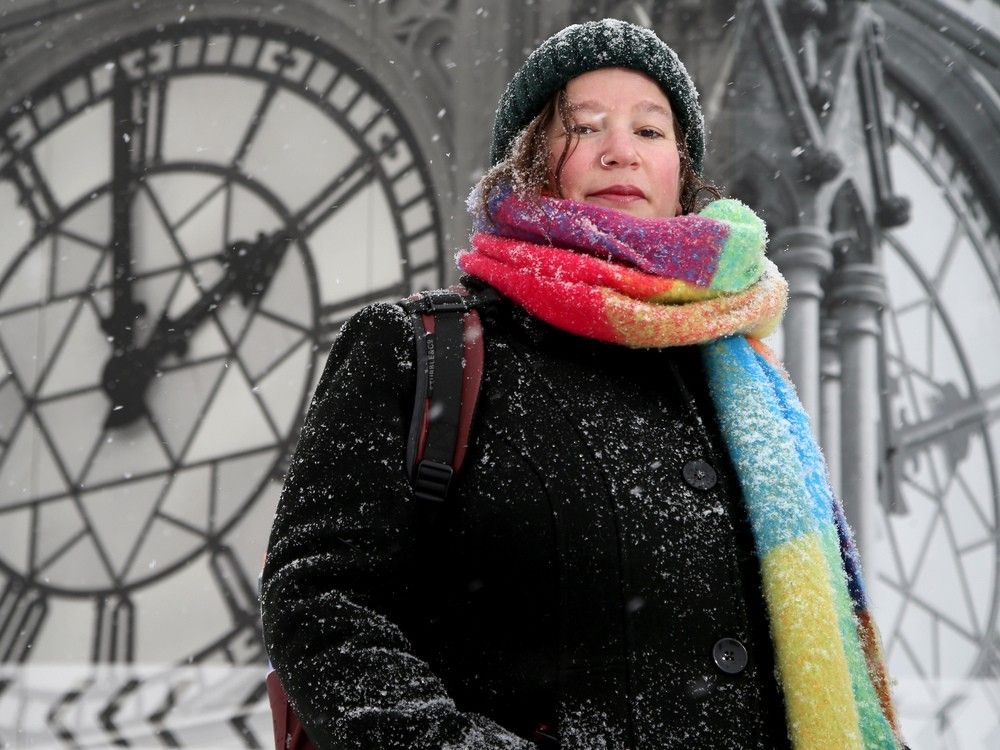
There are few people I’d be excited to meet, especially famous people. This isn’t because I’m a cynical restaurant owner, although I am, but because it can be disappointing, for a variety of reasons. In Alison Roman’s case, I suspected it would be different, and not just because we are both Virgos, possessed of many similar traits and born almost exactly 10 years apart.
I was right, I instantly liked her. She is very charming and savvy, but it was also because she has this wonderful quality (one I’d like to think I share) of being exactly how you’d expect her to be. I know it to not be performance — more like a switch that is flipped, over which you have total control. It’s how I get through busy restaurant services and probing interviews. I believe it’s possible to be self-aware about how you come across while still being authentic!
Alison was in Toronto on Nov. 20, on tour for her excellent new book, “Something From Nothing.” I’ve already made the Dilly Bean Stew twice in five days, which suggests a star is in fact born, as she presciently jokes in the recipe’s intro. (Do not skip these blurbs; they are written with humour and care!)
Before her live show at the Danforth Music Hall, where the audience gazed up at her with reverence and warmth, she came to one of my restaurants, General Public. We sat at table 25 upstairs, ordered a bunch of raw bar stuff, drank great white Burgundy and talked and talked — and went off the record a couple of times (wouldn’t you like to know!).
What is there left to say about a woman who has had gallons of ink spilled on all the details of her viral recipes and many of her life? A lot, it turns out. Here is our extremely enjoyable conversation.
Jen Agg: I’m so happy to meet you. I think people have been waiting for me to f—k up for my whole career, partly because I’m a successful woman in a country that hates success. Did you have that feeling at the beginning of your career, when your cookies were the first thing that, like, went?
Alison Roman: “What’s it called? Tall Poppy Syndrome.”
You’re the first American I’ve ever met who knows what Tall Poppy Syndrome is.
“Why do you think I know what that is…? People have brought it up to me before. I think it’s a pretty gentle way of describing something that is negative.”
Yeah, that’s what we do here.
“I was too naive to feel that way. I had nothing to lose. It was just fun and cool. And then soon after, you would see an article that was like, ‘Are the cookies even that good?’ And I was like, ‘What? Why? It’s a cookie.’ You see it happen with actors and musicians and anyone who becomes popular. It rarely happens to men. I don’t know if you’ve been paying attention to Jennifer Lawrence’s press cycle. I found it very interesting. She’s like, people were getting sick of me and I could tell. I was everywhere, people were like, oh, she’s so funny and relatable, and I thought, people are going to turn on me, and then they did.”
What a strange feeling for us to have to live with and understand. Why can’t we just do the work?
“At this point, I’m 40 and I’ve been cooking for 20 years. I feel like people have tried to discount me so many times, but the work speaks for itself.”
This book very much feels to me like, ‘I don’t have anything to prove.’ When you write a book, are you thinking about what your audience wants?
“Yeah, I’m a people pleaser. I consider what I do to be service industry in that I’m providing service to people. And if I’m not doing that, then it’s an ego mission. It means nothing.”
I’ve always thought of myself as doing what I want to do and making the people come. You know, if you build it…
“But if people were like, ‘We hate this place, this doesn’t meet the moment,’ I’m sure you would think, well, I have to do something different. You wouldn’t just be like, f—- you guys.”
I think you’re absolutely right. I don’t think any of your books have been flops. These are all hits.
“I very much listen to myself, to what I want to cook and what I want to eat. But I also think: ‘Is someone really going to make this? Is there an easier way to do this?’ Having so much feedback, which is relentless and never ending, and for the most part very positive, I know what people are thinking and what they’re willing to do, what they can’t do. And I feel very responsible in not just making a book of recipes that I think are cool or beautiful, but that actually encourage people to cook, to make those people feel proud of what they’ve cooked, and to make people come back to these recipes again and again.”
I cooked the Dilly Bean Stew yesterday. It’s an amazing recipe.
“It’s really good. I had one interview with a woman in the U.K. who basically was like, the food in this book is not very pretty. I’m almost positive she didn’t mean it as an insult, but she meant, aren’t you being contrarian putting out a bunch of brown, unattractive food? I was like, ‘I think it’s beautiful, what are you talking about?’”
I loved it. On Dave Chang’s podcast recently, you talked about your confidence as a cook — and you made it clear that you’re confident as a cook, not necessarily as a person. Why is that?
“I think that there’s a misconception about me publicly that I’m a very confident person. And maybe that irritates people, and that’s fine. But the irony is that I am extremely insecure. That said, I’m an extremely confident cook. I know that I’m a great cook. I know my food tastes awesome. That is the one area in my life where I’m like, I got it. But with what I wear, how I look, how I sound, when I show up at a party, how I appear in the world, there’s a ton of reasons that a person can feel insecure on the daily.”
I’m fascinated by insecurity because I’m not inherently an insecure person, but I wonder if I built a lot of my own confidence. And my parents loved me. I don’t know if they understood me, but they loved me. That was the foundation.
“I had a pretty tough relationship with my parents growing up. I’m much closer with my dad now, but I don’t talk to my mom anymore. We’re fully estranged. I think not having any support in that department growing up is hard. You give it to yourself. No one’s going to do it for you.”
I feel like I’ve experienced some gatekeeping in my career, lost opportunities because of how I exist in the world or how ‘truth to power’ I might appear to be. I talk a lot about it, maybe to my detriment. Have you experienced that, or it’s maybe something you don’t want to talk about?
“There are things that I keep to myself, or to my group chat, to my friends, and that I just don’t say publicly. I don’t think that’s unique to me. That’s a product of the internet being a crazy place full of people that have no intelligent interpretation of comments. Things are taken out of context and quotes are pulled and it’s just not worth it.”
I once read on Reddit that I love the smell of my own farts too much. And I was like, honestly, accurate, random Reddit user 0067!
“Oh, don’t go on there. I have by accident once or twice and it ruins my week and I can’t shake it. It’s like, imagine thinking something bad about yourself and then someone else says it. I think there is not a single person alive that is more successful than either of us that reads the comments, so why should we? It doesn’t make my work better. It makes me feel small. The exception being when people are like, ‘Hey, this recipe didn’t work.’ I’m like, great, let me fix it.”
I wish people would do that in the restaurants when things don’t go right for them, instead of leaving a s—-ty Google review.
“How are you with feedback?”
I’m great with it if it’s reasonable. I want things to be perfect all the time. Not that I think it’s necessarily achievable, but why shouldn’t we be trying to get there? But people tend to not know the difference between it’s not good and I don’t like it.
“We’ve entered the part of the meal where we’re both eating with our hands, so that’s good.
What did you think you wanted to do 15 years ago?
“I was working in restaurants still and I just wanted to work in the best restaurants. I did that for six or seven years, and at that point I realized that I did not want to open or own restaurants or work for anybody else’s restaurant.”
You’re a grocery store owner now, which seems insane to me.
“I mean, life is hard, owning a business is hard. The hardest part is hiring people and management. Everything else is great and fun.”
Yes, that’s exactly correct. Does it give you that feeling of having a space where you can make a thing that’s beautiful?
“Yeah, it does. It’s very fulfilling. Right now, we’re doing a First Bloom pop-up in New York City so it’s a lot more involved than normal. I’m in there every day. Versus the store upstate, where we do a fraction of the business. My dream was to only buy local produce and as it was turning, to process it into things to sell or food to cook. It’s as close as I’ll get to opening a restaurant. It’s manageable. I didn’t want to take time away from writing cookbooks.”
You’re a writer. This is what I’m hearing.
“I think so. I’ve written four cookbooks now, and I am ready to do a book that isn’t a recipe book. I want to know what that feels like. But it’s so much work, to work on a book and have a business and also feed the beast of content on the internet.”
I don’t really have a five-year plan, do you?
“I’m very decisive and I know what I like and I have goals. But I’m not that calculated. People are like, ‘Oh, your books look so natural. How do you achieve that?’ I cook, and then I take photos. I know how I want it to look, and it looks that way because it is authentic. I use a lot of my own plates, my linens, my glassware. Because I want it to feel like me, my taste, my life.”
You’re so good on camera, in your videos. Was it always that easy?
“I think that I continue to get better at it. I genuinely have so many people in my life that text me questions about cooking, and I literally just talk to camera as if I’m talking to them. It’s me trying to distil the information. You have to assume your audience is really intelligent, but you can’t assume that they know everything. The bigger the audience gets, the more people you on-board that know less. Then it becomes more challenging, because you don’t want to lose the people that have been with you since the beginning, that maybe are more confident in the kitchen.”
Yes, when I noticed the shallot pasta in the book, it was like, ‘Hey, we’ve been down some roads together.’ You’re technically an elder millennial but close enough to the cusp that this may be relatable: There’s this element to Gen X of being embarrassed to care too much. But I care so much.
“Yeah, I care so much, and the older I get, the more comfortable I am with caring a lot. I always have. Even with my first book, everything was intentional; every art choice, every recipe, every word. I think a lot of people thought I was an accident, or that I was a product of being young and hot, or young and bubbly, or good at the internet, or however you wanted to excuse my success. Four books in, I’m like, am I good now? If you still think there’s a reason I’m successful that isn’t related to me being good at my job, I can no longer resist that.”