

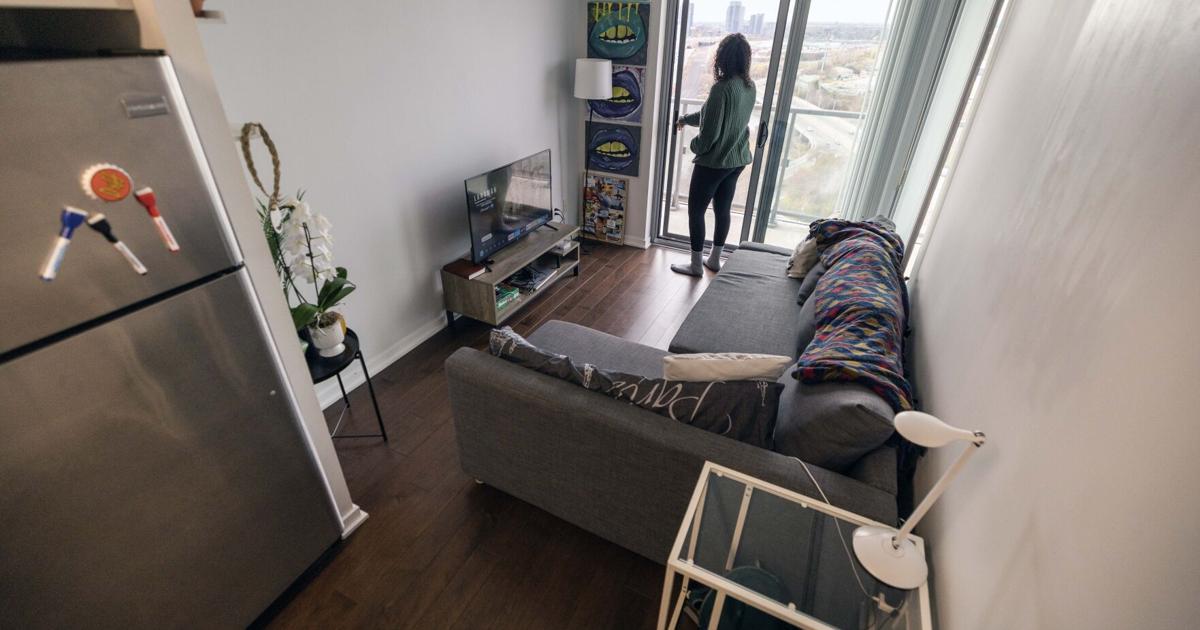
Kyla Van Dusen Boxe wanted to rent a one-bedroom condo downtown, ideally in the Fort York area or near Yonge and Eglinton, by the subway. She had a budget around $2,200, or $2,350 with parking.
After finding a Midtown apartment that fit the bill in September, Van Dusen Boxe’s realtor sent her tenant profile — details about her employment, income, and credit score — to the landlord to gauge if they would be interested in receiving her application. They were not.
“They didn’t specify why they wouldn’t consider me,” said Van Dusen Boxe, who has two full-time jobs — one where she’s worked for 10 years and another where she’s been for four — and a credit score around 700.
“It seemed like they were looking for someone overqualified,” her realtor, Justin Bailey, said.
The lifelong renter wondered if she could buy a home, instead. Within weeks, she was pre-approved for a mortgage and purchased a one-bedroom condo with parking on Etobicoke’s waterfront. Her mortgage payments work out to be about the same as her budget was for renting, she says.
For Toronto renters, this market is likely as good as it’s going to get. While prices have declined since the market peaked in the third quarter of 2023, they’re not likely to continue falling much, if at all, and even now, many renters are struggling to secure apartments.
In Toronto, rents in the third quarter of 2025 fell nine per cent compared to two years prior, according to Urbanation data shared with the Star. However, experts predict rents will soon slowly start to climb, since there won’t be the same record-high condo completions that boosted supply and eased prices in 2024. Once condo completions plummet and the remaining new supply is occupied, they will then rise more dramatically.
At the same time, realtors say landlords are increasingly cautious about who they rent to, as some have seen their mortgages rise in the last few years, and many are weary of delays at the Landlord and Tenant Board. They want tenants with strong credit, high incomes, savings, references, and long-standing employment.
“They’re looking for everything,” Bailey said.
Rent declines are slowing
Prices have fallen from 2024, but not as sharply as they did right after the 2023 peak.
In purpose-built rentals constructed since 2000, prices for bachelors in the third quarter of the year decreased four per cent annually to $2,226, one-bedrooms decreased two per cent to $2,555, two-bedrooms decreased five per cent to $3,462 and three-bedrooms dropped seven per cent to $4,334, according to Urbanation data.
In condos, rents for bachelors decreased 4.5 per cent to $2,011, one-bedrooms decreased four per cent to $2,320, two-bedrooms dipped two per cent to $3,126, and three-bedrooms dropped five per cent $3,870, Urbanation data shows.
“(Rents) are down from their absolute highs a year ago and two years ago,” said Shaun Hildebrand, president of Urbanation. “But if you look at the month-to-month and quarter-to-quarter trend, rents are kind of moving sideways, if not increasing modestly.”
Condo supply helped rent prices remain stable
While demand was “incredibly strong” in the third quarter of the year — typically the busiest season when people like to move and students sign leases ahead of the school year — prices were fairly stable because there were many new condos available to rent, Hildebrand said.
Across the Greater Toronto and Hamilton Area, this period marked the first time in three years that lease transactions grew faster than listings, he said. Yet the vacancy rate — the percentage of unoccupied rental apartments — was a “healthy” 3.5 per cent, higher than the historically low rates of less than two per cent in Toronto over the last few decades.
Still, there are limits to how much a higher vacancy rate can be helpful for renters.
On the one hand, experts say rental operators offer more incentives, like a free month of rent, to fill up their apartments. On the other hand, they’re doing this so they can attract renters without dropping prices.
Jordan Nanowski, Canada Mortgage and Housing Corp.‘s lead economist on the GTA, said smaller landlords, such as those who own condos, may be willing to reduce their price to get a tenant sooner. But bigger landlords who own entire rental buildings are “less willing to make concessions on rent” and may be approaching their “floor” for rent prices.
Realtor Sue McLay said prices in generic “cookie-cutter” condos are most likely to fall because there are so many available, while townhouses, semi-detached and detached homes continue to generate “premium rents” because there are fewer available and they’re more competitive
Rental market reaches ‘turning point’
The third quarter of 2025 also marked a “turning point,” Hildebrand said.
While condo completions will still be near record highs for the next several quarters, they’re going to start trending lower. And with less growth in supply, plus continued strong demand among renters, Urbanation expects rents to “flatten out” on a year-over-year basis for the remainder of 2025, rather than continuing to decline, he said.
“As we move into the second half of the next year, we’ll see rent growth resume,” likely rising between two and five per cent, Hildebrand said.
“As we move past the 2027-2028 period, that’s when you’re going to see rents really begin to ramp up,” he said.
Condo units make up about half of the new rental supply, Nanowski said, but condo developers are struggling to get started on new projects. Even though some developers are pivoting to building purpose-built rentals, those projects still won’t be enough to make up for the loss of new condo units.
Nanowski similarly said he expects soft rental market conditions until 2027, with high vacancy rates and decreasing rents or “very sluggish rent growth.”
In 2028, he expects a “reversal” on softening rents with no new rental units being completed. At this point, the rental market will “heat up” more.
Landlords seeking ‘overly qualified’ tenants
McLay, the realtor, said many landlords have seen their monthly costs rise, and they’re nervous about facing LTB delays and rules that they feel “favour the tenant a little bit more than the landlord” if their tenant stops paying rent.
As a result, they’re rejecting applications from “great tenants,” who may need to submit three or four applications before securing a home, she said.
”(Landlords) ultimately try and avoid any issues as much as possible,” she said.
Bailey, Van Dusen Boxe’s realtor, agreed landlords are weary of the LTB “taking forever to deal with tenants,” and are therefore making renters “jump through a lot of hoops” in order to protect themselves.
“They’re really trying to go above and beyond and find someone overly qualified,” he said.
The LTB, for its part, says addressing delays “has been a top priority,” and it is making “steady, measurable progress reducing its backlog and improving service delivery.”
The board says it has reduced its backlog from 55,000 in December 2023 to about 36,000 cases in November. Additionally, applications for nonpayment of rent are now scheduled within nine weeks, down from eight-to-10 months in early 2023.

