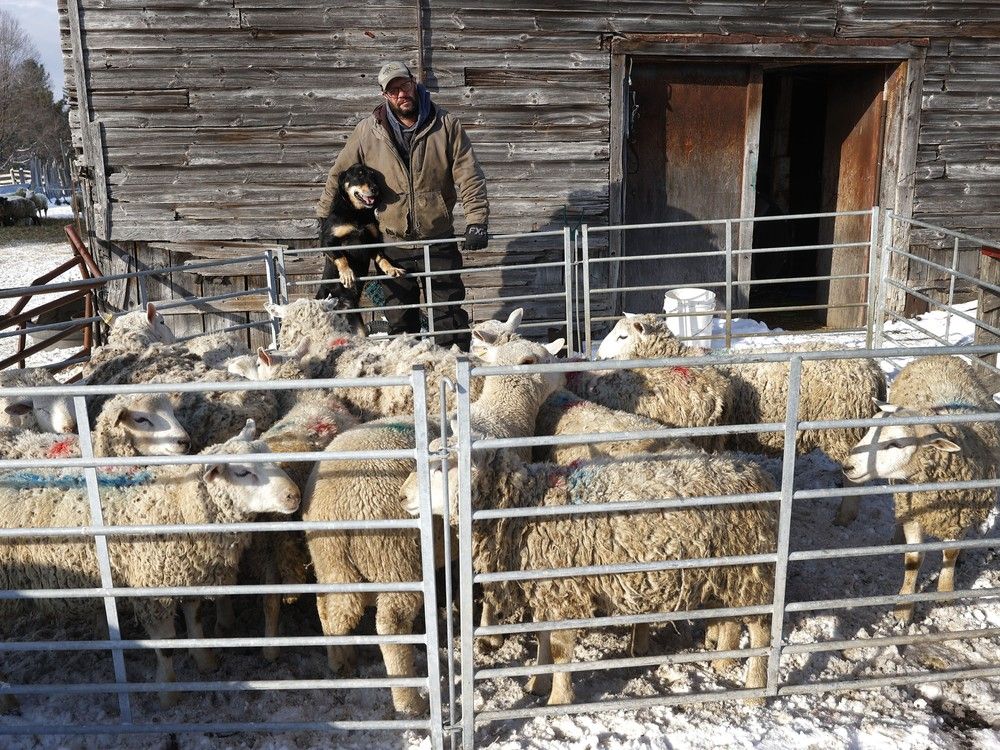
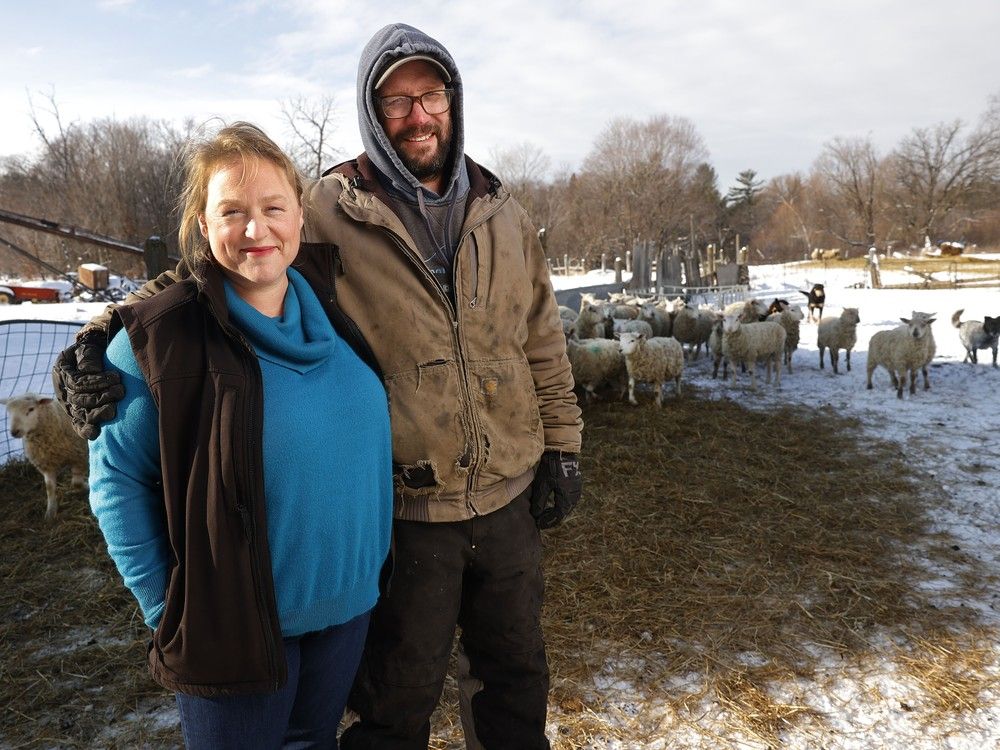
As is the case for many things in farming, solar grazing started as an experiment for Chris Moore and Lyndsey Smith.
Solar grazing, sometimes called “lambscaping,” is the practice of using sheep grazing to manage vegetation under and around solar panel arrays. Sheep are too small to do any damage, and they’re not finicky eaters. The solar farm is less dependent on mowing. The farmer is producing an agricultural product. It’s an all-around win.
But solar farming is also complicated, as Moore and Smith, who own Shady Creek Lamb Co., have learned over the past eight years.
The reason for trying solar grazing in the first place started with the grazing limitations of their farm, 100 acres near Kinburn that has been in Moore’s family for three generations.
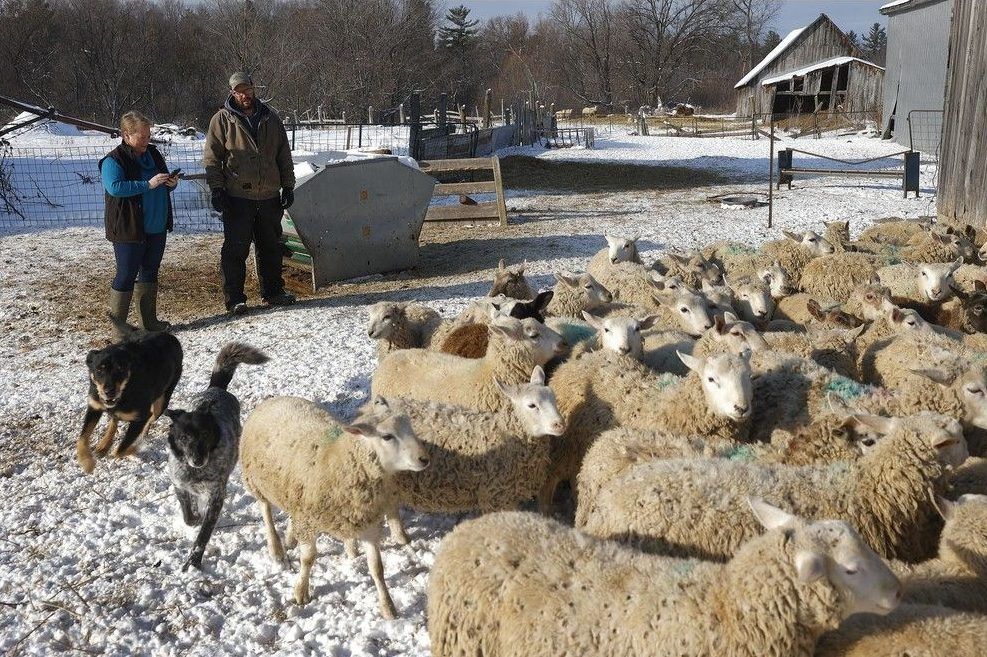
“It sounds like a lot of land if you live in the city,” Smith says. “But it’s really not because we have winter, which means a portion of your land has to be growing feed that you store in the form of hay or silage, so you can’t be grazing it all year and making hay. It’s one or the other.”
They needed to scale up their operation. The cost of buying land was an impediment. So was the cost of building barns.
The solution to the barn problem was to build a farm business in which the livestock carried their own shelter, in the form of wool, Moore says. The answer to the land problem was to graze the sheep on “other people’s ground.”
Moore has raised sheep since he was 12. Every time he went past a 200-acre solar farm near Galetta and saw vegetation being mowed, he thought sheep could do the job while being sustained by food that had no other use.
Smith wrote up the business proposal. “I literally cold-called them. I sent them a very finely worded email and said, ‘We live 10 kilometres away, and we’d like to propose this idea.’ So that’s what we did.”
A pilot project was approved for the fall of 2017 for about a month, then came a one-year contract that rolled into a three-year contract. They’ve been doing it for eight years now.
It has been a learning curve. Dealing with solar companies is very different than farming on your own.
“I do all the contract stuff and all the lawyer stuff and all the insurance stuff because there’s a lot of it,” says Smith, an agronomist who also works full-time as an agricultural journalist.
There’s more to it than letting sheep loose to nibble around the panels. The grazing areas are limited by moveable solar-powered electrical fences that keep the sheep in and the coyotes out. The ewes have their lambs while they’re outdoors. The fences must be moved regularly. There are timber wolf-sized Maremma guardian dogs that watch the flocks full-time, as well as herding dogs to help move the sheep around.
Coyotes are only one part of the predator problem, Moore says. The ravens are nearly as bad, attacking any sheep that has fallen. Then there are the bears.
The trick is learning how to co-exist with the wildlife with the help of the dogs and the fences, Smith says.
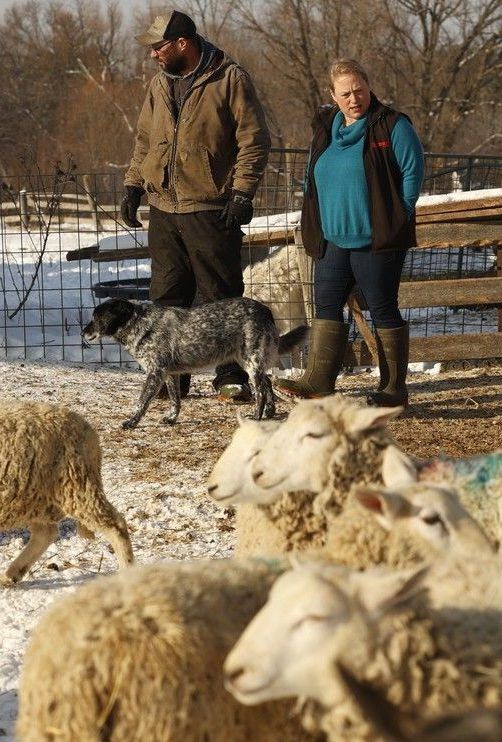
“It’s not about like trying to eliminate any sort of biological threat. It’s about adapting to stay just one step ahead.”
Shady Creek’s primary product is lamb. When Moore and Smith started solar grazing, their flock had to expand, pronto. Moore points out that there are more sheep in a few sheep stations in Australia than there are in all of Canada. Even Spain and Iceland have more sheep. It’s impossible to go out and buy 500 more of the right kind of sheep to do the job under Ottawa-area conditions.
“You could get them from out west, but then you’re dealing with sheep that have been selected under very dry conditions to come into very wet conditions,” Smith says. “And then you get foot issues, health issues, parasite issues, because you’re you’re bringing a biological being into another biological system. And bad things happen.”
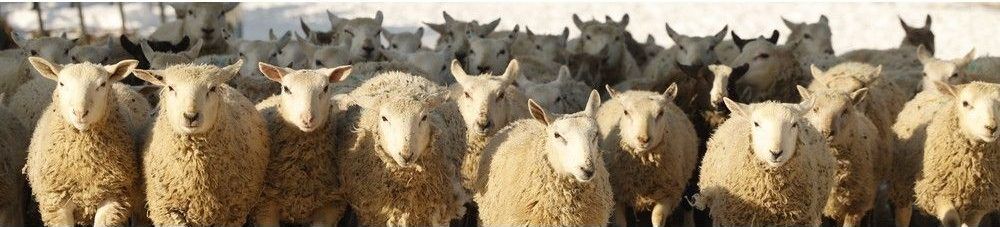
An ewe has her first lamb at a year old, then typically has twins every spring for the next five or six years. The Shady Creek flocks are a “motley crew” of Canadian Arcott, a breed developed by the Central Experimental Farm, mixed with Border Cheviot, which originated in the region between England and Scotland, Romanov, a Russian breed, and Coopworth, which originated in New Zealand.
“We don’t need pampered animals,” Smith says. “We don’t need animals that have a name. We need them to walk to their food, have good feet and legs. Birth their babies alone, love them, feed them, flock and thrive on a really variable diet of grasses and legumes and woody shrubs.”
Meanwhile, Moore has developed new avenues for grazing their sheep on other people’s ground. Four years ago, he started grazing his flocks on a neighbour’s cover crop after the winter wheat had been harvested. For the farmer, a cover crop catches energy from the sun and prevents erosion and nutrient runoff. For the grazier, it provides nutrients for the flock. The sheep manure improves the farmer’s soil.
When Moore started grazing cover crops in 2021, it was pioneering. But it’s catching on now, he says. There’s one important limitation: how far a flock can be moved either on the hoof or by truck. The fences have to be moved, the sheep have to be monitored and the dogs have to be fed. Shady Creek has grazed sheep as far way as Renfrew, but the cost of trucking and the cost of hiring someone to monitor the flock was just too high, he says.
“Chris has been as successful as he is because he will do what no one else is willing to do,” Smith says. “And it has absolutely been terrifying at times. But, when it works, it works really well.”
Sheep still need to be shorn annually, but in this case not for their wool. There’s a particularly gruesome flesh-eating maggot called the screwworm that can infest the mucous membranes of sheep with wet wool. Shearing helps prevent that, he says.
Smith is a board member with the 1,100-member American Solar Grazing Association. She estimates there are about 15 large solar grazing operations in Canada. Some solar farms in Alberta are 500 to 600 acres.
“Most companies want some form of food production on these sites because one of the biggest pushbacks when they try to move into an area is that they’re taking farmland out of food production,” Smith says.
But for farmers, solar grazing also requires a different skill set.
“Most farmers don’t have to pitch to a corporate board or have to sit down with your insurance and your lawyers over a service contract, or deal with customer complaints,” Smith says. “It’s not for everybody.”
One of the rewards has been the biodiversity they have found in a solar field grazed by sheep. Because the sheep are systematically moved across the site, there’s always a spot that is still actively growing in flower, a spot that the sheep just left and a spot that’s in between.
“We have butterflies and birds and honeybees,” Smith says. “The native pollinators are everywhere. We have milkweed for the monarchs. We have frogs. We have praying mantis. We have ground-nesting birds. It’s alive in there because it never gets harvested all at once. It’s lovely to walk through.”
Our website is your destination for up-to-the-minute news, so make sure to bookmark our homepage and sign up for our newsletters so we can keep you informed.