

The City of Ottawa is proposing a
property tax increase of 3.75 per cent
, which is projected to increase tax revenue by $117 million in 2026.
The Ottawa Police Service has tabled a budget that includes a five per cent increase to the tax levy. Transit services developed their budget with a tax levy increase of eight per cent, while Ottawa Public Health and the Ottawa Public Library have tabled their budgets with a 2.9 per cent increase.
If approved by council, those tax hikes will mean an average property tax bill will jump by $166 for urban homeowners and $108 for rural homeowners. The average commercial property will see an increase of $354 in its annual property tax bill.
How the Ottawa set its tax rates for 2026
The average value of properties is based on the 2016 Municipal Property Assessment Corporation (MPAC) assessment, which is used by municipalities as the basis to charge property taxes.
The MPAC reassessment for 2020 was delayed by the pandemic and the province has offered “no certain date for resumption,” according to the city.
City staff have recommended a 4.5 per cent increase for rate-supported services, which includes a 2.7 per cent target increase for water revenue, a wastewater revenue increase of 4.9 per cent and a stormwater revenue increase of 7.6 per cent.
Mayor Mark Sutcliffe
first floated the 2026 budget directions during a press conference in August, with council approving those budget directions on Sept. 10.
The draft budget was tabled at council on Nov. 12, with each standing committee then convening throughout November and early December to consider and debate each departmental budget, with public delegations weighing in from residents, businesses and community groups.
Here are some of the highlights council will consider before voting on whether to adopt the 2026 budget on Wednesday.
How will the Ottawa Police Service spend its money?
The
Ottawa Police Service Board approved the budget
for policing in the city with the net operating budget of $414.9 million, which includes an additional $26 million thanks to a five per cent increase in the property tax levy — the largest police budget increase in more than a decade.
The board heard from a number of delegations both opposing and in support of the budget increase.
“I know there are some people who have said that the police budget increase is too much, that we should be freezing or cutting our investment in policing, but that’s not what I hear from the vast majority of residents that I’ve spoken to,” Sutcliffe said at a recent press conference outlining the city’s plans for enhancing public safety.
Sutcliffe called the budget increase a “historic investment” that will pay for 25 new hires in 2026 — including 21 sworn officers and four special constables — the implementation of a new district policing model and a pilot program that will see officers in the OPS crisis intervention team outfitted with 30 body-worn cameras.
The police operating budget also includes a one-time injection of $5.4 million from the city’s tax stabilization reserve.
Where will there be an OC Transpo fare increase?
OC Transpo will hike fares by 2.5 per cent
on Jan. 1, 2026, which equates to an additional $4 million in revenue, while an eight per cent increase to the property tax levy equates to another $43.4 million.
The $938.7-million operating budget for OC Transpo represents a 10.8 per cent increase over the 2025 budget after seeing an 11.4 per cent increase the year before. An additional $177.1 million will be invested in capital projects.
The rate increase means an adult monthly pass will rise from $135 in 2025 to $138.50 as of Jan. 1, 2026. Monthly passes for seniors will increase from $58.25 to $59.75 next year and single-ride tickets will increase from the current $4 to $4.10 for those paying with cards.
Fares for the community pass, Access Pass and EquiPass will remain frozen.
The majority of the operating budget ($417.6 million) goes to bus operations and maintenance, with $177 million going to service delivery and rail operations, $53.3 million to customer systems and planning, and $25.3 million to safety, regulatory, training and development.
The budget accounts for $414.4 million in revenue and $33.1 million in cost recoveries through efficiencies, including savings from the carbon tax reduction, along with funding allocations from other levels of government, leaving a net requirement of $491.2 million.
The draft budget includes $4.52 million in provincial funding for OC Transpo’s special constable unit, with $3.5 million of that going to compensation for additional staff, including special constables, sergeants, communications officers and administrative staff.
OC Transpo hired 18 special constables over the last year and will hire four more officers in 2026. The unit saw about 22,400 calls for service in 2025, an average of 215 calls per week. With a “full complement” of officers in 2026, the unit expects that each special constable will respond to more than 300 calls per year.
The budget accounts for the extension of O-Train Line 1 to Trim Station in 2026, investments in bus and train reliability, new zero-emission buses and charging stations and fare enforcement.
An additional $177.1 million for capital projects will maintain equipment and facilities, improve service reliability, safety and security, and will prepare for the O-Train’s west extension.
What about the money for public safety and emergency services
The budget includes $3.3 million for 23 new paramedics and additional bylaw and regulatory services staff, with another $3.6 million to replace breathing devices for firefighters.
The new equipment for firefighters is part of an $8 million investment that will also strengthen operational capacity in fast-growing neighbourhoods across the city.
There will be 12 additional firefighters assigned to Kanata North and another 22 in Stittsville, and the fire service is looking at a long-term location study that will see more firefighters in outlying areas like Manotick and Greely.
The budget also invests $1.6 million in a ByWard Market streetscaping renewal project as revitalization efforts continue in the heritage district with the city preparing to celebrate the 200th anniversary of the founding of Bytown next year, followed by the ByWard Market’s 200th anniversary in 2027.
Sutcliffe recently announced his public safety “action plan” that will divert $500,000 annually for two years from the municipal accommodation tax (MAT) to fund private security guards in the ByWard Market.
The city will spend $400,000 to improve safety at the Rideau-Sussex pedestrian underpass near the Senate of Canada building.
The city will also expand the Centretown safety and revitalization plan to Somerset Street with investments in safer sidewalks and crossings and will spend $500,000 in 2026 on new street lights citywide.
Is Ottawa spending more on roads, water mains, and other infrastructure?
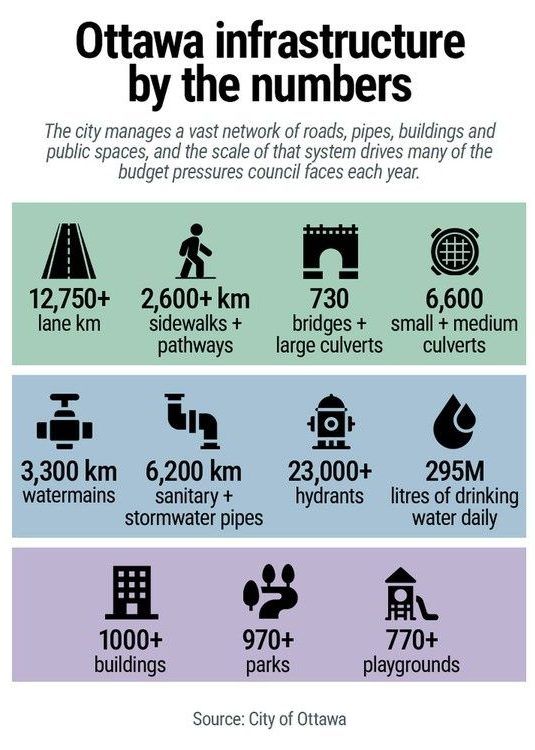
The city will make several investments to enhance roadway, cycling and pedestrian infrastructure, with $135 million in road resurfacing and preservation, and an additional $25.4 million to rehabilitate sidewalks.
The city has allocated $533 million to road resurfacing during this term of council, a 50 per cent increase over the previous council term, and a total of $65 million for sidewalk investments, a 77 per cent increase over the previous council term.
The budget will include investments in a transportation master plan that was previously approved by council and will include funding for “priority corridors,” including $20.4 million for Carp Road, $56.1 million for Greenbank Road realignment, $3.1 million for widening Brian Coburn Boulevard and $1 million for the Stittsville Main Street extension.
Council will consider a motion on renewing rural infrastructure after the five-member agriculture and rural affairs committee approved its $3.6 million operating budget, but voted against a recommendation to approve the capital portion of its budget.
That portion includes $14.3 million in capital funding, with $10.2 million earmarked for renewing rural roads and guiderails, with $3.6 million of that funding to maintain rural roadside ditches. That work would include removing debris, re-establishing grades and slopes to maintain drainage, flushing culverts to remove silt and sand and cutting grass twice a year.
Infrastructure funds also include $23.25 million for affordable housing initiatives with a target of building 350 new affordable units in 2026.
The city will also invest $87.2 million in wastewater treatment renewal at the Robert O. Pickard Environmental Centre, with $12.7 million for the storm and surface water rehabilitation program and $3.6 million for the rural ditching program.
Our website is your destination for up-to-the-minute news, so make sure to bookmark our homepage and sign up for our newsletters so we can keep you informed.

