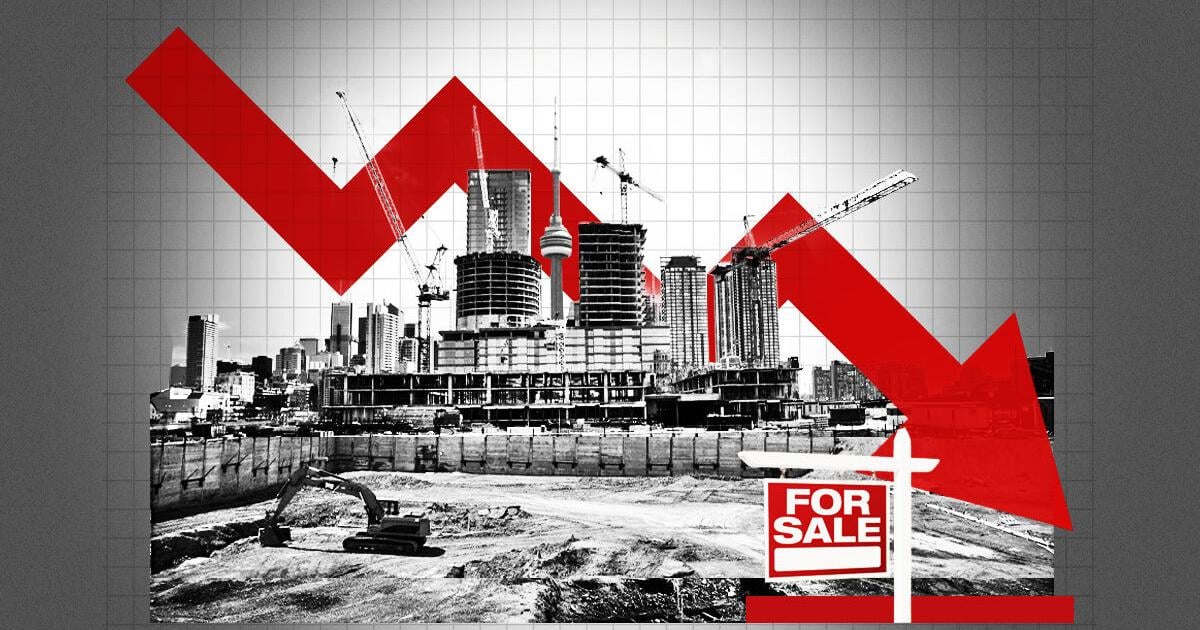
Toronto’s real estate market today is reminiscent of the 1990s housing crash for Dan Cooper.
“I find this very similar to that recession,” said the Oakville-based real estate agent of more than 30 years. “The market went into a recession and prices dropped for around six years. We’re now almost four years into our downward spiral … we’re going back in time.”
In order for the Toronto-area market to rebound, sustained positive economic news would have to take place, and it doesn’t look like that’s happening any time soon, experts say.
That means 2026 won’t be much better than the tumultuous year we just had, as continued uncertainty with U.S. tariffs, job loss in manufacturing and the auto sectors, as well as the threat of AI impacting the job market shake consumer confidence.
Two of Canada’s leading real estate companies have both forecast price declines for the Toronto market until the end of 2026, unheard-of projections for brokerages that wish to boost sales, indicating the dire situation the real estate market finds itself in.
Experts say the price decline was inevitable given the “artificial” prices at the 2022 peak, but the current economic conditions are set to wipe out six years of price gains.
Along with job pressure tamping down consumer confidence, buyers are not likely to see further variable rate cuts, while fixed rates may even rise, further diminishing their buying power. Meanwhile, sellers are facing a lot of competition as pent-up supply on the condo market, and even freehold, outstrip demand and keep downward pressure on pricing.
Next year, home prices will likely reach levels seen pre- or early pandemic, just before prices took off, Cooper said.
“Probably if things don’t turn around in the spring market we’ll see homes selling for what they sold for back in 2020,” he said.
What Cooper, who is the CEO of Dan Cooper Group, tells his seller clients now is eerily similar to what he told them in the ‘90s.
“When the market is going down clients looking to sell should list in the new year and sell by spring, because prices are likely to go down further,” he said.
And for buyers? Because Toronto is in a buyers’ market, they can take advantage of lower competition and borrowing costs that have decreased considerably in the last two years.
Home prices to continue downward spiral
Canada’s leading real estate companies, Royal LePage and Re/Max Canada, have forecast that Toronto-area homes prices will drop by 4.5 per cent and 3.5 per cent, respectively, until the end of 2026 — taking the average price to just over $1 million.
Other experts including Cooper think they’ll drop farther. To reach 2020 pricing, which was around $930,000, prices would need to fall more than eight per cent, bringing us beyond the 30-per-cent threshold that some say is considered a crash.
There will be an uptick of demand in the spring, which is usually the busiest time for the real estate market — even in “down years,” said Cooper.
While Re/Max forecasts a five-per-cent increase in sales next year, the flood of inventory that has piled up throughout 2025 due to low sales means market conditions aren’t “tight enough” for there to be upward pressure on prices, said Cameron Forbes, COO of Re/Max Realtron Realty Inc.
“There are a lot of homes available for sale, there’s good choice for buyers,” he said. “There’s less demand, and on average, there’s more supply.”
Consumer confidence hampers activity
The biggest factor depressing the market is economic uncertainty, said Tony Stillo, director of Canada Economics at Oxford Economics.
“Concerns about job security due to the trade war will likely keep Canada’s housing market on a tenuous footing well into next year,” he said.
“We expect a weaker labour market, and slower population growth will weigh on demand and keep supply high,” adding this should lower house prices a little further, helping sellers find buyers, and ultimately moving transaction volumes to a healthy level.
Oxford Economics forecasts that economic growth will pick up again in the second half of 2026 due to government stimulus, lower interest rates, and hopefully lower tariffs after the renegotiation of the United States—Mexico—Canada Agreement (USMCA).
Only once economic conditions improve, will buyers and sellers be more inclined to be active in the market, Stillo said.
Condo crash continues
Royal LePage forecasts condo prices will drop a further 6.5 per cent in the Toronto-area, as a record level of supply — due to the pandemic presale boom — hits the market.
That supply will largely be smaller one-bedroom and studio units, which were favoured by investors when interest rates were low. Since rates started to rise in March 2022 and rents have fallen, investors have largely left the space, but those small units aren’t of interest to end users, who want larger spaces.
“It will at least be another year before things improve,” said Daniel Foch, chief real estate officer of Valery.ca, an AI-powered real estate brokerage and technology platform. “There’s around a 22 per cent failure rate of preconstruction buyers failing to close.”
Typically, in a “normal market” it would be five to 10 per cent, he said. But more people today are failing to close because many pre-construction buyers bought during the height of the pandemic when interest rates were low, with some investors buying multiple units at the same time. But as a condo typically takes five years to build, by the time they had to close, interest rates had risen drastically and the carrying cost of the mortgage became untenable for many buyers.
Developers that have bought land but haven’t started construction will continue to pivot to purpose-built rental, especially if they can find Canadian Mortgage and Housing Corp. financing, which offers favourable loan financing for multi-unit rental properties.
“Next year will be worse for receiverships, delinquencies, and power of sales,” he said. “It will bottom towards the end of 2026.”
Interest rates expected to hold steady
Since June 2024, the Bank of Canada’s overnight lending rate has dropped nine times — reaching 2.25 per cent in October from the five per cent peak. On Dec. 10, the central bank held the overnight rate at 2.25 per cent and it’s likely to hold for most of 2026, said Penelope Graham, mortgage expert at Ratehub.ca.
“The Bank has considerably brought that benchmark rate down. They’ve done a lot of work to unwind the rate pain that had occurred post-pandemic and during spiking inflation,” Graham said.
“They have stated both in this announcement and in the last announcement, that they think the current policy rate is about right. It’s where it needs to be to support the current economic conditions.”
For variable-rate mortgages, which are tied to the Bank of Canada’s announcements, consumers can get a five-year mortgage for 3.45 per cent, which should hold throughout the year, Graham said.
“That’s a pretty competitive and attractive offer for those types of borrowers,” she said.
It’s “much harder” to forecast fixed rates as the bond yields have been volatile all year. Because the current economic conditions are unstable, fixed rates are likely to rise over the coming months as bond yields increase above three per cent, Graham added. The best five-year fixed rate is in the high three per cent range.
“It’s really hard to predict beyond that. But as long as we’re seeing yields sticking around above this three per cent mark, we’re going see that upward pressure,” she said.
The majority of consumers, around 80 per cent, are still opting for fixed-rates as they provide certainty during this unpredictable period, she added, but more people are inquiring about variable-rates.
Overall, economic uncertainty will be the main factor for consumers looking to buy or sell property, and it’s unlikely conditions will improve soon, said Oakville realtor Cooper.
“The real estate valley in the late 1980s and 1990s lasted 12 years,” he said. “It wasn’t until the early 2000s that home prices returned to their peak.”