

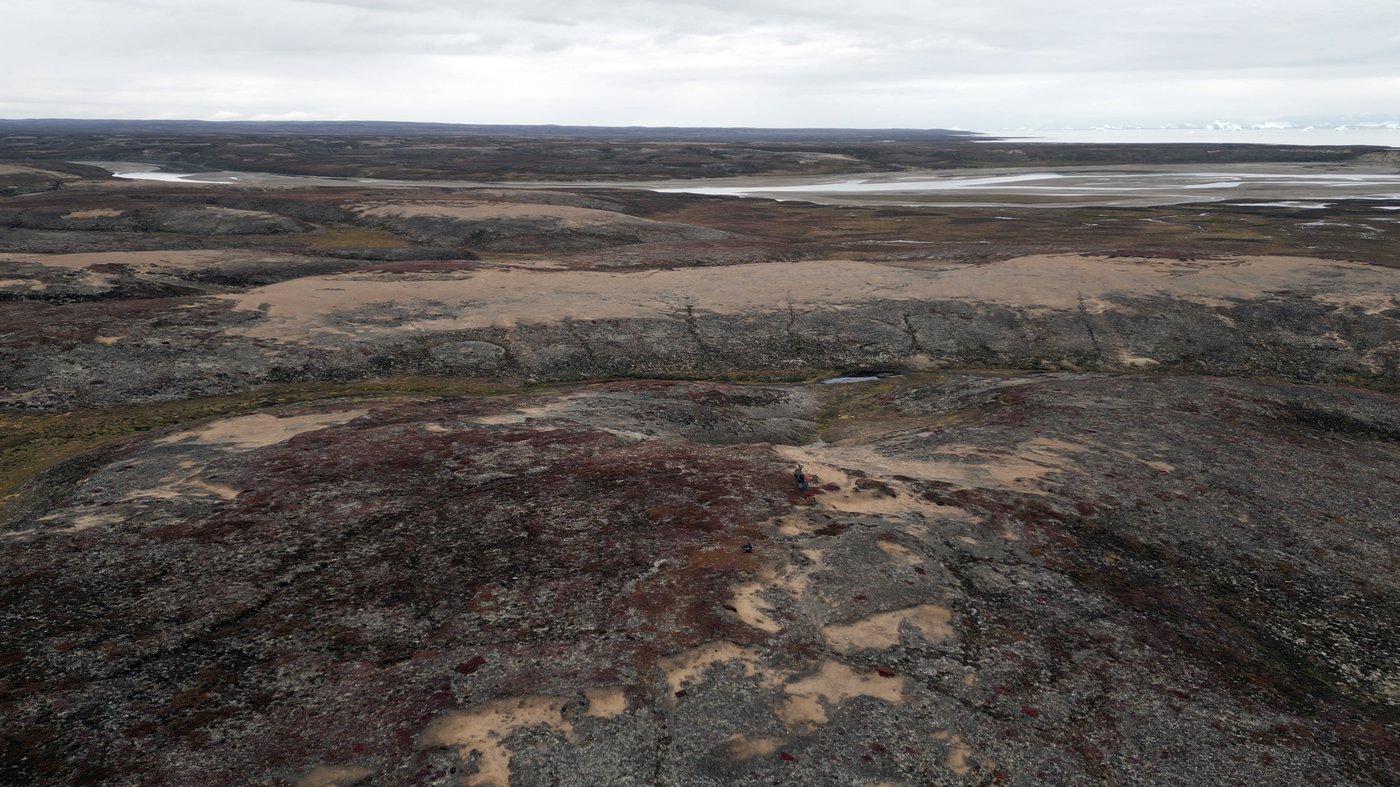
CALGARY — The promotional video shows a small creek trickling through a mossy patch in an otherwise brown, barren landscape, icebergs looming just offshore.
A petroleum engineer dips a hand into the stream, then takes a sniff.
“It smells like crude oil,” he says, grinning at the camera.
A small group of contractors and engineers were filmed as they joined veteran U.S. oilman Robert Price on a visit to Jameson Land, a remote peninsula about halfway up Greenland’s eastern coast. The short documentary is meant to showcase how Texas-based Greenland Energy Co. is preparing for a two-well exploration program set for later this year.
If the oil naturally seeping out of the ground is any indication, they could be looking at a gusher.
“It’ll be like the oilfields of the ’20s and ’30s and ’40s,” said Price, chief executive of newly formed firm Greenland Energy, in an interview.
“The pressure and the oil will actually come at you.”
Canadian companies are playing key roles in the effort to tap what Price said could be one of the world’s largest oil basins. The drilling rig is courtesy of Stampede Drilling Inc., a Calgary-based outfit normally active across Alberta and Saskatchewan. Quebec City-based shipping firm Desgagnés is handling transport.
The prize could be enormous, to the tune of 13 billion barrels of gross oil, according to an independent estimate from energy consultancy firm Sproule ERCE. Price likens the potential to the Prudhoe Bay field in Alaska discovered some six decades ago and forming the state’s economic backbone since.
Price said that samples taken from Jameson Land show the oil is akin to the crude long produced further east, off the shores of the United Kingdom and Norway. North Sea oil is light, sweet and easy to refine. Its price benchmark, called Brent, has been trading well over US$100 per barrel recently, at a premium to West Texas Intermediate produced in the U.S.
“I’ve been in the oil and gas business a long time and I’ve been on many wells and when you smell that light sweet crude, it actually smells sweet,” said Price.
“The aroma’s amazing.”
The logistics of the upcoming drilling are mind-boggling, with equipment being hauled from Alaska, Denmark, Alberta and the other side of Greenland. Cargoes are being staged at the Port of Valleyfield west of Montreal and then shipped to the site.
“It’s like playing Tetris,” Price said, describing the precise way equipment needs to be loaded. “It’s a fairly massive operation.”
With war engulfing much of the Middle East and upending global oil markets, it’s easy to forget that a possible U.S. takeover of Greenland was in the geopolitical spotlight mere months ago.
Price said he does not see a U.S. annexation of the mostly self-governing Danish territory being on the table.
“We are focused on respecting the Greenlandic people, their culture, their independence and doing what our part is in helping them become more independent and revenue-generating,” he said, adding that interactions with local regulators have been positive.
Price said a resource boom could help the population — 56,000 people, mostly Inuit — become less economically reliant on Denmark.
“People that I’ve talked to in Greenland, they want to know if they have one of the largest oilfields in the world.”
But the exploration would be happening five years after the Greenland government declared “the future does not lie in oil” and banned new oil and gas exploration.
The land Greenland Energy plans to drill in is under licences belonging to its joint-venture partner, U.K.-based 80 Mile PLC, that predate the 2021 policy, so they are still valid.
The first well is expected to take 30 days to complete. A well of a similar depth in Alberta would take about a week, Price said.
“Because we’re in the Arctic Circle, because this is the first well ever drilled in the basin, we’re going to take our time, we’re gonna go slow” he said.
For an American businessman looking to tap Greenland oil, Price has been spending a lot of time in Canada — specifically Calgary and Montreal.
Stampede Drilling chief operating officer Terry Kuiper said the company was approached about a year ago about joining the project.
Greenland would be the first international foray for Stampede, he said, though team members have worked abroad through previous jobs.
The company is preparing to bring one of its rigs to a yard south of Edmonton for modifications needed to accommodate the required spill prevention equipment. After that, it will be trucked to the Port of Valleyfield and then shipped to Greenland.
“We are really excited to be part of this,” said Kuiper. “There are not too many opportunities like this in North America, let alone globally.”
Stampede plans on having seven-worker crews situated in Greenland rotating through two 12-hour shifts. In Alberta, a rig would be crewed by five or six people, but the company is adding some redundancy given the remote conditions.
Greenland Energy announced last month that it had entered into an agreement with Desgagnés to handle the marine transport.
Desgagnés has a 50-year history moving freight through harsh Arctic environments and its Far North exploits are featured in the CBC reality series “High Arctic Haulers.” It has operated in Greenland, though never at the scale of the upcoming project, said Etienne Duchesne, project manager in business development at Groupe Desgagnés Inc.
“The west coast of Greenland is much more developed in terms of facilities, and there’s more villages on the west coast than the east coast. The east coast is very exposed to weather conditions,” he said.
“In general, the Arctic is a very difficult area to navigate, but some places are worse than others. The east coast of Greenland is particularly difficult due to winds that can last for weeks in a row, large waves.”
The exploration team will have to be completely self-sufficient as they’ll be working in “complete, absolute wilderness,” said Duchesne. Everything they need — fuel, food, accommodations, lubricant for machinery and more — is being consolidated at the Port of Valleyfield.
It will be crucial to make sure every item from several different vendors is closely tracked. Duchesne expects the ship to be loaded some time in September, with the whole trip taking about a month.
The vessel will likely be the Miena Desgagnés multipurpose cargo ship, which has two cranes that can together lift 500 tons. It will anchor as close as possible to the drill site and the cargoes will be taken to shore by barge.
The delivery will be made to “a random beach” as opposed to an existing hamlet, village or industrial site, as is usually the case for Desgagnés’ work in Canada’s Far North, said Duchesne. So the ship’s superintendent will check out the location ahead of time to figure out how to best set up a staging area for unloading.
The ship is to fly a Canadian flag, with a Canadian crew — and employees are clamouring to be part of the Greenland mission, said Duchesne.
“It’s really an adventure.”
This report by The Canadian Press was first published March 29, 2026.
Companies in this story: (TSXV:SDI)
Lauren Krugel, The Canadian Press

