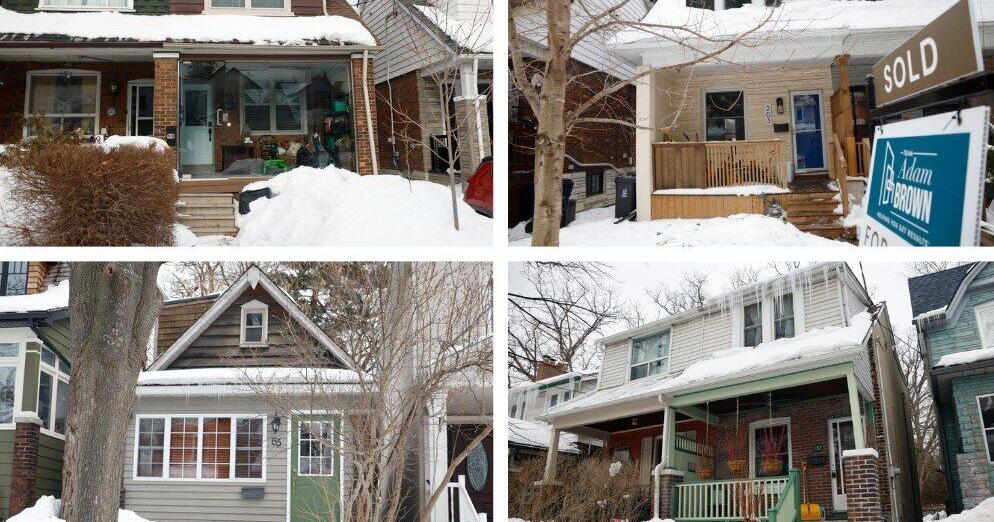
Grace Chan never saw a downtown Toronto condo with a price tag less than $600,000 at the height of the pandemic.
The Toronto-based realtor who works primarily in Yorkville and the downtown core said 400-square-foot studios were snatched up for more than half a million dollars day after day, no questions asked.
Now, in the condo market crash, Chan is seeing those same units sell for as low as $349,000.
“Smaller units have really lost significant value,” she said. “Prices (in general) are lower.”
It’s not just condos experiencing price dips, but the entire market from detached homes to micro units. In January, the average selling prices for all home types in the GTA was $973,000 — the first time prices fell below $1 million in five years. The feeding frenzy of the pandemic, which saw over-leveraged buyers jump into the market and speculators push prices to their limits, is gone. Sales hit their lowest number in 25 years, and prices are down 27 per cent from the February 2022 peak.
A growing share of single-family homes are popping up in the market for under $1 million, and an increasing number of condos are selling for less than $500,000.
These properties act as an appealing entry point for first-time homebuyers looking to get into the market at prices not seen in years, and for those outside the GTA who have returned to the office and want a pied-à-terre in the city to cut down on long commutes. They’re also attractive to buyers simply looking for a long-term investment — though experts warn economic challenges will continue to dampen consumer confidence, hindering potential price or sales growth in the year ahead.
Condos
During the pandemic peak, 2.5 per cent of condos sold between $400,000 and $499,999, according to the Toronto Regional Real Estate Board (TRREB). In January, that share of units ballooned to more than 26.9 per cent.
While bigger two- and three-bedroom units are still performing well, one-bedroom and studio apartments are struggling — these units were mostly bought from preconstruction investors who wanted cheaper units to rent out to give them a positive cash flow. But once prices and rents came down, and interest rates shot up, investors deserted the space. At the end of the day, it’s left a surplus of small units on the market that end-users don’t want.
“Micro units are suffering a lot more because there’s a glut of them,” Chan said. “Two-bedroom apartments, or bigger, are holding up better because they’re livable spaces.”
Jarrod Armstrong, real estate agent at The Armstrong Team, said it’s common to see condos listed below $400,000. In downtown Toronto, 77 condos are listed below $400,000 with 315 condos listed below $500,000, according to the Multiple Listing Service (MLS) as of Feb. 3.
With 1,500 units on the market, which will likely grow by the spring (typically the busiest time of year for real estate), the supply will continue to overpower the number of interested buyers, he said.
“We might even see a few sales below $300,000 this year,” Armstrong said, adding sellers will need to provide competitive prices to stand out.
But condos selling in the $300,000 range aren’t getting scooped up, Chan said. If there is an interested buyer, it’s coming from someone who lives outside the GTA in London, Peterborough or Barrie, calling to ask about wanting “a piece of Toronto,” ideally to have a place to stay downtown when they’re visiting, or a home for their kid going to university. For these investors, it’s a long-term investment instead of a cash-flow positive income maker, she added.
Armstrong has also gotten calls from people looking to buy due to return-to-office mandates, where their commute is too far and so they want something close to work that won’t cost a fortune.
While there’s interest from some buyers, in the short term, “the condominium market will continue to be a dumpster fire,” Armstrong said. “It is a falling knife that no one wants to grab at the moment.”
Single-family homes
In February 2022, 4.5 per cent of detached homes sold in the $900,000 to $999,999 range and 1.8 per cent traded in the $800,000 to $899,000 range. Those have jumped to 10.4 per cent and 11.8 per cent, respectively, in January, according to TRREB.
“The numbers are quite telling,” said Imran Zaidi, regional manager for the brokerage Right At Home Realty headquartered in Toronto. “We’re seeing materially more homes come to market under $1 million. Year-over-year listings below $1 million (for a detached home) are up about 30 per cent and there’s been a 50 per cent spike compared to two years ago.”
There’s a growing share of semi-detached homes selling in the $700,000 to $799,999 range, reaching 17.3 per cent of semi-detached sales this past January compared to 0.7 per cent in February 2022. The same can be said for townhomes, which hit 21 per cent of sales in January compared to 0.2 per cent at the pandemic height in the same price range, according to TRREB.
The growing inventory has flooded the market as sales hit multidecade lows, creating a supply and demand problem, Zaidi said. And while affordability is closer in reach, it’s a challenge to buy property given the higher cost of living and interest rates that still feel elevated for many consumers.
“Couple that with an economy that’s slowed down, consumer confidence has dipped so they’re more cautious,” he said. “We don’t have that urgency we saw in 2021 and 2022.”
Toronto’s east end is where a growing number of single-family homes are selling for under $1 million, experts said, which historically hasn’t been as popular as the city’s west end.
“Prices are more aligned with 2019, prior to COVID, so that’s becoming more and more the norm,” said Ralph Fox, founder of Toronto-based brokerage Fox Marin Associates. “Obviously it’s asset class and location dependent.”
East of Coxwell Avenue and Gerrard Street East is where more homes in these price points are appearing, he said.
West-end neighbourhoods such as Caledonia-Fairbank, Eglinton West and North Etobicoke are also offering enticing properties for entry-level buyers.
“Traditionally first-time buyers would have been locked out of the freehold market,” Fox said. “But now they’re starting to have opportunities.”