

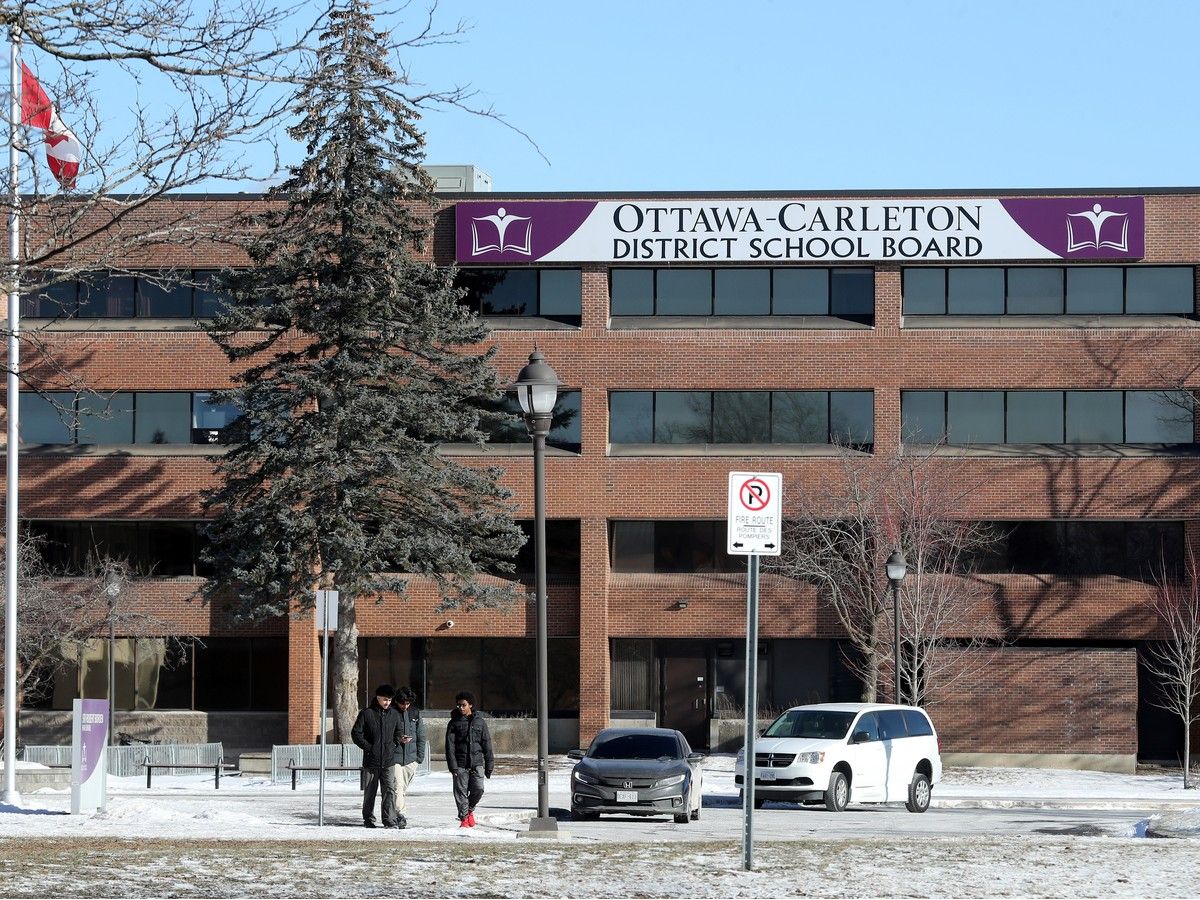
Central administration is on the chopping block as Ottawa’s largest school board faces
a larger deficit than anticipated
and looks to cut $15 to $20 million.
The Ottawa-Carleton District School Board is facing an $11.5-million deficit this year, which brings the cumulative deficit to about $21.2 million by the end of this fiscal year, director of education Stacey Kay told the members of the audit committee on March 3.
“As a district, we are already implementing measures mid year to moderate the size of this deficit and to curb further growth,” Kay told the audit committee.
The district is looking at an “ambitious” target of a $15- to $20-million reduction to the operating budget, she said.
“Importantly, it should be noted that this target does not include a reduction to current special education investment,” she said.
A report from the Ontario East Regional Internal Audit Team, which provides independent assessments for school boards, reported last September the OCDSB
spends over 25 per cent more
on special education than it receives from the provincial government.
While Kay was not specific about cuts, she said a committee has been formed to examine every function and position and ask two main questions: whether the resource maximizes impact on student achievement and well being and whether it’s necessary for the organization to meet its compliance obligations.
Based on that assessment, the committee identified essential resources to be protected, support services that can be streamlined and “low-impact resources” that can be reduced or redirected, as well as holding consultations with principals and vice principals, she said.
“The consultation confirmed that resources like special education services and educational assistance continue to be exceptionally important for students,” said Kay.
The OCDSB has assessed the portfolios of its senior team, which has resulted in a recommendation to “reduce and reshape” the senior team for the next school year. Functional areas and departments from human resources to technology and facilities have also been assessed, she said.
“We are intentionally dismantling department silos and bureaucracy to ensure that internal protectionism never distracts from our core mission,” said Kay.
“This isn’t just a department-by-department assessment. This is an organization-wide assessment with student achievement and well being as the singular North Star guiding every decision and structural change that we make.”
The school board, which is under provincial supervision since last June has conducted a “credibility analysis” of the 2025-2026 budget to learn where planned expenditures have not matched planned spending — and found that some of projected expenses were not credible.
For example, supply staffing costs were $6.6 million more than anticipated, school facilities and maintenance was $8.8 million more and capital asset amortization was $6.4 million more.
On the other hand, classroom staffing cost $11.1 million less than anticipated. Textbooks, supplies and computers cost $5.3 million less and secondment costs were $3.2 million less.
Chief financial officer Kevin Gardner said there have been difference between projected enrolment and
actual enrolment
.
Most provincial funding is tied directly to average daily enrolment, known as ADE. In 2025-2026, there were 692 fewer students enrolled at the OCDSB than projected.
“We have to really adopt a conservative approach to how we project enrolment, because once you lock in your enrolment, quite often you lock in some of the costs that goes along with that,” he said. “It’s hard to shed that cost.”
Under provincially-appointed supervisor
Bob Plamondon
, an auditor and expert on governance, the OCDSB has embarked in a
“student focused resource optimization project.”
The project represents a fundamental shift in how the district is approaches its finances, said Kay.
“In the past, when the district faced budget pressures, we often fell into the pattern of what people began calling ‘shaving the ice cube,’ asking departments for small savings within a clear strategy or a specific financial target,” she said.
“We have reached a point where we cannot shave the ice cube anymore, but we also can’t take a wrecking ball to our budget. We need an approach that is far more intentional, targeted and impactful.”
Kay said she expects to have a more concrete update in April.
“Our goal remains quite simple, ensuring that every dollar is intentionally directed towards a district where every student can thrive,” she said.
The OCDSB is still required to have budget approved by June 30 this year and will hold budget audit committee meetings in April, May and June, said Gardner.
NDP education critic Chandra Pasma, the MPP for Ottawa West-Nepean, called the meeting an “exercise in political communication and not transparency.”
“What was very clear is that if you look at the data that was presented it underscores what trustees, teachers and education workers have been saying, which is that there are areas where the province’s funding does not cover the actual costs, whether it’s replacement teachers or the maintenance of school buildings,” said Pasma, who was at the meeting.
“There should have been an actual honest discussion about how the funding doesn’t align with the costs.”
Related
- OCDSB facing $12.1 million deficit, new director of education says
- OCDSB supervisor to introduce ‘student-focused resource optimization’

