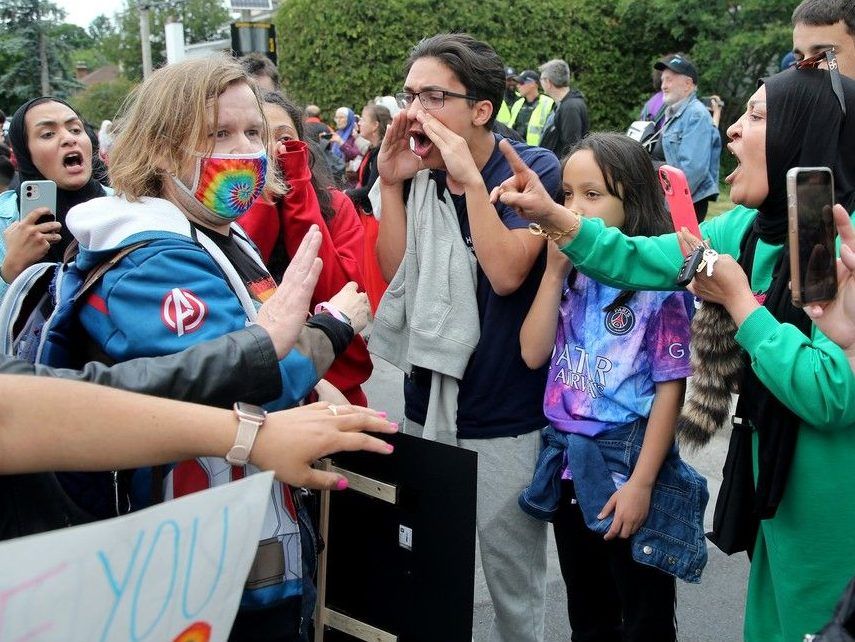
After a nearly year-long wait, Ottawa city councillors will now have a chance to debate the controversial “bubble bylaw” that aims to restrict protests near schools, hospitals, long-term care facilities and community health facilities.
According to a 39-page staff report, the bylaw would establish “safe access zones” around those facilities, which would extend 50 metres from walkways, doorways and driveways to those buildings
instead of the original 80 metres proposed last year.
Staff said the distance would still allow protesters to be heard while allowing people to access those facilities, while also preventing protesters from spilling into residential areas and impacting neighbouring communities. It is also consistent with restrictions in other municipalities like Toronto and Oakville, which passed similar bylaws in 2025.
The bylaw could also ban loudspeakers and other sound amplification devices, as well as pyrotechnics.
Facilities would have to apply for the safe-access zone status, which would be valid for a year with a chance to renew it. These designations would apply 24/7 to residential care facilities and to one hour before opening and closing at others. Staff said this regulation would provide more flexibility for demonstrations and didn’t interfere with public use of the facility.
Labour disputes and marches passing through one of these facilities would be exempt from the bylaw, staff said.
If passed by council, the bylaw will take effect on Aug. 1.
“The recommended by-law responds to council’s direction and is designed to prioritize safe access to vulnerable social infrastructure while ensuring that measures are proportionate and minimally impair fundamental freedoms, including freedom of expression, assembly, and association,” the report read.
Somerset Coun. Ariel Troster,
who voted for the motion with “extreme reservations,” previously expressed concerns over the potential for handing sweeping new powers to police or bylaw officers. She also cited landmark protests that advanced LBTQ2S+ causes, like the Stonewall riots in New York City in 1969, and said the act of protest was “not always convenient” and “not always quiet.”
“The purpose is to be disruptive and it is to make people listen,” Troster said after a committee meeting in May 2025. “And people do it when they’re desperate, when they don’t have any other place or any other way that they can make their voice heard.”
Community safety vs. right to protest
The staff report noted that the bubble bylaw came amid a rise in hate-motivated crimes, demonstrations and public perception of community safety.
Data from Statistics Canada suggests that the number of police-reported hate crimes has more than doubled in recent years, with 4,777 cases reported in 2023. Ontario ranked second among all provinces per capita with 15.6 incidents per 100,000 people. This was higher than the national average, which was 12 incidents per 100,000 people. Most police-reported hate crimes targeting a religion were directed at Jewish and Muslim populations.
Data from the Ottawa Police Service’s Community Safety Data Portal also suggests that police-reported hate crime incidents have increased since 2018. However, there was a four-per-cent year-over-year decrease in hate crime incidents reported in 2024: 467, down from 487 in 2023.
City staff said that any restrictions on protests must adhere to the Canadian Charter of Rights and Freedoms while balancing individual freedoms and community interests.
“These freedoms, however, are not unlimited … When municipalities regulate activities that may affect Charter rights, they must balance individual freedoms with broader community interests,” staff wrote in the report.
“The proposed by-law seeks to take a targeted and measured approach. It seeks to respect the right to protest while also addressing concerns about health, safety, and access to important community infrastructure and services.”
Knoxdale-Merivale Coun. Sean Devine, who voted against the motion last May,
previously told the Ottawa Citizen
that he wanted to defer the bubble bylaw development because he was concerned about serious infringements to freedom of expression, which would make the city prone to lawsuits and legal challenges.
His concerns aren’t unfounded. The Canadian Constitution Foundation
filed a legal challenge against the City of Calgary’s safe and inclusive access bylaw
, which was passed in March 14, 2023.
The case went before the Alberta Court of King’s Bench in late February 2026 and reignited a debate about freedom of expression and government overreach. Lawyers for the CCF argued that the bylaw violated fundamental freedoms guaranteed by the Charter and Alberta Bill of Rights while also chilling speech that criticizes government policies and decisions.
Federal legislation incoming
City of Ottawa staff also mentioned said they took into consideration potential provincial and federal legislation while drafting the bylaw, particularly Bill C-9.
The Combatting Hate Act,
which was tabled by Justice Minister Sean Fraser in September 2025, would make it a crime to intimidate someone to the point of blocking their access to a place of worship or another facility used by an identifiable group. It would also criminalize the act of promoting hate by displaying hate or terrorist symbols, like those tied to the Holocaust (swastikas, etc.) or a listed terrorist organization.
The bill has since moved to the Senate, where it passed first reading on March 26.
The City of Ottawa staff acknowledged that, while the federal bill isn’t legislation yet, Fraser had made clear that municipalities had roles to play in regulating activities on public land.
Other federal legislation cited in the city staff report included the Criminal Code, which includes provisions empowering police to respond to unlawful behaviours at protests and demonstrations.
The report also cited the province’s Community Safety and Policing Act, Keeping Ontario Open for Business Act, Trespass to Property Act and Bill 16.
What’s next?
The emergency preparedness and public works committees will meet at 9 a.m. on Friday, April 17, in council chambers to discuss the bylaw.
The 16 committee members were also asked to keep Monday, April 20, clear if needed.
If the bylaw is approved at the committee level, it will move to the city council meeting on April 22 for a final vote.
With files from Joanne Laucius and Christopher Nardi