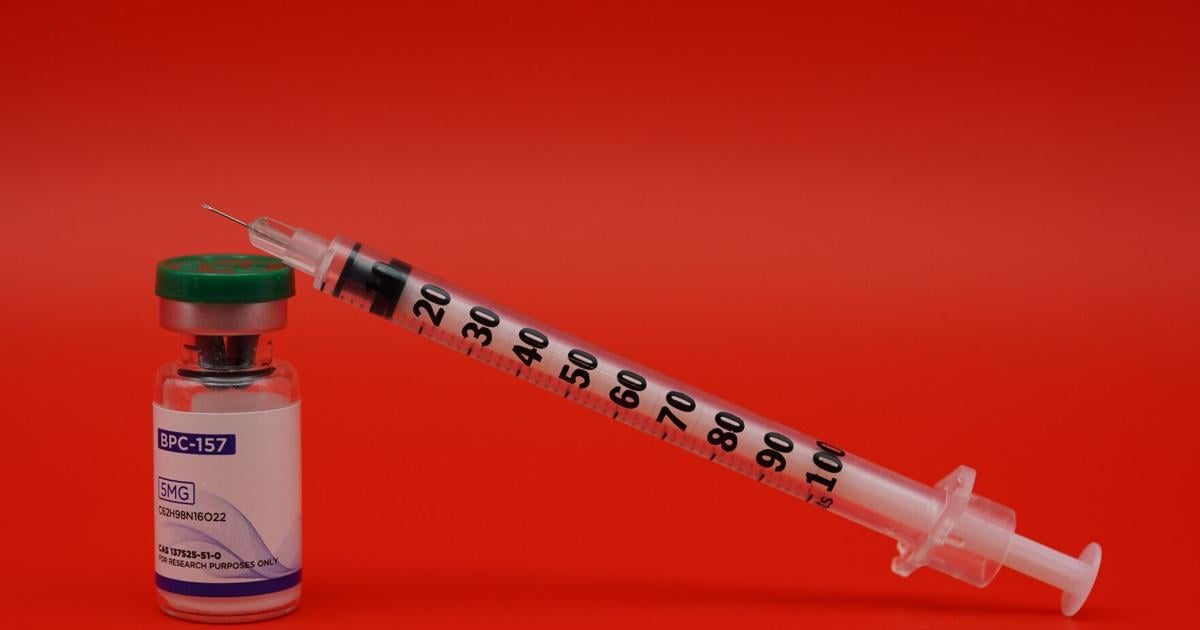
Josh Lundon’s hands shook as he readied the syringe. He’d never injected himself with anything before, much less the experimental peptide drugs he’d ordered online.
Weeks earlier, the 23-year-old Toronto student and AI entrepreneur began seeing posts online from influencers touting the many health benefits of peptides, from smoother skin to a clearer mind. Intrigued, Lundon began “doing a lot of research, going on Reddit.”
“Some people said they didn’t feel anything. Some people said it was amazing,” he told the Star. “I didn’t really know what to believe. So I was just like, ‘let me just try this myself.’”
But it felt a little different when he had the needle poised, loaded with experimental peptides he’d read could help with his sleep and anxiety problems. “I was all like, ‘Oh f—k, what am I doing to myself?’” he said. “But honestly, I got over the fear because I realized I’m, like, working with my biology.”
Experimental peptide drugs are all the rage online, endorsed by biohackers, fitness influencers and U.S. Secretary of Health Robert F. Kennedy Jr. It’s led a wave of people like Lundon to dose themselves with various peptides in pursuit of purported health and appearance benefits. But most of these drugs are not approved for human consumption by regulators, because we don’t fully understand what they’re doing to our bodies.
“The bottom line is, we simply don’t have the human data,” said Dr. Peter Wu, a physician with Toronto’s University Health Network specializing in pharmacology and toxicology. “We all want these things to work. But we also want to ensure that they’re studied properly so that we know exactly what works at which dose for how long, and what the long-term safety is.”
For that reason, it’s illegal to sell these drugs for human consumption in Canada. But that didn’t stop me — or plenty of other Canadian peptide users — from buying a vial online with shocking ease. In the back of my fridge, next to the eggs, sits a tiny glass vial labelled BPC-157. Below, in barely discernible font, are the words “for research purposes only.”
Here’s how I got my hands on it — and why drugs like it are in such high demand.
What are peptides?
Peptides are a huge group of biological molecules.
They are short chains of amino acids that can act as messengers in our body for various purposes. Some are approved for human use: Insulin is a peptide; it tells cells to start sucking up glucose, lowering our blood sugar. The peptide GLP-1 slows down how quickly our stomachs empty, leading us to feel full for longer.
That’s the technical definition. Today, the word “peptide” has come to describe experimental, grey market drugs that are often manufactured in China and peddled by websites claiming to sell them for research use. Some vendors combine peptides into compounds, branding them with names like “Glow Stack” or “Wolverine Stack.”
Why are peptides suddenly everywhere?
Influencers have portrayed peptides as something of a miracle cure. Scan through the nearly 300,000 TikTok posts tagged #peptide and you’ll be inundated by shirtless thirst traps touting benefits from shredded abs to clear skin, as well as videos explaining how to administer compounds like the “pretty boy peptide.”
“I’ve been taking peptides for three months now … I feel like I look like a completely different person,” TikTokker princesssliah says in a video with nearly 140,000 views. She adds that her skin “did a complete 180” and her psoriasis “completely cleared up.”
U.S. Health Secretary RFK Jr., who has promoted vaccine misinformation and other health conspiracy theories like HIV/AIDS denialism, has also jumped on the peptide bandwagon. In a Feb. 27 interview with podcaster Joe Rogan, who has admitted to using peptides himself, Kennedy said he wished to make 14 peptides banned by the FDA in 2023 “more accessible.”
But experts call this approach reckless, given we don’t have conclusive evidence that many peptides even work in humans.
“Neither Canada nor the U.S., and I could include the European Union in this as well, recognizes (these experimental peptides) as effective compounds or drugs that can do what anybody out there is saying they can do,” said Stuart Phillips, a professor of kinesiology at McMaster University. “There’s almost no human trials… So it’s completely through anecdote and self-experimentation that people have decided these things are in any way effective.”
“I am the lab rat”
The peptide craze underscores how many people have come to trust the opinions of influencers over health care practitioners, observed Kyle Ganson, an assistant professor at the University of Toronto researching youth mental health and the looksmaxxing phenomenon. “They see the anecdotal online evidence as more trustworthy, because people are speaking quite openly and honestly about their experiences online.”
Jay Campbell is one such peptide influencer. The U.S.-based biohacker, podcaster and author told the Star that injecting peptides has given him a “general sense of biological resilience that I can only describe as feeling younger than my chronological age.” He added that he’s experienced “dramatically accelerated recovery from training and injury, improvements in sleep quality, better body composition.”
Campbell co-founded BioLongevity Labs, which sells “research-grade peptides for laboratory applications” online. He acknowledged that many of these products haven’t undergone thorough human testing. But he believes his personal testing helps bridge the gap.
“I test everything on myself first. I document everything. I track my blood work obsessively. That’s the only way you can speak with real authority about these compounds,” he said. “I’m not sitting in an ivory tower citing studies I’ve never lived. I am the lab rat, and I wear that proudly.”
But while social media is flooded with positive accounts like Campbell’s, there’s a big difference between anecdotal evidence and the years of clinical trials medications must go through before approval, Wu noted.
Peptides may be effective for some. But what works for one person might not for another. And a drug that you tolerate fine might cause a serious adverse reaction for me.
That’s not to mention the risks of infection or injury from an injection gone wrong, or the potential for contaminants in the product. “What if there’s something that is an allergic compound or harmful compound or a toxic compound?” Wu said. “You have no idea if they’re contaminated, because these are unregulated.”
How are people getting peptides in Canada?
While experimental peptide drugs are not approved for human use, you can easily purchase them online from numerous companies and Canadian compounding facilities creating and selling the drugs “for research use only.”
Health Canada cracked down on this last year, seizing 42 “unauthorized injectable peptide drugs” sold by the company Canada Peptide.
“Selling unauthorized drugs is illegal in Canada,” Health Canada said in a public advisory that warned their usage could cause “infection, allergic reactions, and other poor outcomes,” contain “high-risk ingredients, additives, or contaminants” and potentially interact with other medications.
The BPC-157 chilling in my fridge is one of the drugs Health Canada seized from Canada Peptide.
Like so many biohackers before me, I began by doing my own research on Reddit and stumbled upon a thread recommending a supposedly Toronto-based company called “Growth Guys.” The site claimed BPC-157 could help activate “cells involved in tissue repair, including muscles, tendons, ligaments and the gastrointestinal tract, stimulating the synthesis of growth factors, and inhibiting inflammation.” It featured a third-party lab report, claiming the compound was 99.88 per cent pure.
I paid $40 for a 5 milligram vial, enough for about 10 bi- or triweekly injections. Canada Post delivered the glass bottle in two days. There was no verification process to ensure I was a researcher; I didn’t even have to check any boxes. It was as easy as ordering from Amazon.
I reached out to Growth Guys for comment, as well as other Canadian vendors like ReVICO Labs and Canada Peptide, but none of them responded. A few days after my email, I noticed the Growth Guys website had moved to an Icelandic domain.
Do peptides actually work — and are they safe?
Lundon ordered his peptides, Semax and Selank, the same way but from a different vendor. By his third dose, he said he began noticing improvements to his sleep. After three weeks of daily injections, he felt he could better focus, remain calm and retain information. He said he hasn’t experienced side effects so far.
It may have worked out for Lundon. But there have been serious injuries related to peptides. Last year, two women became critically ill after taking peptide injections offered at a Las Vegas anti-aging festival — although an investigation was unable to conclude whether the women were reacting to the peptides themselves or if the injections were contaminated.
And that’s the other big concern. Because the products are unregulated, peptide users don’t truly know what they’re injecting into themselves.
“What’s happening now is like a large-scale, open-label, public human trial that’s being done on these drugs, the long-term consequences of which we don’t know,” noted Phillips “That doesn’t smell or look anything like the regulatory process that we have that governs the approval of drugs, and that makes me highly skeptical.”