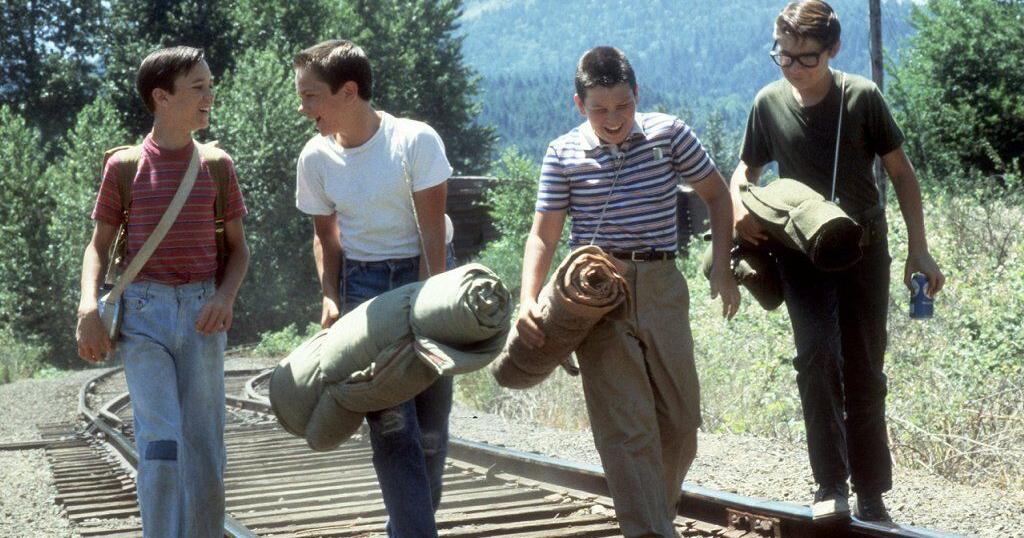
Stephen King’s 1982 novella “The Body” is a shivery, elusive account of four preteen boys who set out into the woods beyond their hometown in search of a fifth: a missing classmate, whose corpse, rumoured to already have been discovered by a group of hooligans, becomes a strange sort of holy grail. The body of poor, disappeared Ray Brower — last seen picking blueberries in his Keds in the vicinity of Castle Rock — provides King’s story with both its title and a morbid, evocative emblem of childhood’s end; while not explicitly a campfire tale, “The Body” is frightening stuff.
By the early 1980s, Stephen King movie and TV adaptations had become a cottage industry, the purview of brand-name genre specialists like John Carpenter, David Cronenberg and Tobe Hooper. (Not to mention Stanley Kubrick, whose version of “The Shining” appalled the author due to the liberties it took with his text.)
When Rob Reiner decided to turn “The Body” into a film, he was coming at it from a different angle. He recognized the story’s potential for something other than scare tactics. Reiner was an entertainer with a knack for reaching a broad audience. As if to put a fine point on his crowd-pleasing sensibility, he ultimately swapped out King’s ominous title for the name of a vintage Billboard Top 5 hit by a singer who shared the author’s surname: Ben E. King’s “Stand by Me.”
Sticklers for accuracy noted that “Stand by Me,” which was released in 1961, did not belong in a story set in 1959. Still, the song vibrated on a deeper frequency: why worry about a minor anachronism when the goal is to make something timeless? “Stand by Me” is a Brill Building classic that combines soul, gospel and doo-wop; the lyrics describe loyalty and courage in the face of chaos. The stalwart message synced brilliantly to a coming-of-age narrative whose heroes have one another’s backs at all times.
“Stand by Me” is a song about the things that endure. “Stand by Me” is a movie that has stood the test of time. Though it was successful, the film was neither a blockbuster nor an Oscar magnet (its only nomination: best adapted screenplay, which it lost). Still, “Stand by Me” has come to be acclaimed as a modern classic — a film to be passed down from parents to children.
Because “The Body” was written with a framing device, it reads partially as an exercise in nostalgia — an attempt to mythologize the America of the 1950s from a safe distance. Forty years later, though, the movie’s vision of kids wandering around, left to their own devices — and without any literal devices — feels like a transmission from a lost civilization, even as the filmmaking retains its immediacy.
There’s a certain morbid poetry to the fact that the 40th-anniversary theatrical re-release of “Stand by Me” (opening at select Cineplex theatres on March 27) is happening in the shadow of the tragic deaths last December of Reiner and his wife, Michele. The timing is bittersweet; it places the film’s anguished preoccupation with mortality — and the tragic, blindsiding, inescapable nature of death — in even more acute and aching relief.
“People have their favourites — the cliché, ‘We love all our children, even the bad ones,’” Reiner said when asked which of his own movies he liked best. “But I always say ‘Stand by Me,’ to me, is the one that meant the most to me.”
Reiner had his reasons for identifying so deeply with “Stand by Me,” and also for keeping the focus of the story — via the skilfully adapted script by Raynold Gideon and Bruce A. Evans — on Gordie Lachance, the aspiring writer played by Wil Wheaton. In interviews, Reiner said he used a movie set in a world of adolescents to work through his own complicated feelings about his father, the legendary comedian Carl Reiner.
“In the book, it was about four boys,” Reiner told The Guardian. “This movie was all about a kid who didn’t feel good about himself and whose father didn’t love him … and through the experience of going to find the dead body and his friendship with these boys, he began to feel empowered and went on to become a very successful writer. He basically became Stephen King.”
King has always been good at writing kids and teenagers: he’s terrific at evoking the contradictory impulses (and desires) careening through the chasm between innocence and experience. But while the characters in “The Body” are vivid, Reiner’s casting brings them indelibly into three dimensions.
Each lead performance is perfectly calibrated: Wheaton’s mournful shyness as Gordie, who’s grieving the death of his older brother; Corey Feldman’s bristling charisma as Teddy, broken but unbowed by his father’s brutal abuse; Jerry O’Connell’s soft-bodied neediness as Vern, who just wants to be included. Most extraordinary of all: River Phoenix’s haunted decency as Chris, the group’s leader and oldest soul. The cumulative effect of their acting together is musical: boasting and posturing, laughing and bickering — they’re like a well-conducted string quartet.
“Stand by Me” is a sentimental movie, but it’s not a benign one: it’s got a naughty streak after King’s own. Reiner curates the inventory of four-letter words and dirty jokes with aplomb. His comic chops are on display in the heroically disgusting vignette — narrated by Gordie to his pals to stave off boredom — about a pie-eating contest gone horribly wrong. (Cronenberg probably couldn’t have done this part better; ditto Monty Python.)
When it comes time to dial up the menace, the film gets genuinely pressurized and unsettling. The final beat lands like a gut punch without hitting below the belt. “I never had any friends later on like the ones I had when I was 12,” observes the adult Gordie as he brings “Stand by Me” to an end in the present tense.
Reiner’s film inhabits the sadness of that statement, and the gratitude as well.