

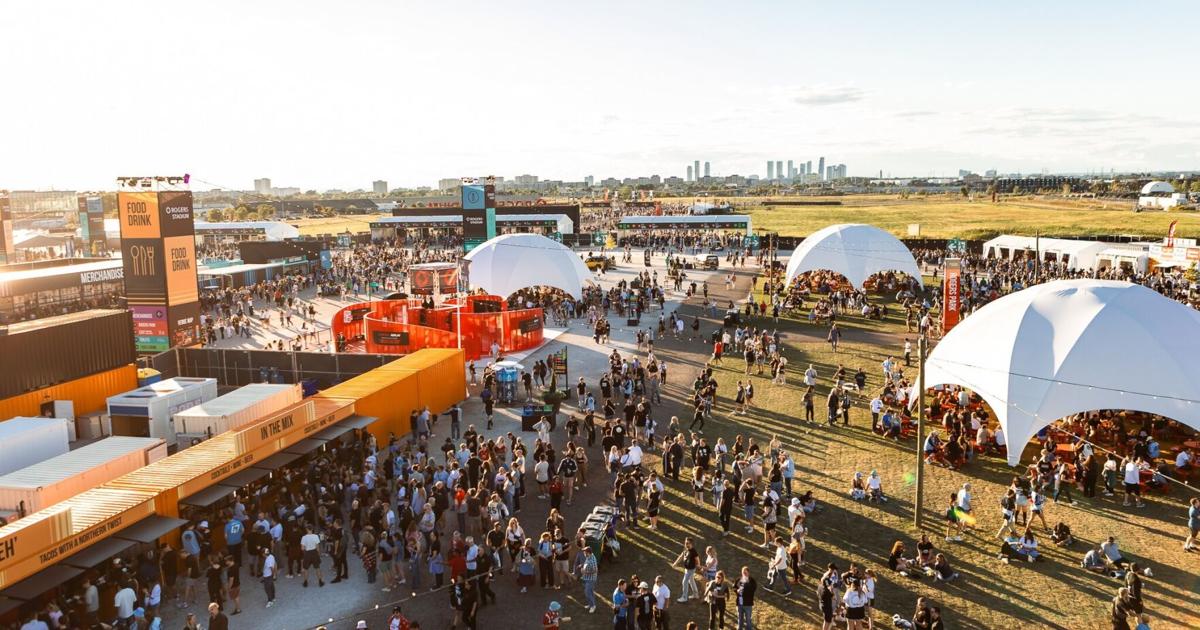
The Rogers Stadium on the former Downsview Airport Lands has been called “bizarre” and “a weird venue in the middle of nowhere.”
Despite the criticism, a new report says the 50,000-seat outdoor venue contributed more than $500 million in economic activity during its inaugural season over 14 nights last year, which included concerts by global megastars Coldplay and Oasis.
The report comes in advance of the stadium’s first concert next month and after a litany of criticism that followed last year’s season.
“We wanted to make sure, more broadly, that the benefits are understood as well as some of the challenges,” said Wayne Zronik, president of business operations for Live Nation Canada, explaining why his company commissioned the report on the temporary stadium, which will operate for a total of five years.
“Because while we have great traffic management plans and noise mitigation plans…regardless of what we do, putting 50,000 people anywhere will be somewhat disruptive to the community,” said Zronik.
The report, by consulting firm Nordicity and commissioned by stadium operator Live Nation, estimates the venue contributed $388 million in GDP, which refers to the total value of goods and services added to the economy as a result of event-related spending, including construction.
Another $115 million went to federal and provincial tax coffers, raised through tax on items such as ticket sales, tourism spending, corporate taxes, property tax, and even personal taxes paid for jobs generated by the stadium.
Markus Giesler, a professor of marketing at the Schulich School of Business at York University, said the report is a pretty standard approach to an economic feasibility study “that is supposed to demonstrate the benefit and the value of the stadium” to the public as well as policy makers.
But Giesler said the true economic impact of the stadium won’t be known for three to five years.
Last year, complaints from fans included grumbling about the long walk to the venue from public transit; that it took two hours to exit the stadium and that transit services couldn’t handle the crowds. Residents were unhappy that the music could be heard from miles away and some felt trapped by numerous road closures in place for Coldplay.
Next month, Bruno Mars’s sold-out show will kick off the 2026 season, which includes 20 concerts — six more than last year.
James Pasternak, city councillor for York Centre, the riding where the stadium is located, said he knows the venue has its detractors “as noise levels and traffic has been a major problem.” Pasternak said in an email that the city is working with all stakeholders to address the problems.
For the upcoming concerts, Zronik said Live Nation is adding more noise mitigation measures, more access points to the site, and marked routes through neighbourhoods to reduce congestion. The stadium will also have more shade structures and other site improvements.
“We continue to try every day to make the experience better for fans and artists when they come to the stadium,” said Zronik.
The TTC, which added extra subway service last year, said it is working with Live Nation to “determine what this year’s service will look like,” and will announce its plans when they are firmed up.
While Pasternak acknowledged the stadium’s faults, he also praised it, noting that the 700,000 people who attended concerts — the majority of which were from outside Toronto, according to Live Nation data provided to Nordicity — “stayed in local hotels and ate locally,” with nearby restaurants seeing an uptick in business.
Pasternak said the venue also employed about 1,000 part-time employees and that Live Nation has supported music programs in local schools.
The downside for Pasternak was that “much of the sales tax revenue goes to the other levels of governments.”
The report by Nordicity used the postal codes of anonymized ticket buyers, provided by Live Nation, to establish how many patrons from outside Toronto attended the stadium. Based on that information, Nordicity incorporated costs, such as a night at a hotel, as well as spending patterns of tourists based on a model used by the Ministry of Tourism, Culture and Gaming, into the GDP estimate.
The GDP estimate also includes nearly $100 million generated from the construction of the stadium, which was partially dismantled at the end of the 2025 season.
Giesler noted that if the the GDP related to construction is taken out of the calculation, the overall GDP number goes down quite substantially. The report isn’t “totally inflated,” said Giesler, “but it’s a little bit, I would say, on the optimistic side.”
Live Nation said the stadium is on track to reopen prior to the first of Bruno Mars’ sold out shows on May 23.
Andrew Weir, the president and CEO of Destination Toronto said he wasn’t surprised by the numbers in the report.
“We’ve seen consistently, over the last number of years, that the way visitors are choosing destinations and experiencing cities now is more based on events than it’s ever been before,” said Weir.
In comparison, Destination Toronto estimated that Taylor Swift’s six Eras Tour concerts in November of 2024 generated $282 million in overall economic impact.

