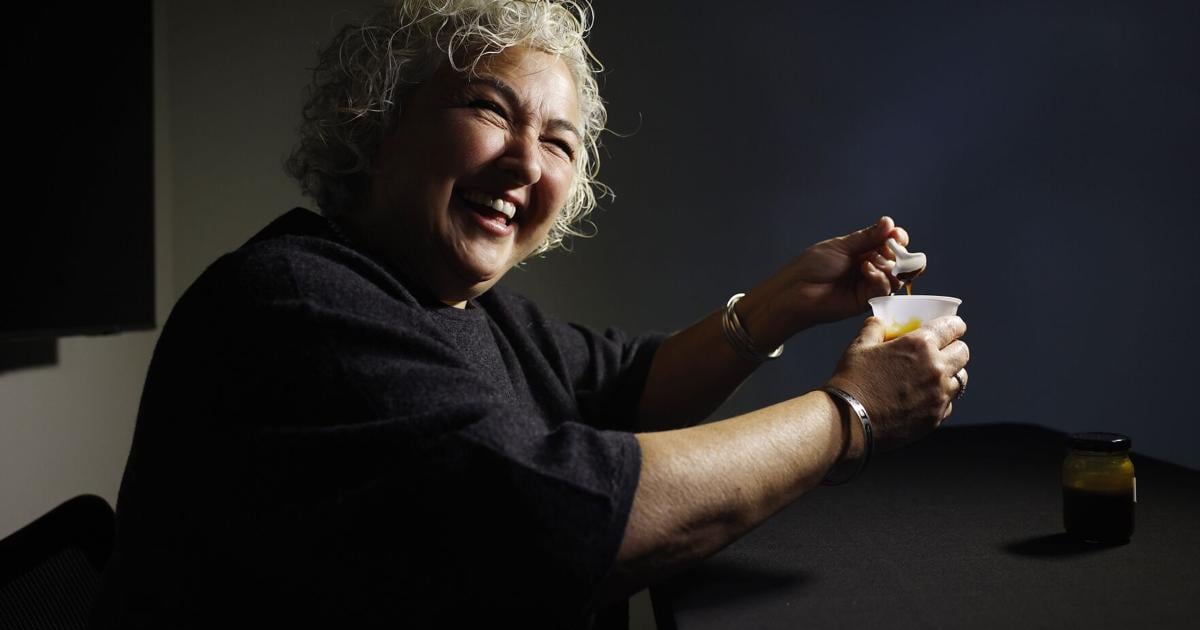
Elspeth Copeland examined the cherries, licked them, chewed them, then spit them into a paper cup, while we watched. After a few minutes, she delivered her verdict.
“I think they’ve been abused,” she said.
In food manufacturing, there are some mysteries that can only be solved by tasting. And there are some people who can taste better than almost anyone. Copeland is one of those people, a sort of independent professional taster. She’s in high demand among major food companies in Canada and the U.S., because she can identify what’s going wrong in their factory, or their supply chain, or their formula, just by trying the product.
After about 16 years at Canadian grocery giant Loblaw Companies, where she developed products for the chain’s President’s Choice brand, Copeland went out on her own as a consultant. Now companies bring her in when they need help getting a new product to market, or they need to figure out why an existing product doesn’t taste the way it should.
One morning in August, she brought me to Chudleigh’s bakery in Milton, Ont., northwest of Toronto, where she was tasting samples of cherries, among other things. The team of product developers in the test kitchen was suspicious of one cherry sample in particular, because there was a texture they couldn’t quite place, something slightly grainy on the skin. The developers worried that the supplier was adding a secret coating, maybe some combination of sugar and citric acid, presumably to mask imperfections in the crop.
Around Toronto, Chudleigh’s is mostly known for its interactive farm, where families go to pick their own apples. But quietly, Chudleigh’s has also become a serious player in the North American food business. Five minutes from the farm, the company runs a 110,000-sq.-ft. production facility that makes pies, cakes and pastries for top supermarket chains in the U.S. and Canada.
This summer, the bakery had to find a new cherry source because its existing supplier had growing issues. The product development team gathered samples and was trying to pick a winner. They set out three different dishes for Copeland to try. One sample was labelled W, because those cherries came in a white box, another B, because they came in a brown box.
Copeland pointed at the little dots on one of the cherries, which the developers thought could be sugar. But Copeland was skeptical. It just didn’t make sense that a supplier would take on the added cost, and risk, of adding something to their product without putting it on the label.
“I think it could be freeze-thaw,” she said.
When fruit freezes, then thaws, then freezes again, the texture degrades. So she thought the salesperson might have just left the sample cherries in the car too long.
It was a surprising discovery, because to me, they all tasted like cherries. Copeland, however, could taste enough to come up with theories about the cherries’ backstory. She either had a supernatural ability, or was putting me on. But after spending months following her around, I learned the real reason she can taste things other people can’t.
Copeland has a standing arrangement with Chudleigh’s, where she visits the test kitchen twice a month to help the young product developers with new projects.
One developer presented Copeland with a fried, stuffed pastry. Copeland tasted it then spit it into a paper cup. The spit cup is a common tool in test kitchens. Most people at the bakery were using one, all in more or less the same way, never looking at the cup, always fixated on the product on the table, as if deep in thought, as if the spitting wasn’t really happening. And when they weren’t using it, they must have held it in a special way that covered the top, because I never got a glimpse of the rejected food inside, not once.
I tasted everything Copeland tasted that morning, and I couldn’t bring myself to spit. I just swallowed. But by the end, I understood the importance of the cup.
“What temperature was it at?” Copeland said, inquiring about the oil that was used to fry the pastry.
It was 350 degrees Fahrenheit.
“It should be higher,” Copeland said. That way, less oil would soak into the dough.
“I would check your oil,” she continued. “Is it fresh? It doesn’t taste fresh.”
Throughout the morning, Copeland tasted about 10 products, plus the cherries. One tart needed 20 to 25 per cent less fruit. Another dish needed about 0.5 per cent more salt. There was a green onion note in a savory pastry that was coming on too strong.
When I heard that, I panicked. I couldn’t taste any onion. I closed my eyes tight and searched around for it, almost begging the onion to appear on my tongue, but nothing. I worried my mouth was broken. Each time, I’d listen to Copeland detect imperfections and prescribe remedies for something, then I’d taste it and think: “Oh my, this is very nice.”
“That’s the tricky thing,” she said later.
As one manufacturing executive told me recently, it’s easy to cook something nice in a test kitchen. The tough part is producing the same dish at a commercial scale. According to the executive, it’s the difference between painting the Mona Lisa and reproducing 100,000 Mona Lisa prints. Something is bound to go wrong. Nuances get lost. Textures change. And while most people can taste the new version and know it’s worse, almost nobody can accurately describe why. That is where Copeland comes in.
One day we went to visit Mildred’s Temple Kitchen, a popular Toronto brunch spot that now sells its own brand of pancake mix and syrup. Copeland was helping them develop a line of spreads, including apple butter, based off recipes from the restaurant.
Sitting at a table near the back of the restaurant, she tasted a spoonful of the apple butter.
“It is very gingery,” Copeland told the chef and owner, Donna Dooher.
After some discussion, Dooher turned to me.
“Let’s ask Jake,” she said.
I froze. I wasn’t getting any ginger. It was like they’d said there was a fire alarm going off, and I couldn’t hear anything.
“I think it tastes lovely,” I said.
Afterwards, Copeland told me to go home and get a jar of ground ginger.
“Smell it, carefully,” she said. “The best way to smell dry things like that is to hold it far away and just bring it closer.”
Next, I was to dab a little ground ginger on my hand and taste it, then drink some water, take a break and go back to the apple butter.
At home, I followed the instructions exactly, but when I tried the apple butter, the same panic washed over me. The ginger wasn’t there.
“Damn it,” I said.
Then, all of a sudden, a flash of ginger sparked on the tip of my tongue.
Until that point, I’d thought Copeland had some sort of inexplicable, God-given talent. Once, at her kitchen counter, I watched her conduct a “blind triangle” taste test where she was able to detect a difference between two batches of lime-flavoured sparkling water that were made by the same facility, only at different times. It seemed like a magic trick.
After the ginger experiment, I realized what was really going on. I had just uploaded a single taste profile into my head. Copeland had built an entire library.
I asked her if that highly technical method of tasting and dissecting food ever starts to take the joy out of eating.
“When I’m having a meal out, I don’t really dig down,” she said. “Sometimes I’ll be with someone and they’ll be like, ‘I taste something. Do you think it’s turmeric?’ And I’m like, ‘I’m just enjoying my meal.’”
It didn’t take long for me to realize how ridiculous my question had been. Of course she was having fun. It was a warm day and we were on the patio at one of her favourite coffee shops. She still made a point of going inside, just to have a peek at the pastry case. Another day, she was making a special trip to a west-end chocolate shop that carried a very rare type of vanilla.
Her kitchen is a calm place, where nothing looks like it’s been crammed to fit in a drawer. Her baking dishes are stacked neatly on a shelf. She has a cutting board designated solely for fruit and sweets, so she never gets a hint of garlic in her watermelon. Her postal carrier is on a first-name basis with her dog, Lucy, because so many companies send samples to her house for Copeland to taste. She goes to New York and Paris and Mexico City for research. I talked to her clients and one made a point of bringing up her laugh, how it draws in her whole face.
If this woman isn’t finding joy in food, who is?
There was a moment in the test kitchen at Chudleigh’s in August, when a young product developer stepped forward to present an egg custard dish she’d been working on. Copeland had seen it several times before. The first time, it was grey. But the developer had since gone through more than 25 iterations.
Now it was butter yellow and didn’t run when she cut into it, just a perfect, jiggly slice. Copeland was so happy for the developer she gasped.