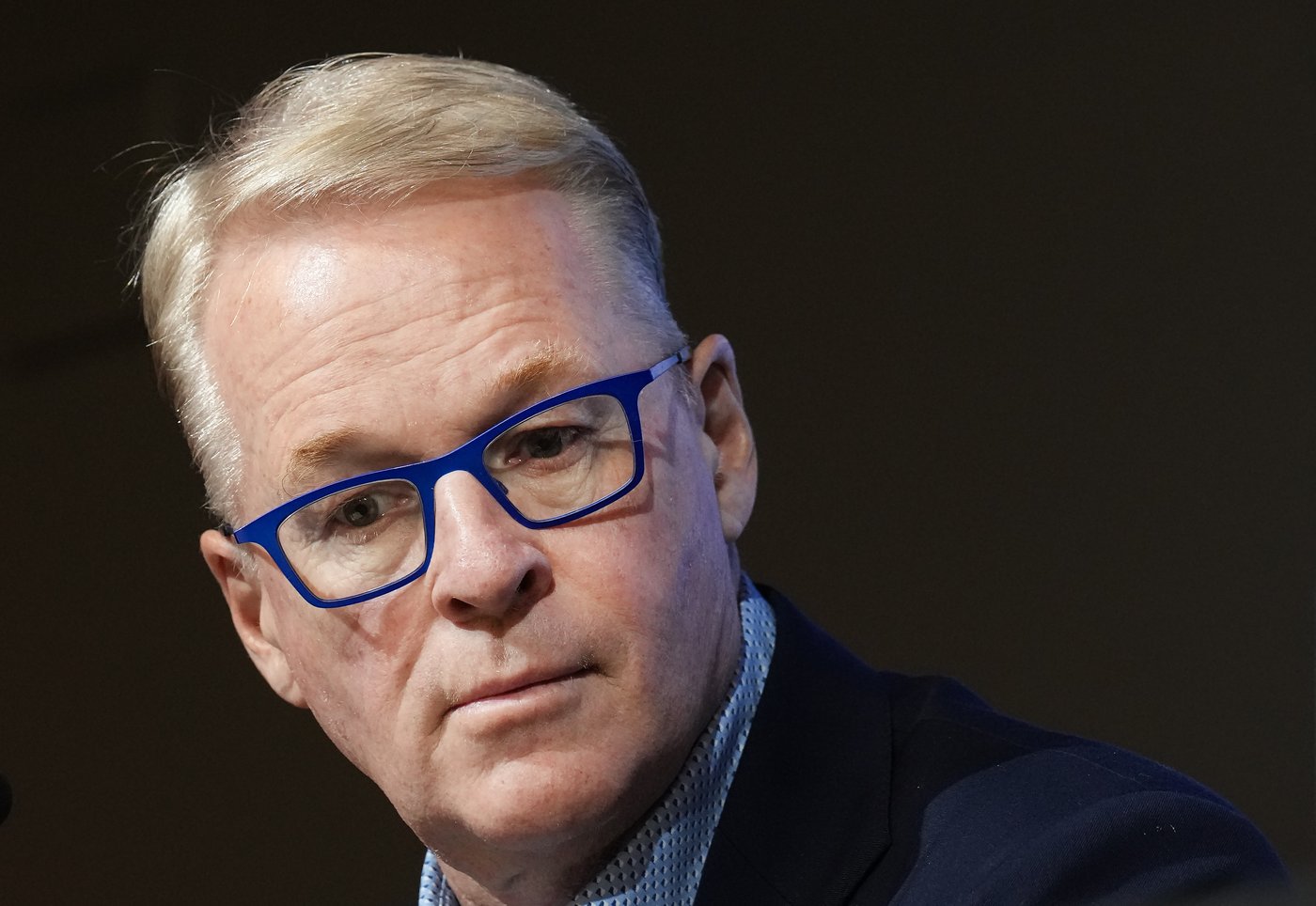
Stephen Lewis, a longtime politician and diplomat who rose to prominence as leader of the Ontario NDP in the 1970s and became known for his passionate oratory, commitment to social justice and the fight against AIDS, has died at 88 after a lengthy battle with cancer.
His death comes just two days after his son Avi, a filmmaker and activist, was elected leader of the federal NDP, extending the Lewis family’s legacy in the New Democratic Party.
The elder Lewis’s fiery advocacy for issues like rent control, workers’ health and safety and the environment helped the NDP rise to official opposition status for Ontario in the 1970s. He went on to become a major human rights advocate, representing Canada at the United Nations before desperately urging the Western world to take action as the UN’s special envoy for HIV/AIDS in Africa.
He was known as a great orator who delivered memorable speeches largely off the cuff, with just a few notes to spark his thoughts.
“In the early hours of this morning, Stephen Lewis died peacefully in Toronto while under hospice care. His loving wife Michele Landsberg, daughters Ilana and Jenny and his sister Janet were with him until the end,” the New Democratic Party said in a statement Tuesday.
“Stephen spent the last eight years of his life battling cancer with the same indomitable energy he brought to his lifelong work: the unending struggle for justice and dignity for every human life. The world has lost a voice of unmatched eloquence and integrity.”
The party said Avi will be “travelling to Toronto to be with his family and asks for patience and grace in this difficult time.”
In his victory speech Sunday, Avi said his father, “ever the political fanatic,” had “demanded daily updates” about his campaign from his hospital bed, despite “not doing too well.”
Award-winning author Naomi Klein, Avi’s wife, said on Saturday that “contrary to the opinion of a very long line of doctors, Stephen Lewis was not going to miss this weekend for the world.”
The recipient of dozens of honorary degrees, Stephen Lewis served as a distinguished visiting professor at what was then Ryerson University before recently being renamed Toronto Metropolitan University. Lewis liked to joke that all of his university degrees were honorary, and that he dropped out of law school twice.
“I was a terrible student,” he told the Hamilton Spectator in 2021 after he donated his archives to McMaster University in Hamilton.
He spoke with the newspaper after he announced he was diagnosed with inoperable stomach cancer, but he refused to be depressed.
“I’m struggling,” he said. “But I’m still here. It hasn’t got hold of me yet.”
Instead, Lewis said he was thrilled his archives would sit alongside those of Hamilton’s powerful unions, including CUPE and the Steelworkers.
“I’m as tickled as I can be,” he said. “I’m palpitating with joy.”
Born in Ottawa on Armistice Day, Nov. 11, 1937, Stephen Henry Lewis was given the Hebrew name “Sholem” for “peace.”
His father, David Lewis, was national secretary of the Co-operative Commonwealth Federation (CCF), the predecessor to the NDP. His grandfather, Moishe Lewis, was an activist in the Jewish Bund in Russia and the Jewish Labour Committee in Montreal.
Lewis was married to journalist Michele Landsberg, a longtime Star columnist. The couple had three children, including Avi.
Lewis’s family moved to Toronto in 1950, and he attended Oakwood Collegiate Institute and Harbord Collegiate Institute, and then the University of Toronto, where he was part of the Hart House debating committee.
A high point there was when he debated John F. Kennedy, soon to be the American president. What happened next was the stuff of legend, son Avi told the Star’s Mitch Potter.
“It was the fall of 1957, and my dad, then a student leader, had just turned 20,” he recalled. “The topic was: ‘Has the United States failed in its responsibilities as a world leader?’”
Kennedy, then a Massachusetts senator, had the role of defending American policy. “…Everyone knew he was being groomed for the presidency,” said Avi.
“My dad was on the other side. At one point, according to legend, he went after Kennedy and summed up America’s emerging nuclear policy of mutually assured destruction by singing ‘Que Sera Sera.’
“It was audacious and brilliant, by all accounts. And sitting in this room now, I can just hear it.”
The elder Lewis wasn’t overly keen on university life and didn’t write his final exams at the University of Toronto. Instead, he headed to Africa, where he taught in Ghana and Nigeria before travelling and eventually landing in a Sudanese jail.
“I was imprisoned in Sudan for being a ‘colonial infiltrator.” he told the Spectator in 2021. “I was terrified. But on day four they offered me a Coca-Cola and I knew they were going to let me go.”
At the urging of federal NDP Leader Tommy Douglas, Lewis entered Ontario politics in 1963 at age 26. He was re-elected four times in his Scarborough West riding.
In 1970, he became leader of the Ontario NDP at 33. Lewis pushed for rent control and workplace safety and urged Ontario Premier Bill Davis to create the Royal Commission on Health and Safety of Workers in Mines, which ultimately led to the creation of the Occupational Health and Safety Act in 1979.
He was leader of the official opposition in 1975, but stepped down and retired from electoral politics after the party lost that status in 1977 to the Liberals.
At Queen’s Park, current Ontario NDP Leader Marit Stiles spoke movingly about “a friend and a mentor … and a sounding board” who was generous with his advice.
One of the last times Stiles said she spoke to Lewis was in the final days of the February 2025 election. “I remember he talked to me about what it would be like to be waiting for the results to come in on election night and … how to frame my response no matter what those results were — and how people would be looking to me and my party to show them the way forward no matter what the results were,” Stiles told reporters.
“I’m just very glad that he got to see, I hope, his son step into the leadership role in the national NDP.”
Lewis didn’t stop his public work after leaving elected politics.
In 1984, he was appointed, to great surprise, as Canada’s ambassador to the United Nations by Prime Minister Brian Mulroney, a Progressive Conservative.
At the UN, he spoke out against South Africa’s apartheid system, helped develop the first comprehensive policy on global warming, and pushed for economic support for African nations.
He dedicated much of his later life to urging international action against the AIDS epidemic, co-founding two foundations to tackle the issue.
Witnessing widespread death at the hands of the crisis left him “ricocheting between hope and despair,” he told the Star’s Oakland Ross in October 2005, just months before his term as the UN’s special envoy on the issue ended.
“I cannot expunge from my mind the heartless indifference, the criminal neglect of the last decade,” he said in a searing Toronto Massey Lecture speech that month.
Lewis, an Order of Canada recipient, “moved millions with his appeals for a compassionate and just society,” Prime Minister Mark Carney said in his condolences Tuesday.
His influence on his son Avi was also undeniable.
In a 2021 interview with the Star, Avi grew emotional when discussing how his decision to enter politics as an NDP candidate for Parliament dovetailed with a recurrence of his father’s cancer.
“My first thought was that I shouldn’t do it,” said Avi, before learning that his decision brought a “tremendous amount of joy” to his dad.
On Sunday, Avi vowed to continue his father’s legacy as he promised a revival for the battered NDP.
“At age 88, (dad) is more passionate about the promise of democratic socialism than he has ever been in his life,” Avi said to the party faithful in Winnipeg.
“But he told me something kind of heartbreaking that David, his father, said to him once. David said, ‘Son, not in my lifetime, but maybe in yours.’ And recently, my dad told me the same thing, ‘Not in my lifetime, maybe in yours.’”
“Well, dad, I refuse to tell that to my kid. We cannot wait another generation. We’ve got to start winning now.”
With files from Robert Benzie and Raisa Patel.
Error! Sorry, there was an error processing your request.
There was a problem with the recaptcha. Please try again.
You may unsubscribe at any time. By signing up, you agree to our terms of use and privacy policy. This site is protected by reCAPTCHA and the Google privacy policy and terms of service apply.
Want more of the latest from us? Sign up for more at our newsletter page.