

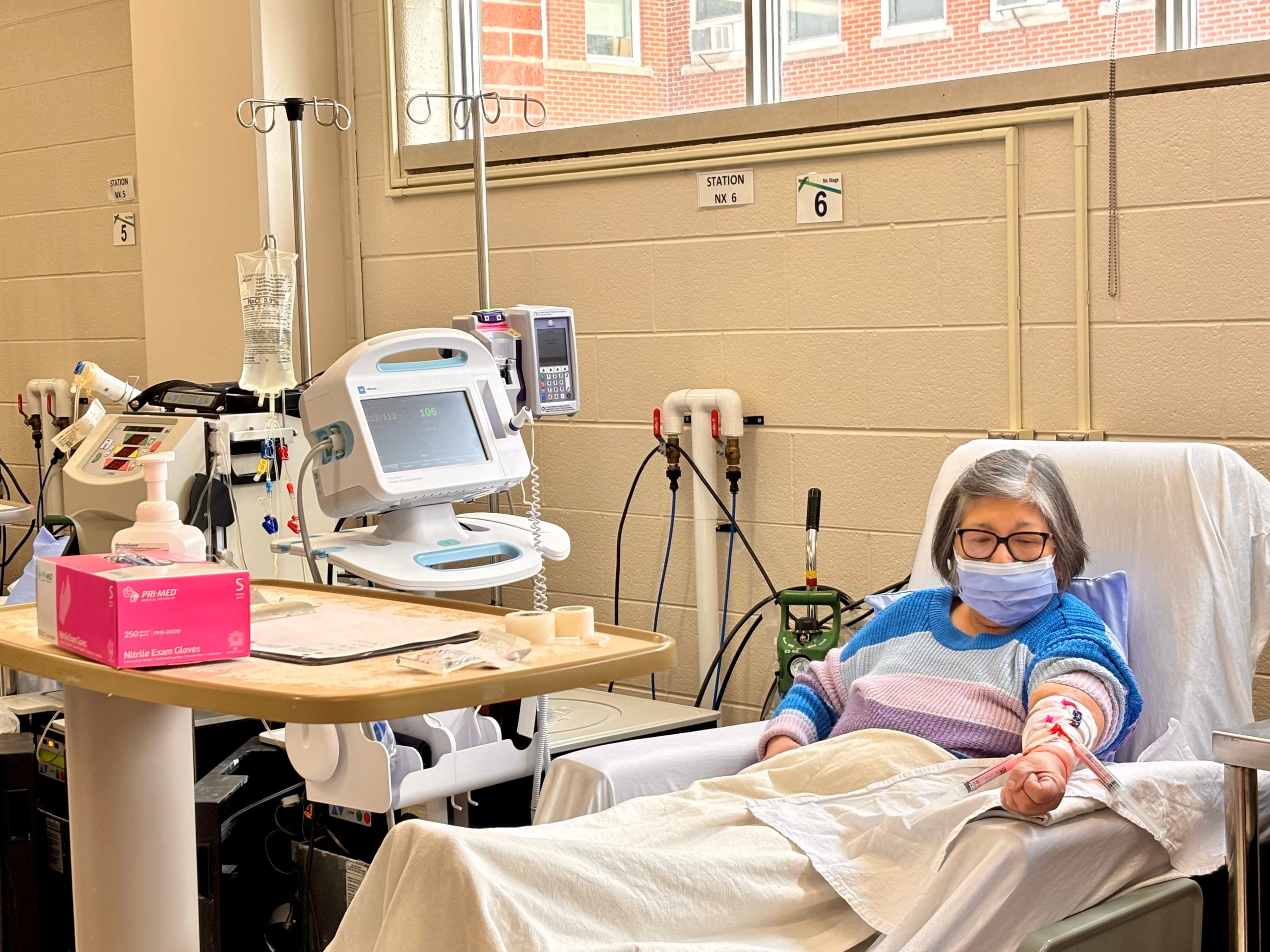
Living in Oshawa, 69-year-old retiree Wenida Dimaculangan spends almost an hour travelling to Scarborough for her hemodialysis appointment three times a week.
The procedure includes being hooked up with tubes to clean out toxins from her blood, a procedure that takes three hours per session.
“The thing is, sometimes I still feel the needle inside,” says Dimaculangan.
This has been Dimaculangan’s routine since 2019, just two years after being diagnosed with end-stage kidney disease.
Although patients living with kidney disease may have the option for a transplant, it’s different for Dimaculangan’s case.
“I have a problem with my heart,” she says. “I have irregularities, that’s why I can’t get a transplant.”
Dimaculangan, who is from the Philippines, has lived in Canada for more than 30 years. She says she doesn’t have any other medical history aside from chronic hypertension.
Dimaculangan is among thousands of patients being treated in Scarborough General Hospital’s Hemodialysis Unit.
Most of them are from immigrant communities.
It’s an observation that led Scarborough Health Network Nephrologist Dr. Tabo Sikaneta to study kidney disease disparities, focusing on the risk among immigrants receiving care in Scarborough.
“What I found was that there were certain groups, sub-sections, that were overly represented. Scarborough is very diverse,” said Dr. Tabo Sikaneta.
“This information tells me these are people at the end of the road in terms of needing dialysis … Their kidneys are not going to recover, and at the other end of the road, the community, the people who don’t yet know they have kidney disease, have not yet been screened, need to be screened.”
In the study, Dr. Sikaneta found that country of birth is a stronger predictor of kidney disease risk than ethnicity alone. Residents from the Caribbean, Sri Lanka, and the Philippines are six to 12 times more at risk of the disease. The reason remains undetermined.
“It’s not one explanation for all the groups that have increased risks, but it’s likely a combination of environmental factors, like diets, do they see their doctors, do they trust their doctors, do they take their medications? Biological factors play a role as well,” says Dr. Sikaneta.
According to Dr. Sikaneta, ongoing research could serve as a foundation for early screening initiatives, particularly for specific demographics, to help prevent and delay kidney problems.
“There are treatments now, regardless of the why, the specifics of the disease, there are many conditions that give you kidney problems that could be treated, so if we catch them early enough.”
As for Dimaculangan, she says she continues to hope her heart condition improves soon, and that she can be put on the waitlist to receive her needed kidney transplant.

