

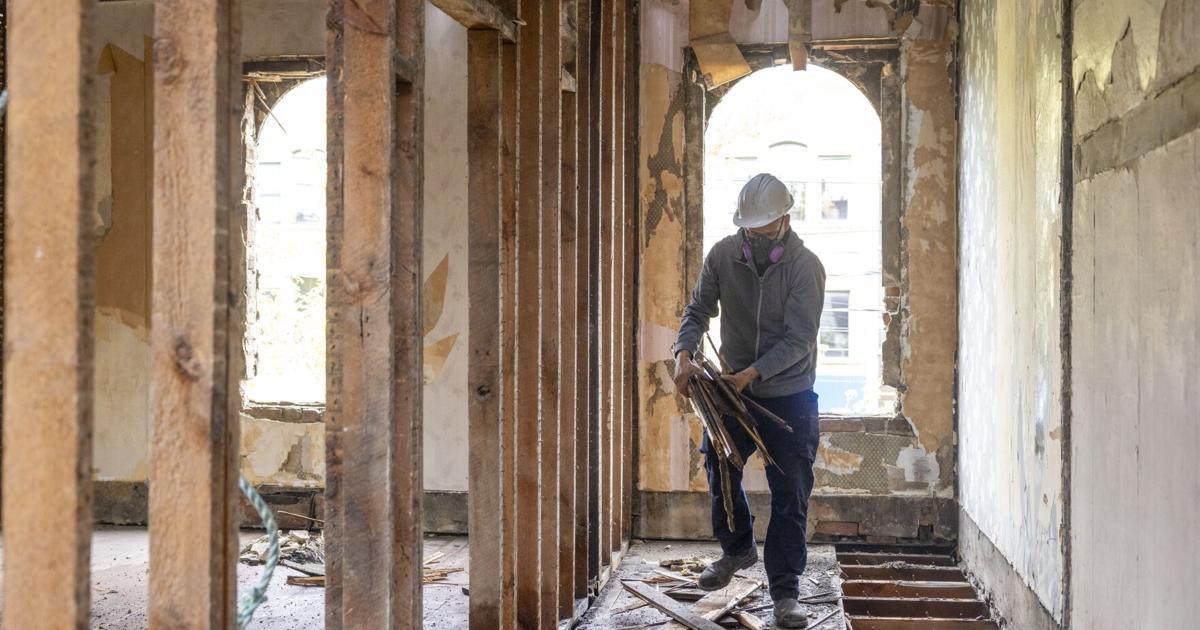
Inside an abandoned house in Toronto’s west end, workers last March started pulling down lights, cabinets and doors. They knew some of the plaster inside contained asbestos, that needed to be dismantled with particular care.
Up came the flooring, and out went the appliances. Then it was time for the whole house to come down — not with the blunt crunch of a bulldozer, but disassembled by hand, stretching the process out for a whopping 627 hours.
The salvaged materials were then catalogued for reuse. Some 1,800 bricks were ferried to Riverdale to re-clad a Victorian house, as other materials were listed for sale, tucked in storage or taken to specialized recyclers.
This intricate process, clearing space for a city affordable housing project, took around five weeks longer and cost about 40 per cent more than bulldozing. But the head of city hall’s real estate arm says the payoff was worth it.
“That’s a delta of cost that we’re prepared to stand behind,” said Vic Gupta, CEO of CreateTO, despite recent belt-tightening at city hall.
Deconstruction wound up costing the city around $130,000, Gupta said, versus around $90,000 for traditional demolition.
Working with a company called Ouroboros, whose takedown work in Toronto’s private housing market was profiled by the Star last fall, Gupta said “more than 90 per cent” of materials from the old abandoned house were diverted from landfills.
He said the choice is in line with directives from city council around climate, housing and economic development, noting the more intensive process also meant more jobs. “Not all of those objectives are the cheapest way to deliver something. And so, I think it’s about the kind of city we want.”
The house at 1113 Dundas St. W. in Trinity Bellwoods came into public hands in the early 2010s, when the nearly 130-year-old structure was purchased by the Toronto Parking Authority (TPA) for $950,000. TPA already owned a parking lot next door.
For years, ideas about how to use these pieces of land were batted around at city hall. Should they be sold to a private developer? Should the city build something itself? Finally, a few years ago, municipal officials settled on a plan. The site would be used for a pilot project, which aims to increase the city’s supply of affordable housing using “mass timber” construction — a form of homebuilding considered more environmentally friendly than other methods.
The choice of a more sustainable construction method during the pilot project is what led to talks about using careful deconstruction versus demolition, Gupta said.
“If what we’re building is a mass-timber, geothermal, net-zero building, then why not kind of continue that thinking and that attitude, that mindset, into how we deconstruct or get rid of the neighbouring house?”
Hugh Clark, executive director of Toronto’s housing development office, was already familiar with Ouroboros, having worked with them in a past role with real estate company TAS.
“They have this really interesting system where they go in and they scan all of the existing structure, and catalogue all of the pieces to see what material is salvageable and could be reused, and what material can’t be reused,” Clark said.
A routine demolition would have taken about two weeks, versus the seven it took to deconstruct piece-by-piece, Clark said. That didn’t add to the overall project timeline, he said, as it took place during other steps like rezoning.
“It was work we were doing outside of the site that allowed us to do this over this extended period of time. The neighbours probably don’t prefer that, but at the end of the day, it is worth it in the grand scheme of things,” Clark said.
A report on the deconstruction outcomes, prepared by Ouroboros and shared with the Star by CreateTO, counted 3,750 bricks out of 5,000 in the home that were able to be salvaged, with a company called Arcana Materials then selling them for reuse. Workers set aside a stained-glass window, antique door hardware and 7.95 tonnes of asphalt taken to a specialized recycler.
Three months post-takedown, Ouroboros’ report said resale of materials had brought in around $4,000. That money stays with Ouroboros.
Organic waste like ceiling tiles made of pressed paper were being tested for potential “farm and City landscaping use” at the time of the report’s writing in August, while rigid core insulation pulled from the was listed on a secondary marketplace and “reused in a local Toronto home,” the report said.
“And so, while the life of 1113 Dundas St. West comes to an end after 140 years, the story of its bones continues,” Ouroboros concluded.
Meredith Moore, founder of Ouroboros, told the Star the 1113 Dundas teardown was the company’s first time working directly with city hall, and she hopes it opened municipal officials’ eyes to an “emerging” sector focused on reuse.
“We were really able to use this project as a way to highlight all the wonderful people that are working on the circular economy with us,” Moore said.
Their team’s report to city hall suggested Toronto could consider deconstruction options when issuing demolition permits for certain types of homes, such as pre-1950s builds, and come up with targets for reusing materials when procuring companies to work on housing and infrastructure projects.
Moore noted that any growth in the sector would also require infrastructure growth, such as creating spaces where salvaged materials could be stored.
“A lot of times it’s cost effective and it saves materials that are completely viable for reuse from going to the landfill,” Moore said of their approach.
Asked about Ouroboros’ recommendations, Gupta said the topic is worthy of further discussion among city and industry players.
“We would definitely do it again,” Gupta said.

