Shivering in their unzipped winter coats, broccoli haircuts unburdened by hats, the four male teenagers huddling together on a sub-zero night on Toronto’s Bloor Street West don’t look like they’re trying to hide anything.
But then one boy suddenly takes a pull from a grape ice-flavoured vape concealed in his palm, and admits, sheepishly, that he’s hooked on the device.
Another of the boys, a 17-year-old high school student from the west end of the city, said vaping in class can be tricky — the cloying scent of the exhale is difficult to hide. But a nicotine pouch — or “lip pillow” — like the one tucked in his mouth between his lower lip and gum, is easier to get away with.
When asked where he gets the pouches, which can only legally be sold to adults 18 and older through pharmacies in Ontario, he laughs.
“Everywhere,” he says, looking around at his friends who nod in agreement. “You can get them anywhere.”
(The Star agreed not to name the boys as they could face retribution for buying products containing nicotine while being underage.)
Despite the ban on selling them to minors, nicotine pouch use among young teens is skyrocketing. Their reported use in 2024 is more than six times what it was in 2022 among Canadian youth aged 16 to 19, according to one peer-reviewed study.
So far, Health Canada’s attempts to regulate access to the highly addictive product have been a dismal failure, some experts say.
Currently, the pouches, which are produced and marketed by the world’s largest tobacco companies, are only allowed to be sold as smoking cessation aids through pharmacies. But a survey of websites and about 30 independent Toronto convenience stores by the Star found the pouches are often being sold without age verification, and some retailers are selling brands, flavours and dosages that are not approved by Health Canada.
Health professionals are concerned. Some worry that rather than helping users quit smoking, the pouches could addict users and lead to cigarette smoking and vaping later in life.
Now law-abiding convenience store owners, who feel they’re forfeiting profits for playing by the rules, are asking the government for permission to sell the pouches legally. The stores argue that they’re already allowed to sell age-restricted products like cigarettes and alcohol, and should be allowed to sell a product that could help customers quit smoking.
Generally speaking, “stores that are arguing that they should be trusted to sell these products … are also the ones that are selling illegal nicotine pouches right now,” said David Hammond, a professor in Waterloo’s school of public health.
To put pouches back in convenience stores, Hammond said, would be like “putting the fox in the henhouse.”
Only two brands of nicotine pouches are legally allowed to be sold in Canada — Zonnic and NEÖ — and both are limited to a 4 mg dose and mint flavours. But when Health Canada first approved nicotine pouches as a natural health product in July 2023, there were few regulations.
The original approval was for use as a nicotine replacement therapy to help adults quit smoking, but often the advertising showed young people using them and having fun.
“Vapes and nicotine pouches came out of a world not initially making health claims, but where these could be kind of a lifestyle enhancement product that would stimulate you,” said Daniel Robinson, a professor of media studies at the University of Western Ontario and author of “Cigarette Nation.”
Zonnic is owned by Imperial Tobacco Canada, a subsidiary of British American Tobacco. One of Zonnic’s original advertisements, since pulled from social media, featured a young person with the words “Pop it … tuck it … and it tingles,” and was available in flavours like “tropical breeze” and “berry frost.” NEÖ is owned by Swedish Smokeless Solutions.
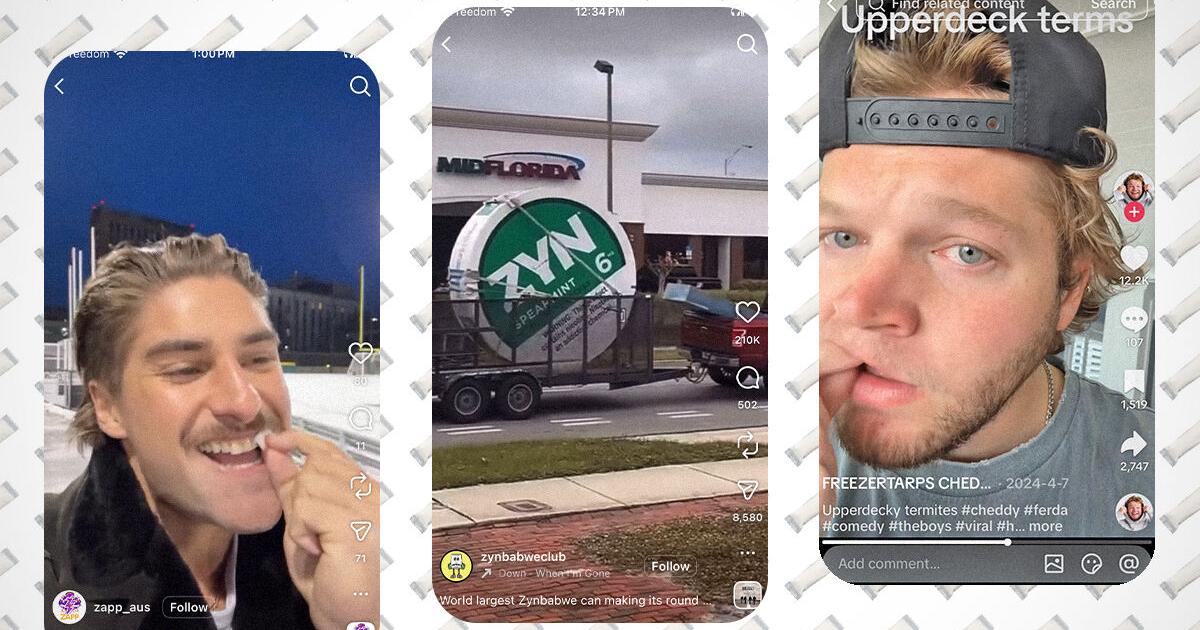
Social media influencers continue to target young adults through videos and advertising spots on podcasts.
“Zynfluencers,” as they’re called (Zyn is another brand of nicotine pouch), leverage sizable social media followings to sell young men on the idea that nicotine pouches are compatible with both active and party lifestyles — you can pack your lip with a pillow at the gym or the bar.
Many influencers talk about the pleasure of the nicotine buzz as well as positive cognitive effects that help you focus.
Robinson noted that cigarettes were also initially marketed as a productivity booster, helping workers execute otherwise boring tasks.
Imperial Tobacco Canada said that it follows the rules when selling its products in Canada.
We work “with thousands of licensed retailers across the country who sell our legal nicotine products in compliance with federal and provincial regulations,” said Eric Gagnon, vice-president of corporate and regulatory affairs at Imperial Tobacco Canada, in a statement to the Star.
“We maintain standard commercial relationships with retailers, as well as provincial and national convenience store associations, that help ensure only adult consumers can access regulated nicotine products through legitimate channels.”
The easiest brand to find on the street and online, Zyn, is not authorized for sale in Canada. It’s owned by Swedish Match, a subsidiary of Philip Morris International.
When asked about Zyn’s prevalence, the tobacco company suggested that the product seen here may be counterfeit.
“In Canada, we’ve increasingly seen the rise of counterfeit Zyn originating from China, in flavours and nicotine levels not manufactured or sold by Philip Morris International,” a spokesperson for Rothmans, Benson & Hedges said in a statement.
The subsidiary of Philip Morris said it works with law enforcement to stop illicit trade of counterfeit and contraband products in Canada.
In late 2023, former health minister Mark Holland said that the government was “duped” by the tobacco companies who, he claimed, used a loophole to push the product through.
According to Robinson, the industry hasn’t changed its approach much since the 20th century; convenience stores have always been on the front line of Big Tobacco’s strategy.
“It’s a better defender of your industry to have a mom-and-pop person in a variety store saying, ‘without that business we could go under and we’re not going to be here for the milk and bread that you might need in your neighbourhood,’ ” said Robinson.
Both Imperial Tobacco Canada and Rothmans, Benson & Hedges are vendor partners of the Convenience Industry Council of Canada (CICC).
Kenny Shim is the president of the Ontario Convenience Stores Association and has operated Busy Bee Mart at King and Bathurst in Toronto for more than 35 years.
The businessman said the decision to ban nicotine pouch sales was a financial hit to convenience stores that were already struggling due to dwindling cigarette sales.
“Half the sales in convenience stores used to be tobacco related,” said Shim. “It’s like half the revenue is gone.”
He said he doesn’t sell nicotine pouches, but believes they were a healthier option for his customers that could also help recoup revenue.
“If the government decides that it’s killing people, ban it,” said Shim. “But don’t move it to another market so that the black market gets bigger and bigger.”
The Star found that more than 20 of roughly 30 stores visited around the city are illegally selling nicotine pouches in a variety of flavours, and in dosages up to five times the amount of nicotine approved for safe use by Health Canada.
The pouches were typically hidden behind convenience store counters and several had health warnings written in Swedish, inscrutable to English speakers.
Gagnon, at Imperial Tobacco Canada, said that authorizing convenience stores to sell the product legally could help curb such unauthorized sales.
“Our focus is on supporting a well-regulated legal market that protects youth, ensures product standards are respected, and prevents the continued growth of illicit nicotine products that are widely available online and through unregulated sellers,” he wrote in an email to the Star.
“The unintended consequences of restricting Health Canada authorized cessation products, such as nicotine pouches, to pharmacies only are undeniable and dangerous. The illicit market is flourishing, with an estimated 70 per cent of nicotine pouch sales now illegal, involving non‑regulated, often high‑nicotine products sold without age verification.”
Hani Al-Shikarchy, who owns four convenience stores across the GTA, circulated a press release in January via his organization, the Independent Convenience Store Alliance, that called on the new Minister of Health, Marjorie Michel, to reverse the ban on nicotine pouches.
“These regulations do not reduce smoking,” said Hani Al-Shikarchy in the release. “They do exactly one thing: they expand the already-burgeoning illegal market.”
In an interview with the Star, Al-Shikarchy, who said he does not sell nicotine pouches, said his organization has been pushing for age restrictions where black market options have none. He said he’s successfully ordered pouches online, in transactions he said involve no ID check for a home delivery.
Al-Shikarchy said he wants convenience stores to be “partners in public health” with Canada, and selling nicotine pouches is a way to do that.
When asked whether he would remove cigarettes from his shelves to help customers quit smoking, Al-Shikarchy said no.
“We want our customer not to smoke, but I’m not going to be the only one to remove them,” he said. “Pouches are just another option.”
When it became clear that nicotine pouches were being sold and advertised for purposes outside their intended use, Health Canada did react.
“The tobacco industry was able to addict a whole new cohort of young people who had no exposure to nicotine to something that’s absolutely deadly for their health,” said former minister Holland at press conference in March 2024. “Whatever dark corner the tobacco industry crawls into to go after our children, whatever loophole they think they can find, they will meet me like an iron wall.”
Hammond said he thinks the initial release of Zonnic was a big mistake — Health Canada should have never approved the product with so few restrictions. The central question for Hammond is whether limiting the sale of pouches to pharmacies provides adequate access to adults who would use the product, as intended, to quit smoking.
“Pharmacies provide … access for more than 90 per cent of Canadians,” said Hammond. “And then you have the bonus of having a pharmacist there.”
Hammond said that people who get advice from a qualified health professional, like a pharmacist, are more likely to quit smoking. Convenience stores cannot provide health advice and are already violating Health Canada’s orders.
According to Hammond’s survey of Canadian youth aged 16 to 19, the most popular nicotine pouch is Zyn — a brand not authorized for sale in Canada — which is used by 35 per cent of youth who use nicotine pouches, compared with seven per cent who have used the authorized brand Zonnic.
An answer to the illicit market could be increasing enforcement for contraband products.
Health Canada works in tandem with Canada Border Services Agency and the Royal Canadian Mounted Police to prevent unauthorized products from entering the country. The health ministry said it has handled more than 300 compliance cases since August 2024, issuing compliance notices, conducting on-site visits, and seizing products.
“Protecting young people from the harmful effects of nicotine and preventing dependency is a public health priority for the government of Canada,” reads a statement to the Star from Health Canada. “We are committed to implementing robust measures to protect youth, while maintaining the availability of these products to help adults quit smoking.”
Nicotine pouches, while significantly less harmful than cigarettes and vaping, are not harmless.
According to Ottawa Public Health, nicotine raises your heart rate and blood pressure, increasing your risk of heart disease and stroke, while pouch use can cause dental issues such as cavities and gum disease.
Dr. Hassan Mir, a cardiologist at the Ottawa Heart Institute, researches cardiovascular prevention with a focus on smoking, vaping cessation, nicotine pouches and addiction.
Mir said that while pouches led to a reduction in cigarette consumption, they did not lead to cessation. Pouches, he said, are no more effective than nicotine gum, a product that has been tested for decades and has high regulatory standards.
“The majority of users of these products are actually not people that are smoking and trying to quit,” said Mir. “They’re often young adults or people who have never smoked who are now using this as a gateway to nicotine addiction.”
While Mir acknowledged the potential boost to focus that nicotine provides, he added that as the brain adjusts, it requires more and more of the stimulant to function.
Also troubling to Mir is evidence that instead of promoting cessation, nicotine exposure can be a stepping stone to cigarettes. A prior study of his on vaping among youth and young adults showed that the habit increased the likelihood of trying cigarettes by 300 to 700 per cent.
“We have an opportunity here, which I think we kind of blew with vaping,” said Mir of strengthening regulation on emergent pouches. “Small businesses are not going to be happy because they want to sell these products, they want to make money off these products, right? So we need to understand what each of them is hoping to get out of this.”
The teenage boys, standing in the cold on Bloor West, say they’ve heard about how bad vaping is, but they’re not aware of the negative health effects of nicotine pouches.
When asked if he would ever quit, one of the boys shrugs.
“I don’t smoke cigarettes. This just doesn’t seem that bad.”