

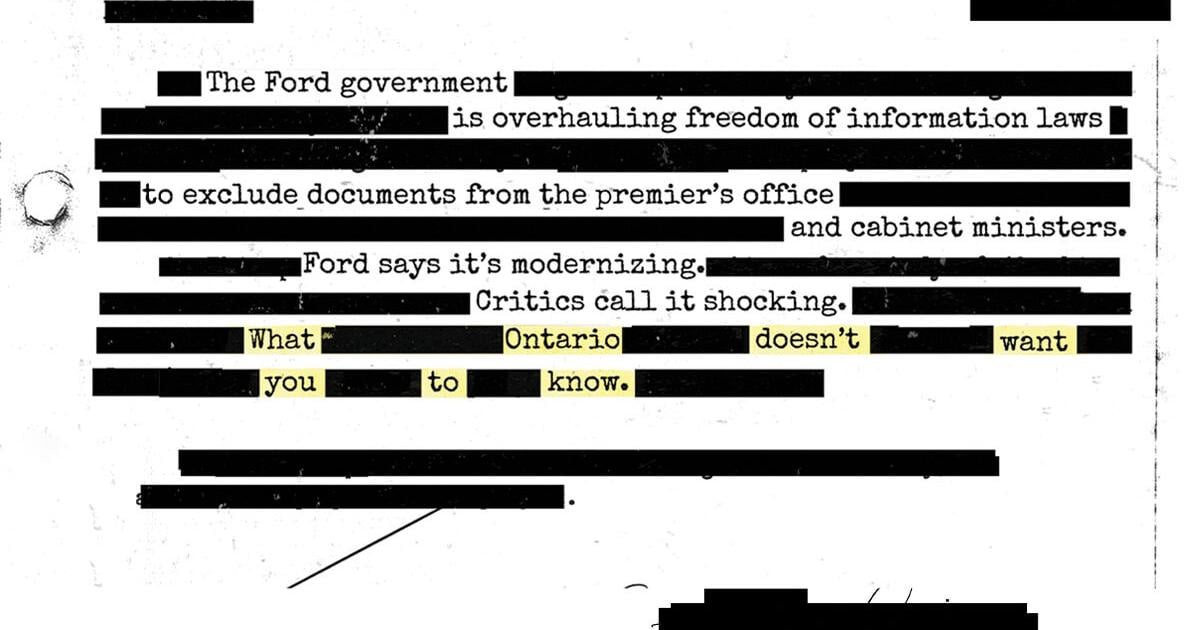
Premier Doug Ford’s government is set to shutter a window that for 40 years has given the public and journalists transparency into decision-making and revealed wrongdoing that would otherwise have remained hidden.
With a bill introduced last week, Ford’s Tories are proposing to exempt ministers, the premier and their staff from freedom of information (FOI) laws, which allow the public to access government records.
“This should be concerning for all Ontarians, regardless of political affiliation,” Information and Privacy Commissioner Patricia Kosseim said last week. The changes would “weaken transparency and accountability for generations to come,” she added.
Last week, Ford said the move is “about protecting cabinet confidentiality with the Ontario public service.” Existing freedom of information rules already shield cabinet discussions from the public.
For decades, the Star has used freedom of information requests to shine a light on everything from cruel conditions in long-term care homes to racial bias in policing.
Many would still have been possible under the Ford government’s proposal, which would not affect records left by bureaucrats. But the changes would cut off access to information about the area of the Ontario government where major decisions are made, and who was influencing them.
Ford has argued that the change would align Ontario’s rules with other jurisdictions. The federal government, Saskatchewan, Alberta and Quebec restrict access to records from minister’s offices. But many provinces, including British Columbia, Manitoba and Nova Scotia, allow access to those records.
The new Ontario law would apply retroactively. That means existing requests for information about Ford government scandals like the Greenbelt land swap and the Skills Development Fund will likely be cancelled.
Here are some of the secrets that the Star would not have been able to reveal under the Ford government’s new legislation.
Greenbelt business conducted via chief of staff’s email
In 2024, the Star used records obtained by freedom of information to reveal that the former Ford government staffer at the centre of the Greenbelt scandal had used his personal email account for government business.
The investigation followed a 2023 report from former Ontario auditor general Bonnie Lysyk, who found that some political staffers had used personal accounts for government business while designing ill-fated changes to the Greenbelt. Because they relate to government work, those records are still subject to Ontario’s existing freedom of information laws. But the auditor didn’t name specific staffers, nor did she detail who they were talking to.
The Star’s Brendan Kennedy filed a request for records from the personal email account of Ryan Amato, the former chief of staff whose role in the Greenbelt changes was highlighted by Lysyk’s report.
That request turned up emails that were forwarded to government email accounts. But Amato, who resigned in 2023, has refused to hand over any other Greenbelt emails remaining in his personal account, even taking Ontario’s privacy watchdog to court to fight an order requiring him to be questioned under oath.
Kennedy is a party to that proceeding, which is ongoing. But if the Ford government’s new changes to freedom of information rules become law, that legislation would likely void the case, blocking the Star’s efforts to access the Greenbelt emails.
Lost emails also played a role in the former Liberal government’s gas plants scandal. In that case, freedom of information requests showed the premier’s office had very few records related to the controversial closure of two power plants ahead of the 2011 election — findings that later led the information and privacy commission to conclude that senior staffers deliberately deleted emails.
Ford’s squeeze on bike lanes
Ford has vowed to remove bike lanes in Toronto, arguing that cycling infrastructure takes road space from drivers. The plan has sparked conflict between the province and the city, as well as an ongoing court battle with cycling advocates.
Using a freedom of information request, Star reporter Andy Takagi found the Ford government’s primary focus is on removing less than a kilometre of bike lanes.
Experts told the Star that, in isolation, the changes detailed in briefing documents revealed by the FOI request, would have a minimal impact on traffic congestion — challenging the Ford government’s stated reason for the move.
Documents reveal how officials blocked info release
In December 2022, as cases of RSV, COVID-19 and influenza were overrunning Ontario emergency rooms, provincial spokespeople offered the Star an interview with two senior health-care officials. Then they abruptly cancelled it.
The Star filed a freedom of information request to figure out why. The result: a set of internal government emails showing the director of communications to Health Minister Sylvia Jones had intervened and pulled the plug, seemingly unhappy that Star journalist Kenyon Wallace would be the one asking questions.
The resulting story offered a snapshot of how the Ford government was making decisions about its public communication during a health crisis. It also pointed to tension between the political side of the government and non-partisan bureaucrats tasked with communicating health information.
The Star has also used freedom of information legislation to report similar stories about senior Ford government staffers blocking the release of details about the long-delayed Eglinton LRT and other matters of public interest.
Records disproved Ontario’s narrative about Ipperwash crisis
In 1995, the newly-elected Mike Harris government was consumed by the Ipperwash crisis.
That year, on the shores of Lake Huron, members of the Chippewas of Kettle and Stony Point First Nation occupied Ipperwash Provincial Park — land that belonged to the nation and contained burial grounds. During the demonstrations, Ontario Provincial Police shot and killed an unarmed Ojibwa demonstrator named Dudley George.
As late as 2002, the Harris government denied there was an Indigenous burial ground at Ipperwash, saying a 1972 study had found no evidence of one. But using freedom of information, Star reporters Peter Edwards and Harold Levy found documents showing the study was not reliable — and that the natural resources minister at the time was briefed about it.
The records allowed Edwards and Levy to challenge the province’s narrative about the events leading to Dudley’s death, shedding new light on an incident that continues to shape Ontario’s relationships with First Nations.

