

Parimal Gosai wasn’t planning to buy a house that night at a Christmas party in 2018 with his brother and sister. But when a listing popped up in a Trinity Bellwoods area they loved, Gosai, who runs a real estate investment company, knew they had to check it out.
“We went and saw it that night and put in an offer,” he says.
There was one small problem: It was barely standing. Crumbling walls, gaping holes in the floors, buckling brick, no running water, and signs of termites, raccoons and squirrels living inside. The city had deemed it unsafe to inhabit. “And the basement was giving ‘The Silence of the Lambs,’” says Gosai.
It took 18 months and a few creative compromises to divide the space into two livable units: one for Gosai and his husband, Hasheel Lodhia, downstairs; and one for Gosai’s sister, Nital, upstairs. Now, the once-uninhabitable space is an elegant respite for the busy couple, a home that continues to evolve alongside them. “Our house is a living and breathing space, and we’re constantly changing it around. It allows us to really use this space as a playground or inspiration for our other projects that are in the outside world,” says Lodhia.
When asked about their favourite memory in the home so far, Lodhia says: “The best is always yet to come. What inspires us and our work is this idea that we have not produced our best work yet.”
The inspiration
The home’s design is deeply rooted in the couple’s Gujarati heritage, layered with a minimalist, Scandinavian sensibility. Spirituality and hospitality play an integral role as well. “It’s this idea that Hasheel and I both conform to, which in Sanskrit is called ‘Atithi Devo Bhava,’ which translates to ‘the guest is the equivalent of God.’ And it’s a really beautiful concept in Hinduism and our culture. That’s what I want people to always feel in my home, that you are so well honoured and we will put on a huge spread for you and the doors are always open,” says Gosai.
The kitchen
The couple loves to host friends and family, using the home as a gathering place for connection, celebration and culture. “The kitchen is always the meeting point at parties,” says Lodhia. Gosai adds: “We decided that we weren’t gonna do Christmas parties, we’re gonna do Diwali parties. The last big one had about 250 people through the house.”
The living room
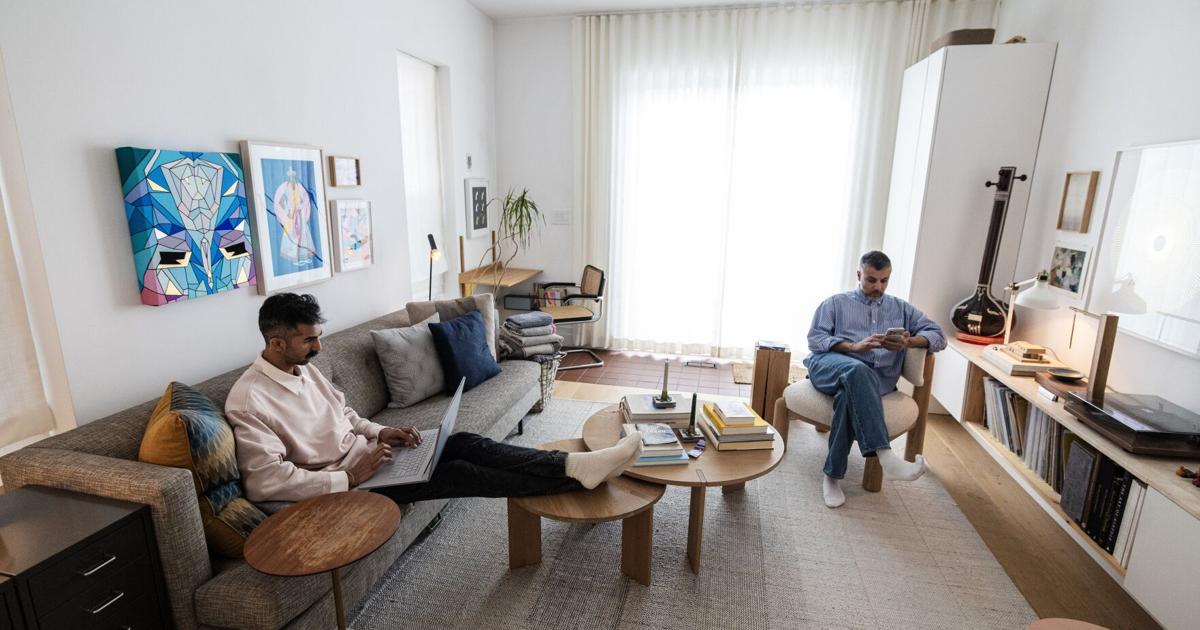
The living room is the most-used space in the home — doubling as a shared work area during the day and a cosy spot to watch TV or host friends in the evening. “It’s where we spend the most amount of time,” says Gosai. “There are these huge trees across the alleyway that are super magical in the winter when they’re filled with snow, and then they’ll start to bud. So, just having a moment in the morning here with your coffee and watching the trees, it’s magic for me.”
The entryway
Painted in Earthly Russet by Benjamin Moore, the entryway draws its rich, warm tone directly from the terracotta tiles underfoot. The floor, walls, and ceiling are all finished in the same hue, creating a cocoon-like effect. The same terracotta tiles are used in the downstairs laundry room and in a small section of the living room floor near the back doors, connecting the space to the garden beyond.
The arches
The couple worked with interior design firm Two Fold Interiors, who designed the barrel-vaulted arches — painted Hale Navy by Benjamin Moore — to frame the kitchen at the centre of the home, connecting it to the dining room on one side and the living room and back garden on the other. Conceived as “a portal into the calm space,” says Gosai, the arches also incorporate thoughtful details: in the dining room, one features built-in shelving displaying books, collected objets, and a Buddha statue, a housewarming gift from Lodhia’s aunt.
The art
A well-curated mix of high and low, the walls are covered in everything from deeply personal keepsakes (like a drawing from Gosai’s little sister, objects collected during their travels, and cultural ornaments) to coveted works by Canadian artists Meera Sethi, Anna Pantcheva, and Rajni Perera, a close friend of the couple. The latest addition to their collection? A screen print by British sculptor Anish Kapoor titled “Out of the Dark,” which hangs beside an assortment of mismatched teacups and saucers in the kitchen.
The instruments
Because of Lodhia’s career as a classical Indian musician, his instruments double as decor. A four-string drone instrument called a tanpura is displayed on a wooden shelving unit in the living room. “I often play it when I practise,” says Lodhia. In the entryway, a set of ghungroos — bells worn on the feet for the traditional Indian dance form Kathak — hang next to a shoehorn. A few shankhs, conch-like temple instruments, are also on display, along with Lodhia’s most prized possession: his bansuri, an Indian bamboo flute.

