This is the first story in our new series “I Survived,” where survivors of near-death experiences once covered by the Star detail how it changed their lives.
She didn’t realize what had happened, not right away.
It was the calm ocean water turning bright red that told her something was deeply wrong.
A bull shark had clamped its jaw around her left leg, the bite causing her muscles to flake away from bone.
Like butter, she said.
It was lying on the sandy Cancun beach, bleeding out from her arm and leg, eventually losing 60 per cent of her blood volume, that Nicole Moore came closest to death.
The feeling, she recounts 15 years later, was one of a warm, white light.
“Some people say it’s very comforting … and I get that now,” she told the Star recently. “But when that was happening for me, I went, ‘Oh, hell no. I have children. This can’t happen. I won’t let my children lose their mother this way.’”
Disasters can change lives in an instant. In “I Survived,” an occasional series from the Star, survivors detail their lives before and after — and the day they brushed with death.
For Moore, a nurse in Orangeville, Ont., that day was Jan. 31, 2011.
‘I need to get out of this water’
She and a group of nine others from her fitness class were celebrating a friend’s 50th birthday with a trip to Cancun, Mexico. The rest decided to rent a car and go shopping. Moore decided to stay behind and play beach volleyball.
Just after 11:30 a.m., she went into the water to rinse off the sand. She stood in the waist-deep ocean, basking in the beauty of the landscape and thinking of her scuba dive to come later that day.
In the distance, she spotted a group of guys ripping around on Jet Skis like cowboys. They were yelling, and Moore eventually realized they were yelling at her. She got the point soon enough — for whatever reason, they wanted her out of the water — so she raised her hand to acknowledge them and started wading back to shore.
Moore felt a bump under the water. She hoped, for an instant, it was just something she hadn’t seen, a kid snorkeling that she had missed. Then the water began turning bright red.
“Sharks like blood,” she thought to herself. “I need to get out of this water.”
Moore was in fight-or-flight, not realizing the damage to her leg. She began paddling with her arms towards shore. When she reached forward, a shark swallowed her entire left arm in its mouth.
“We’re nose to nose, literally,” Moore recalled, “with its jaw locked just above my elbow.”
It thrashed back and forth. Moore raised her right arm and punched it in the nose. It opened its jaw and let go.
A man on a Jet Ski helped her to shore. She learned later the men had spotted two full-grown bull sharks at a nearby resort and were trying to chase them into the deep. Instead, at least one of the sharks moved toward the beach.
An amputation and nerve damage
Moore remained awake and alert while bleeding out in the sand. Being a nurse, she understood what was happening to her body and how close to death she was. She triaged her own wounds and worked to slow down her breathing.
In hindsight, she believes taking control of the situation helped her with the trauma. According to Margaret McKinnon, a McMaster University professor of psychiatry and behavioural neurosciences who studies trauma, not having control is a known risk factor for developing PTSD.
“When you feel trapped and you have no agency,” McKinnon said, “you are more likely to develop symptoms afterwards.”
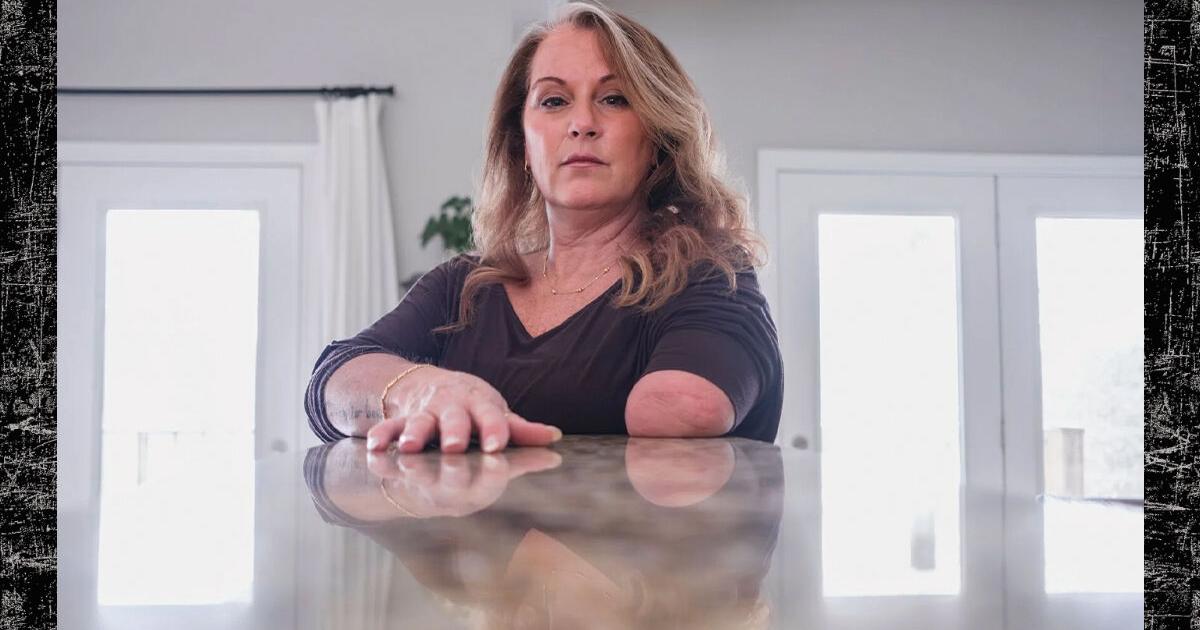
Moore’s left arm was amputated above the elbow and 15 years later, she still lives with chronic pain from nerve damage to her leg and arm. She still goes to physio and sees a pain specialist. She said she has no post-traumatic stress, although she speaks regularly with a counsellor.
Moore, now 53, has talked openly about the difficult and embarrassing parts of the attack and her recovery. She made a conscious effort to dive deep into her feelings. She questioned herself: Why don’t I have any trauma? Why don’t I have any nightmares?
In November 2011, still missing large chunks of skin on her thigh, Moore returned to the spot of her attack. “I wanted to make sure that I wasn’t holding on to anything inside,” she told the Star in 2012.
Celebrating her Sharkaversary
Everyday life can still be difficult for her. There are things she hasn’t done since the attack, like playing volleyball, and daily tasks like getting dressed are a challenge. Her job has changed, too. She is still a nurse, but in a supervising role. She finds it difficult not to be at the bedside of patients.
But there are things she got from the attack, too. She learned how stubborn she is — but also that it’s OK to ask for help when you need it. She came away with a new appreciation for humanity after watching so many people come to help her on the beach.
Moore doesn’t regret getting into the water. She didn’t regret it 15 years ago, and she doesn’t regret it now.
“If I could go back and redo it, I guess I would go back and not get attacked by a shark,” she laughed. “But it’s happened and I’m OK with living with that, and I’m OK with the loss of an arm if that’s what it takes.”
Every year on Jan. 31, Moore celebrates her Sharkaversary. Her friends and family raise a toast. They celebrate the cruelty of life, and the tenacity it takes to overcome it.
“We get into the tequila,” Moore said.