

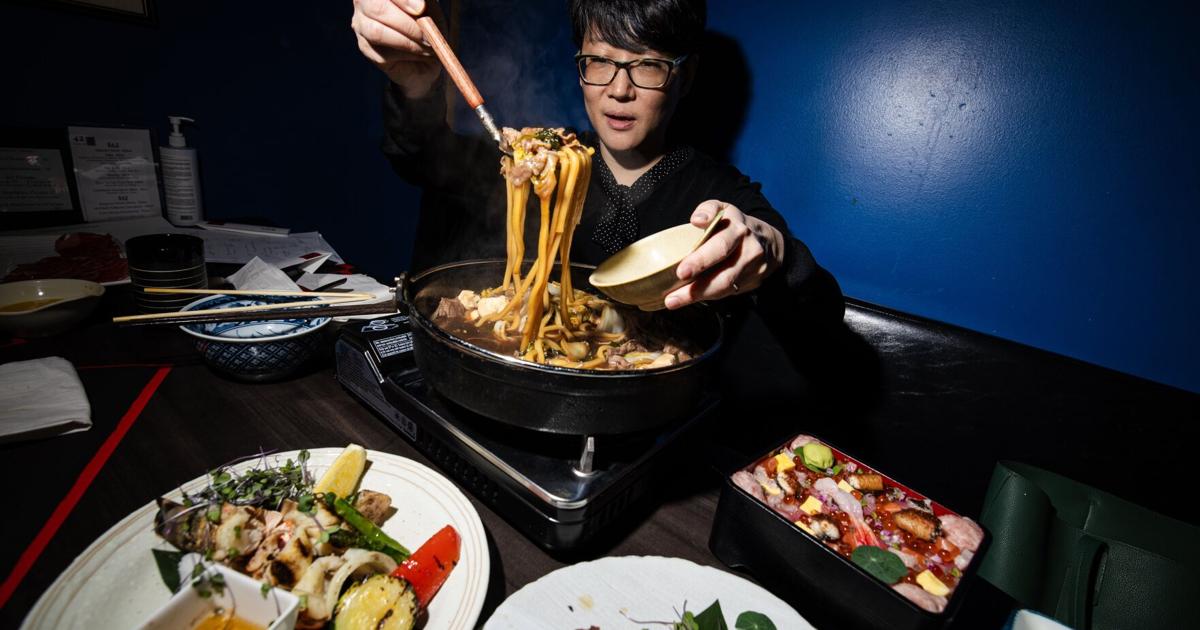
Whenever I’m having an imaginary solo power lunch at Nami Japanese Restaurant, the longstanding sushi and robata bar in Old Town, I half expect a scene from “Die Hard” or “American Psycho” to unfold in its windowless dining room, perpetually set in twilight. In contrast to today’s minimalist omakase restaurants with pale wood counters and bright overhead lighting, Nami has always leaned into mood and mystery. Since opening in the early 1980s, it has offered little rooms to duck into for a secret rendezvous or discreet deal. An imposing set of samurai armour guards the entrance. A grand tatami room in the back sits behind paper screens, backlit so diners can make out the silhouettes inside.
The room speaks to a time of suits entertaining clients with bottomless expense accounts and bottles of sake, as well as celebrities ducking in to avoid being seen. As that era fades, so too does Nami. Its second generation owner, Jennifer Yoo, announced that after more than 40 years the restaurant at 55 Adelaide St. E. will be having its last day on March 7.
“This was the buzziest place in the ‘80s,” Yoo said over a quiet lunch in one of the booths. “U2 was here. Whitney Houston came here, but we didn’t take photos because we had to maintain a private place. When I was in Grade 9, mom called from the restaurant to say the Rolling Hills were here. It was actually the Rolling Stones.”
Yoo said a “perfect storm” of factors led to the closure. Rent went up. Customer traffic never returned to pre pandemic levels as hybrid work became the norm and people cut back on dining out. “We used to be able to do two or three seatings at lunch and dinner,” said Yoo. Food and labour costs have also gone up.
Stricter immigration policies have also made it harder to recruit and retain talent from Japan. Some chefs who were able to work at Nami waited up to seven years for permanent residency. Japanese restaurateurs in Toronto have faced a particularly difficult time keeping chefs in the country, as federal immigration streams in recent years prioritised applicants in sectors such as health care and the sciences.
“They have the skill set. They want to be here and stay, but we lost five chefs in the last year and a half,” she said. “We survived SARS and Covid but that’s the thing that’s putting the nail to all of this.”
Nami’s origin story is somewhat hazy. Yoo’s father, Ken, is now in his 80s and his former business partner Fred Kumoi has passed away. Going through old documents, Yoo said the restaurant was incorporated in 1984. Its longtime robata chef, Abriham Lodin, known as Moha-san, recalls starting work there around 1982.
The late Japanese Canadian architect Raymond Moriyama was once slated to be a third partner in the business, though that never materialized. He did, however, design Nami’s interior, which remains largely unchanged to this day. The restaurant now joins a list of Moriyama designed spaces in the city facing uncertain futures, including the Ontario Science Centre, the Japanese Canadian Cultural Centre and the Goh Ohn Bell Shelter at the overhauled Ontario Place.
When Nami opened, it was one of only a handful of Japanese restaurants in Toronto. Without the internet to scout the competition, Yoo said her father would send her and her friends to eat at places such as Ematei on St. Patrick Street, which opened in 1989 and later became Muni Robata in 2020. At the time, it was one of the few places serving home style dishes like natto, along with full omakase experiences before diners moved beyond spicy salmon rolls.
While it’s origins are still contested, Nami claims to be the birthplace of Toronto’s now ubiquitous sushi pizza, a dish mentioned in a 1993 Toronto Star food column. Chef Kaoru Ohsada, who worked at Nami from 1987 to 1996, previously told the Star he got the idea after trying a rösti topped with smoked salmon. He combined that concept with leftover sushi rice as a way to reduce food waste. Yoo said the restaurant uses a special machine that presses the rice into a uniform shape and removes air bubbles, producing a better patty.
“The sushi pizza was reviled at first,” said Yoo. “Food critics hated it and said it was too expensive. But it was delicious, it’s basically a hashbrown and crispy. And now (people visiting Toronto) consider a sushi pizza as part of the Canadian experience.”
In a social media post announcing the closure, she also encouraged people to share their memories of the restaurant.
“There were so many good memories,” said Yoo, adding that she lost track the number of times she was asked to hide engagement rings in the sushi boats she’d bring to couples’ tables over the years. She also remembers her dad helping staff outside of work. “I’ll never forget a staff member from Japan. He was only 20 and his appendix burst so my dad brought him food to the hospital.”
To keep the legacy of Nami going was well as keep as much of the current staff employed, Yoo said she is asking customers through social media if they would be interested in Nami continuing to exist as a small catering operation. She is also looking into selling merch of the restaurant, as well as reproducing the sushi pizza press that the restaurant uses.
“If we could have made a modest profit, we would have stayed,” Yoo said. “But we can’t.”

