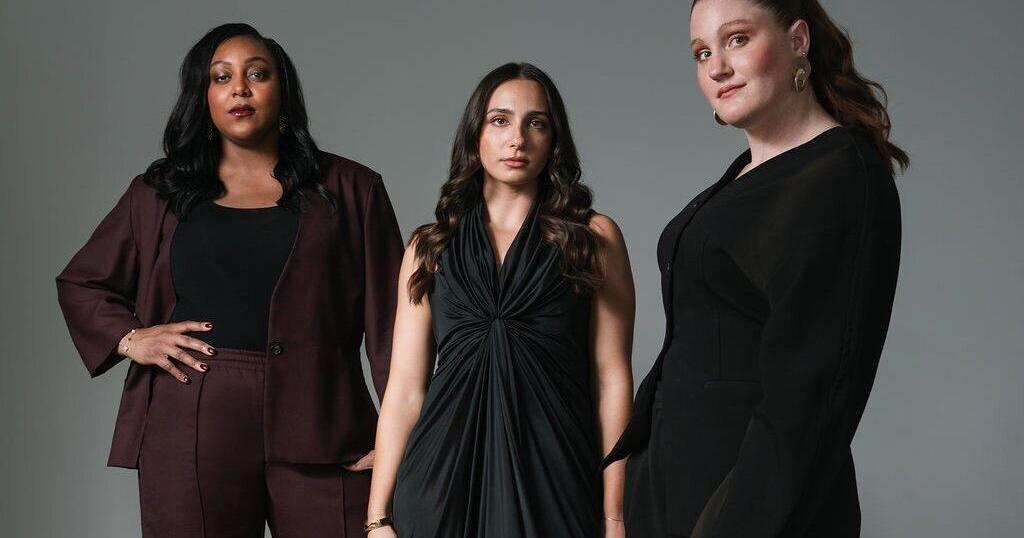
Almost every woman has a complex relationship with her body — how it looks, how it changes over the decades, what it endures over a lifetime. That’s no different for women who are athletes, but they also deal with pressure to perform at an elite level, the need to blaze trails in male-dominated spaces, and professional and public scrutiny that can be objectifying and shaming.
These are not issues that Paralympic sprinter Marissa Papaconstantinou, Toronto Tempo general manager Monica Wright Rogers and Olympic shot-putter Sarah Mitton shy away from addressing. With the same boldness they show in competition, these Canadian sports stars are vocal about the thorniest aspects of living and competing in a woman’s body, from menstruation to the motherhood penalty to simultaneously hearing your body is too big and too small.
They join a chorus of female athletes starting these important conversations. At the Winter Olympics last month, U.S. figure skater Amber Glenn spoke about the physical and emotional challenges of competing while on her period, while her teammate Alysa Liu emerged as a rebellious role model by coming back to the ice “on her own terms” after struggling with her mental health.
This is especially significant because half of Canadian girls drop out of organized sport by the time they’re 17, according to Canadian Women & Sport. Two in five girls said comments about their appearance affected their participation in sport, and one in two cited their menstrual cycle. That’s a problem because playing sport is strongly linked to improved mental health and better body confidence. It also improves career prospects: A survey by ESPN and Ernst & Young found that 94 per cent of women in C-suite positions had played sports.
Exciting strides are being made in women’s sports, with the rapturous reception to the PWHL, the WNBA expanding to Canada and the fact that Paris was the first Olympics to achieve gender parity. As more star athletes emerge and their platforms grow, their voices are getting louder. In a world where women are still told to step back and take up less space, these are the kinds of role models we should be celebrating on International Women’s Day.
Marissa Papaconstantinou, Paralympic blade runner
On the last day of competition at the 2025 World Para Athletics Championships, “Canada’s blade runner” got her period.
It didn’t stop Marissa Papaconstantinou from taking home silver and bronze medals from New Delhi, but it’s an often-hidden challenge that comes with being an elite female athlete. “It was 40 degrees outside, the air quality was horrible. I already felt like I weighed 10 pounds heavier than I was. I definitely felt very ill,” said the three-time Paralympian. “People don’t see, when you’re out there and you’re racing, how much discomfort you can be in. It speaks to the strength and perseverance that female athletes have at this level, to be able to show up and perform on demand.”
Navigating the hormonal roller-coaster has been just one part of the 26-year-old sprinter’s journey with her body. “I was always a strong girl. Compared to a lot of the other 10-year-old girls, I had quad muscles, biceps, abs, whereas a lot of my peers had that stereotypical early-2000s body type,” she said. “I felt like I never fit in that regard.”
In her teens, she dealt with body image issues. “It’s crazy because I look back at pictures of me in high school, and I was so lean. I was probably only eight per cent body fat,” she said. “I remember thinking I was not thin enough, or didn’t have lean enough abs.”
As many women know, that critical inner voice never really goes away. In the lead up to the 2024 Paris Paralympics, Papaconstantinou found herself fixated on “a perfect race weight number on the scale and an ideal lean body mass index.” She cut out certain foods trying to hit those numbers.
“I wasn’t getting enough fat or carbs in, and I just kept shedding weight,” she said. At the Games, she got sick with a “significant” flu, one of several illnesses in a short period. “It was a prime example of not being at a sustainable weight.”
Some of this obsession had to do with wanting to “look a certain way” for this huge moment on the world stage. “I wanted to fit in a certain mould of what a track athlete is supposed to look like.”
Papaconstantinou is referring to the ultralean physiques of most top runners, on display in the track uniforms that tend toward minimal coverage. “It does make me feel good when I have a really good-looking race kit on with the crop top and the bummies,” she said, referencing race briefs similar to a bathing suit bottom. “But sometimes there’s that little voice in the back of my head that says, ‘You’re not bummy ready. You need to do some harder workouts.’”
Being a Paralympic athlete can add to those feelings of not belonging in the sport. Papaconstantinou was born without a right foot and there have been moments when it’s made her feel different, like at her first high school dance, where all the other girls were wearing heels. “I was there wearing my Sperrys, because I didn’t have a high heel leg (prosthetic),” she said. “But adaptive devices have come so far, and I’m able to wear really fun shoes and accessories now, and feel pretty and confident.”
When Papaconstinou is struggling with “negative self-talk,” it’s not related to her limb difference. “I was born that way, and I never knew myself as anything different,” she said. “I don’t really have body image issues with my disability.”
Last year, she made a concerted effort to refocus on properly fuelling her body. “Going into the 2025 season, I was like, ‘You know what? I need to just do the things that make me feel good and run fast,’” she said. Even as her performance improved, the increased food intake was a psychological challenge. “I had to keep reminding myself, ‘What you’re doing is working, and it’s going to continue to get better. Keep eating.’ And I had to keep saying that to myself, because there were moments when I was like, ‘My abs aren’t popping how they normally do this time of year.’”
Turns out, it was one of her best seasons ever, with multiple personal best times. “When I finished my final races in Delhi, I felt like I could have kept racing,” she said. “At the end of the day, if I have a really prominent six pack, it’s not going to make me run faster.”
Monica Wright Rogers, Toronto Tempo general manager
Aging can be a fraught experience for any woman — it can feel as if our best-before date falls around our 40th birthday — but it hits differently when you’re a female athlete.
Just ask Monica Wright Rogers, who at 37 is already on her second life in the world of professional sports. She’s now the general manager of the Toronto Tempo, Canada’s first WNBA team, but before that, she was an elite player herself — the number two draft pick in 2010 and two-time WNBA champion with the Minnesota Lynx.
After seven years of playing at the highest level of women’s basketball, her career ended when her body said no more, despite four knee surgeries.
“For the most part, no one was faster or stronger than me. I was always picked because people knew that I could cover ground, or I would be able to guard anyone,” Wright Rogers said. “Once my injury started to affect my ability to play basketball, it was tough, because there wasn’t much I could do. It was a hard reality that this life as an athlete was coming to a close.” She was 28.
Wright Rogers put her body “through the ringer,” pushing to hang on as long as she could. Her only MO was to “get stretched, get ice, get food in you so you can play, get to this spot, jump!” The physical legacy of that single-minded drive is chronic pain and degenerated joints. “I feel every step I take now.” These days, though, she’s shifted to a place of self-care. “It’s like, ‘How are you doing, body? Oh, you’re not doing good? Just relax today then,’” she said. “I’m in a really gentle season.”
At the Tempo, Wright Rogers is mindful of her responsibility to care for the next generation of players. “It’s a completely free environment in the culture I’m trying to create in women’s sports, because of so many situations we’ve found ourselves in in the past,” she said. “There are some coaches that obsess over being thin. Some players, no matter how hard they try, they can starve themselves but they’ll never be thin. But they’re good! So why obsess over this when they’re doing what we need them to do?”
Wright Rogers is glad to see increasing diversity of bodies in the WNBA, and says younger players seem to be less burdened by the toxic messaging she grew up with. “I was a pretty muscular child, and I remember being called ‘Man-ica’ on the bus,” she said. “I’m proud of this younger generation because I see them accepting the athletic female body.”
Becoming a mother to her son, now five, has evolved Wright Rogers’ relationship to her post-sports body. All those knee surgeries couldn’t prepare her for a c-section; not even being able to sneeze because her abdomen had been sliced open. “I have so much respect for mothers. You give up something about your life to give life,” she said. “As athletes, we sacrifice so much to push our bodies. When I became a mom, my body was put through something again, but it didn’t feel transactional at all. You don’t even feel the pain because you’re so happy.”
Wright Rogers is determined to create an environment that supports athletes who want to be parents. “I remember a time when I was in the league when it was still taboo to have a baby while you were playing,” she said. “We had players who were mothers, but it was not something where I felt like it was fully supported.”
She’s here to help change that. “This is such an important time in these young women’s lives,” she said. “Whether they are carrying the baby or not, if they want to do that, they shouldn’t feel like the odds are against them.”
Sarah Mitton, Olympic shot putter
Right now, Sarah Mitton’s body has a very specific job: Throw an 8.8-lb. metal ball as far as possible.
“Every pound that I’ve gained or lost, every muscle that I’ve developed serves a specific purpose,” said the 29-year-old two-time Olympian. “I’ve gained 15 kilos, and I feel really proud of those 15 kilos because they’ve helped me achieve all of the dreams I’ve ever wanted.”
That’s had a profound impact on her body image. “I’m in a sport where gaining weight has been pushed on me as a positive,” she said. “I’ve gone from someone who was afraid of gaining weight and muscle to someone whose entire identity is wrapped up in being strong and having muscular legs and having broad shoulders. It’s all of the stuff that I was so scared of as a young girl.”
Embracing this has been a process. As an athletic teenager, Mitton felt insecure that her body was bigger than some of her friends. A light bulb went off at her first international shot-put meet. “Everyone was big and powerful and throwing way further than me,” she recalled. She still didn’t feel like she fit in — this time, because she was smaller and shorter than the other athletes.
After she came dead last in her event, a renowned coach who’d worked with multiple world champions came up to her and said he thought she had what it took to be a great shot-putter — if she gained 30 kilos. “My coach at the time was standing next to me, and he tells the story that I just looked ghost white. I couldn’t imagine putting on 30 kilos.”
There was an option B: She could change the way she threw. Mitton and her team chose that route, and along the way challenged some fundamental ideas about what an elite shot-putter could look like. “There is a stereotype in this sport that you have to be this brute power, ginormous human being in order to throw far,” she said. “What we saw is that with this other technique — speed, athleticism — there are other ways to do it.”
Mitton says the sport has evolved to welcome many more body types since her early days, and she values the community of female shot-putters. “To have so many women to look up to, and be surrounded by women who are always trying to be stronger, not afraid to add weight to the bar, is a really powerful thing,” she said.
It’s especially significant as the body positive movement that declared “strong is the new skinny” fades into the rear view, usurped by wraith-thin celebrities on red carpets and social media hashtags like #SkinnyTok.
“It was really exciting to be in the era when women were like, ‘Look at me, I can lift so much’ and basically, ‘Eff body standards.’ It was so cool when non-athletes were so excited about gaining muscle for their health and wellness,” Mitton said. Now, she worries about young girls succumbing to the pressure to be thin. “Having to focus on being small when you’re trying to focus on being smart, an athlete, having friends, being happy — it’s so overwhelmingly cloudy when all you can see is what you see in the mirror, and it doesn’t fit what the media is telling you.”
It’s why she believes athletes with a platform should shout from the rooftops about the benefits of a strong, healthy body. “For me, one of the best parts is being able to keep up with the men in the weight room,” she said. It’s that moment when you’re in the gym, taking over a machine from a male gym-goer, and they patronizingly offer to take off some weight for you. “And you’re like, ‘No. Don’t worry. I’m actually going to put some on.”
Photography: Erin Leydon/The Kit. Hair: Janet Jackson/P1M. Makeup: Sheri Stroh/Plutino. Styling: Christal Williams. Creative direction: Elena Viltovskaia.
Marissa Papaconstantinou wears a Loewe dress from Holt Renfrew, Christian Louboutin shoes and Cos jewelry.
Monica Wright Rogers wears a Regalo Studios blazer and pants, Knix top, Tresolz shoes, Michelle Ross earrings and Birks bracelet.
Sarah Mitton wears a Simons Icône blazer and shorts, Aldo shoes and Michelle Ross jewelry.