When I first heard about LSL, I, a consummate snob, was mainly concerned about the name. It didn’t sound very…now? It had none of the modern hallmarks (bar or studio in the title, referencing a dead relative of some kind, ends in -ina or -ino). What did it stand for? Turns out, each letter stood for one of the chefs that run it. Fair enough. Then I discovered who the chefs were — and the minimalist moniker made a lot more sense. Each is at the top at the top of their field: there’s Toronto legend Didier Leroy, weighted down with numerous fancy French accolades and titles; Toronto’s first two-star Michelin chef Masaki Saito (even if his sushi spot lost one recently); and three-Michelin-star maestro Christian Le Squer, who presides over Paris institution Le Cinq. “It’s a supergroup,” I whispered to myself. “The Traveling Wilburys of the Toronto restaurant scene!”
The restaurant’s origin story got stranger and stranger. It’s the wild brainchild of an eccentric candle magnate? It’s in the wilds of Wilson? They only seat nine people per night? And the whole thing comes with a whopping price tag of $680?! Now, I’m a food freak who has no problem shelling out precious gobs of cash for a great meal, but a big price-tag doesn’t always translate into big flavour, or memorable service, so I was, of course, frothing at the mouth to see if LSL lived up to its golden pedigree (it also scored a spot on Toronto Life’s Best New Restaurants list this year). Upon receiving an invitation from the LSL crew to try out their fall menu, I Ubered north — way, way north — to the restaurant for dinner, accompanied by my mom.
“Where are we?” I muttered, as we tumbled out into an anonymous intersection in the far reaches of Avenue Road, outside a Shoppers Drug Mart. We finally clocked the restaurant, its smooth, expensive-looking, plinth-like façade not exactly blending in with the more utilitarian taverns and nail joints it’s surrounded by. As if by magic, the door swung open at the precise moment of our arrival and the establishment’s maitre’d Mathieu Arteau glided out toward us in a crisp black suit, greeting me like an old friend in his impossibly dainty French accent. I introduced my mother and he erupted into cries of “bonjour, maman!” A cool towel smelling of delicate lemon is pressed into our hands.
We sit down at the counter, my mother’s orange top and my silver jumpsuit making us the only people present wearing colour of any kind. Everyone else was swathed in quiet-luxury neutrals; the entire left side of the restaurant (i.e. five people) was a family who came to dine at LSL regularly, ostensibly ringing up a bill that would buy half a small compact car each time. I didn’t think anything could get more French than Mathieu and then I laid eyes on Didier, who is so French that he looks like the Pixar version of a master chef, complete with giant black glasses. He begins the meal by telling us that his mom gave him two ears, so he could listen twice, so if we didn’t like anything, we must tell him. The idea of telling this man anything is slightly terrifying, but I believe that he wants to hear it. The true masters always want to improve, even when they’ve already been doing it for half a century (or 55 years, to be precise). Now in his seventies, the leonine mane is still remarkably luscious under his little chef hat. At the end of service, he will remove the hat, so that we may all admire his locks (or so Mathieu tells jokes with a conspiratorial chuckle, rolling his eyes lovingly).
But, you say, how was the food? That’s the funny part. The dishes were delicious, of course — the elite work of multiple skilled artisans working at the top of their game, for the love of the game. Le Squer provides inspo and guidance, Saito provides the ingredients, and Didier provides the kitchen leadership and charismatic face. They change the menu every six to eight weeks, to keep it vibrant. When I visited, there was juicy managatsuo and lamb, sure, plus a dessert composed of the softest cream crafted into the exact semblance of a pear. Thinking back on my experience that night, I remember the old adage about poetry: when studying the form, it’s not what a poem is about, but how a poem is about. Or, as Archibald Mcleish put it in “Ars Poetica,” “a poem should not mean, but be.” And what I remember about LSL is not the food, but how I felt.
How the impossibly thin wine-glass stem felt in my fingers, and how every Limoges dish —each made by hand — was just as beautiful as the food, whether it was stippled with tiny holes or bubble-shaped divots.
How Didier started the meal with an amuse bouche of a piece of foie gras, topped with a gel of passionfruit marinated with coffee and mint, and his smile of pleasure at my pleasure, how he issued a Gallic shrug and tossed off a “bit different, eh, non?” as if we were in love, making it together in some attic kitchen in Paris, equals bound in adoration of food.
How Mathieu would pop into frame at the beginning of every course to spin a tale for each dish: how the dancing mushroom got its name or bouillabaisse’s true provenance, say, or why they went with the caviar tonight for one dish: “less salty, more briny, more nutty.” Lovingly describing how the Botan shrimp is the best shrimp (and that each one costs $30 to $40, which helps explain how this experience adds up to the eye-watering $680, fast).
How they warm the figs, just so, before adding the truffle. “We transform the produce to show you who you are, and where we live,” Didier says. While he may be impossibly French, he has lived in Toronto for a very long time, and loves it here dearly. You can taste it.
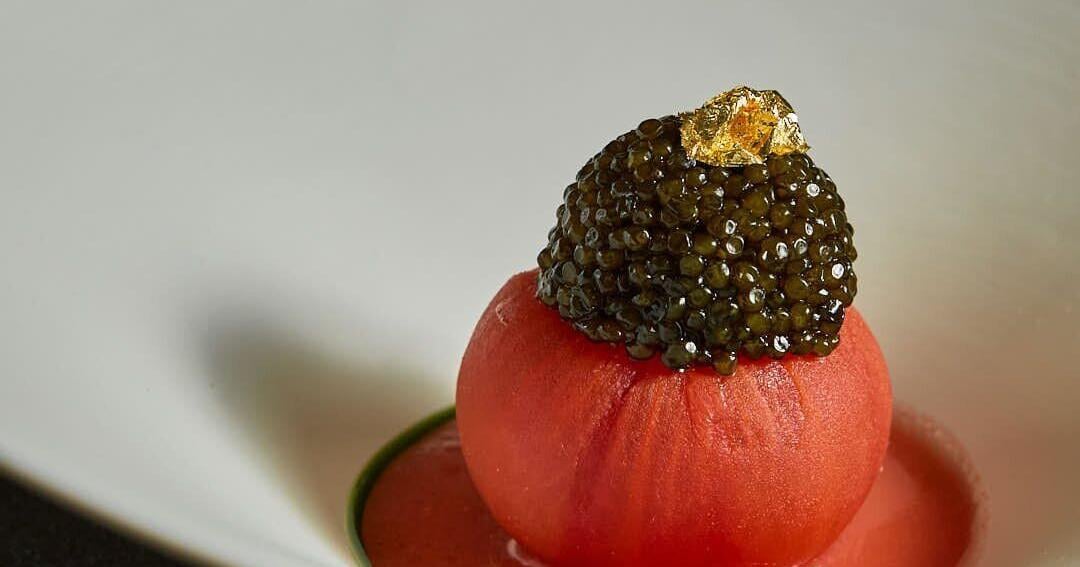
How I felt ashamed that my favourite dish was their signature tomato, a perfect pale-red sphere, peeled and lovingly stuffed with the fanciest bluefin and topped with the aforementioned less-salty-more-briny-more-nutty caviar and, yes, even a little bit of gold. It once made Yo Yo Ma cry. I knew they must be sick of making it, and Didier admitted as much. “But if you come back and it’s not on the menu,” he said. “I’ll still make it for you.”
How when we’re done eating, every single staff member appears, napkin in hand, to whisk away your plate in unison. Even Didier takes part in this ritual, although the second he leaves the counter, one of his underlings takes it from his hands, eager to carry it for him.
How Didier asked my mom if she had been to Paris. She hadn’t, but no matter, he says: “Not everyone can go to Paris, but here they can feel like they are in Paris.” You could probably go to actual Paris for the same amount of money as dinner at LSL, to be fair, but where’s the fun in that? “We all come from the same place, we’re all going to the same place, so enjoy the in-between,” Didier proclaims. “I cook and tomorrow I may not wake up. Life is precious and we are fortunate. I want her to go to Paris. I want you to be happy. Come here and forget your problems.”
How the family next to us said they love coming here just to hang out with Didier, koan-dispensing and all. Didier comes by it naturally, given that he is a long-time Buddhist. The bathroom has a little jar of handwritten affirmations composed by the staff in black marker on little pieces of parchment; Didier’s, according to Mathieu, are always the most Zen, while his are more cuddly. (Mine says “you are surrounded by love, all is well.”) The diners next to us frequent many restaurants, but the chefs never really speak to them, let alone dispense wisdom via notes left in the bathroom. “They just stay behind the glass,” one says. That’s not Didier’s style. “We drink, we eat,” he says, “but the most important thing is that we’re together.”
How Mathieu tells me they send flowers to regulars on special occasions, and how that love is returned: many people, even those coming for the first time, ask him for a hug when they leave. How often do you do that at a restaurant, especially in a town as often-frosty as Toronto? I ask for one, too. On the ride home, wax-sealed souvenir menu in hand (one side English, the other French), I ponder inviting Mathieu and Didier to my upcoming birthday party. Would they show up? That’s how you know it’s truly great service: you feel like they just might. When I got home, I affixed the affirmation to the fridge with a magnet. You are surrounded by love. All is well. My problems indeed forgotten for the moment, I felt happy. And that tastes best of all.