

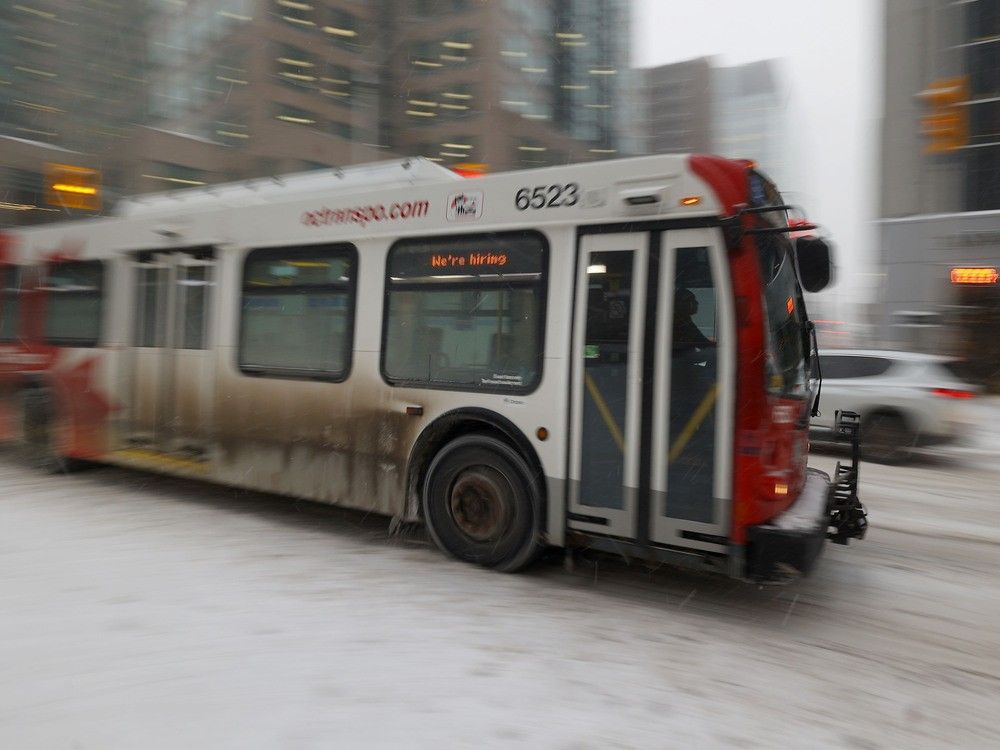
Traffic congestion, long waits for OCTranspo and even longer commute times could await public servants
who are returning to the office four days this summer, observers say.
Last week,
the federal government announced that public servants would be returning to the office four days a week
on July 6, while executives will be required to work on-site a full five days starting May 4.
With that announcement comes the reality of road congestion, costly and full parking lots and buses and trains that will be filled to the brim with public servants and other riders.
The city will have to prepare for that reality, but the beleaguered transit system will have a few months of lead time to figure out lagging issues.
July start date should help OC Transpo adjust
The east-west line of the O-Train continues to struggle with mechanical issues and a bus shortage caused by
delays on delivery of electric buses and an aging diesel-powered fleet has shaken reliability metrics.
“If everyone in the public service was returning to the office five days a week today, I would have some concerns,” said Glen Gower, the councillor for Stittsville ward and chair of the city’s transit committee.
“If you’re asking me is OC Transpo is going to have the capacity in July, when that four-day transition is going to happen, I wouldn’t be concerned about the July date,” he added.
Gower pointed to the delivery of dozens of buses expected to arrive over the next few months, and he said there was a clear path to fixing LRT capacity issues ahead of a four-day return-to-office reality.
“By July, the bus network, the train network will be in a lot better shape,” he said.
Sixty more electric buses are expected
to be on the roads by March or April, which Gower said would “help relieve some of the pressure.”
Gower said there was also a mechanic shortage of around 40 positions, but there had been an influx of applications in recent weeks thanks to an “aggressive communications and advertising campaign.”
An additional 50 new articulated buses are expected by the end of March 2027, with the first one to be delivered by the end of June this year.
Transit advocate Laura Shantz, who sits on the board of Ottawa Transit Riders, thinks the deliveries of new buses will “ameliorate” the situation and get the city back “to where we were.”
Gower added that the city had committed “several millions of dollars” to more bus priority lanes and traffic-signal priority. Those are not expected in July, but “ongoing throughout the year.”
Efficiency remains an issue
However, capacity is not the only issue, with efficiency and time spent in transit leaving
some to choose to remain in their cars
, causing concerns about traffic congestion.
Shantz said transit “has to be able to move the needle on the affordable, reliable and getting us where we need to go faster, or just as fast, or have some other quality trade-off that makes it a better bargain than taking your own vehicle.”
In the past, Shantz said, rapid bus networks would move riders from Algonquin College to downtown “in 20 minutes,” but now the O-train has left riders with extra wait times when they transfer from buses.
“Just having to wait for a bus and then maybe two trains, depending on where you live, every time you wait, you’re adding time,” she said. “Every time you wait, there’s that uncertainty of will the next mode of transit be on time?”
Observers also say that the vast size and sprawl of Ottawa did not support an efficient transit system.
“The size of the network is huge, and that makes for a lot of trouble getting people … to the same place at the same time,” Shantz said.
Adam Weiss, an assistant professor of transport engineering at Carleton University, agreed, going so far as to say that those who made the decision to move further away from the downtown core during the COVID-19 pandemic could end up returning closer to their workplaces with a more stringent return to office policy.
“This is going to be a rude awakening, and what you may see is that there are people returning form farther afield to be close to their workplace to cut down on their commute time,” he said.

Normal summer ridership dip also a factor
Observers also say that the start time for the increased return-to-office mandate should help the city.
Shantz pointed out that students, who are the “number one group of riders in terms of revenue and ridership,” are largely off school in the summer months.
Vacations are also common in the summer, leaving less public servants to be in transit daily.
“July and August on any kind of transportation tend to be quieter,” Gower said.
Weiss says fall is when the real stress test could happen, but even that is not a given.
“By September, I would expect things to sort of be quite challenging as far as congestion, and potentially even in July,” Weiss said.
City officials maintain that OC Transpo will be able ready to handle increased ridership.
“We anticipate O-Train and bus capacity will be able to support a return of more public servants to the office this summer,” spokesperson Katrina Camposarcone-Stubbs said in a statement.
However, if transit remains an issue, Weiss still does not discredit carpooling this summer and beyond, which could help reduce congestion by taking cars off the road for those “farther afield, where transit is not really an option.”
More dialogue needed with government, councillor says
“So far we’ve heard there hasn’t necessarily been a lot of communication from the federal government to city transportation and city transit,” Gower said. “I think it’s something that I’d like to see more dialogue happening there.”
The Ottawa Citizen contacted the Treasury Board Secretariat for comment, but did not hear back by deadline.
Gower isn’t wholly optimistic about a
return-to-office situation
, saying he’s concerned about roads getting busier, as well as parking costs and capacity. He’s also been hearing concerns from local businesses in his ward of Stittsville worried about the likelihood of a quieter local lunchtime rush.
“I don’t personally see why there’s such a rush to get back to in-person work. I think hybrid (work) has given people a lot of great ways to balance their schedule,” he said.
Our website is your destination for up-to-the-minute news, so make sure to bookmark our homepage and sign up for our newsletters so we can keep you informed.

