

Ottawans still dealing with the aftermath of several torrential downpours may have already guessed it.
This summer is officially Ottawa’s wettest since data was first collected on rainfall in 1872, said retired climatologist David Phillips.
“This beat the record of all those years. It’s never been this wet,” Phillips said.
Although data was only collected up to Aug. 10, the monumental 488 millimetres of rain that fell on the city up until that day was enough to break 1972’s summer record, when it rained 464 millimetres.
Phillips defined the summer as June 1 to Aug. 31 and used data gathered from the Ottawa International Airport in his analysis.
Phillips further broke down the amount of rain that fell on Ottawa — so far — this summer.
- In June, 123 millimetres of rain showered Ottawa, compared to an average of 97 millimetres in the same month in other years. There were six thunderstorms.
- In July, which was a record-setting month, an astounding 281 millimetres of rain fell, when only about 88 millimetres is standard for a July in Ottawa. There were also six thunderstorms in that month, including the large one on Canada Day, which flooded thousands of basements and caused the cancellation of fireworks.
- As of Aug. 10, there have been about 83 millimetres of rain, a time period that usually brings about 25 millimetres.
“We still have, of course, 21 days to go in August. We’re just adding to that record. We’ll break the record almost daily,” said Phillips.
Though he said nothing can come close to Ottawa, Montreal and Toronto have also had wetter summers than usual so far.
Montreal has had about 40 per cent more rain than usual, while Toronto has seen about 18 per cent more precipitation this summer.
Ottawa hasn’t had a summer entirely full of rainy days, but when it did rain, Phillips said it rained hard.
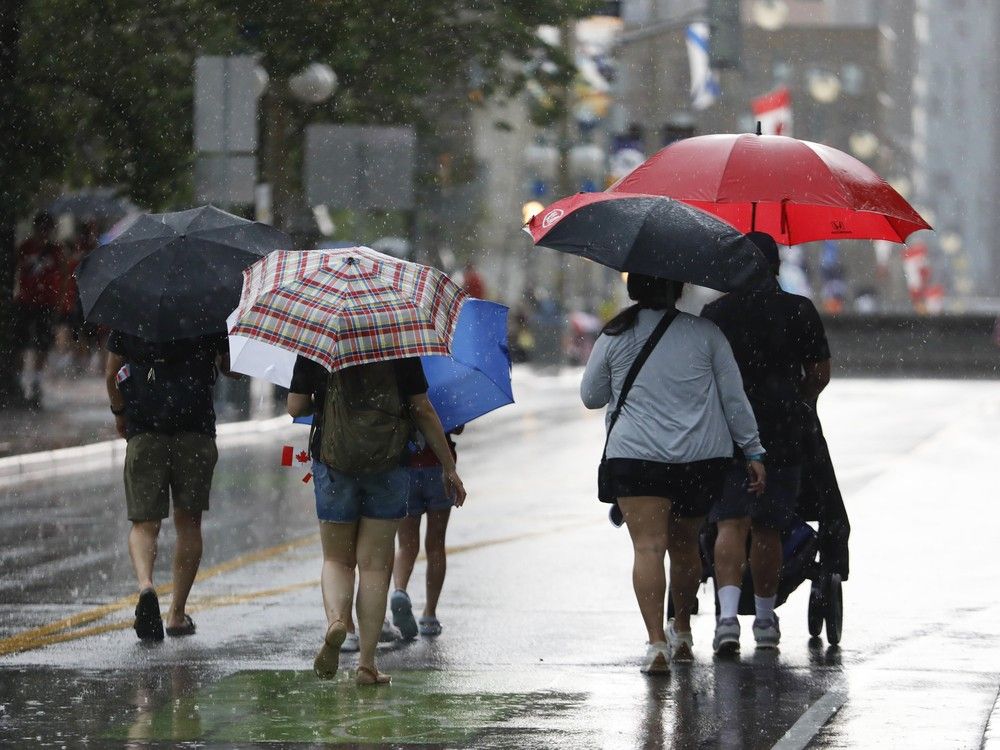
When it rains intensely for just 60 minutes, as it did multiple times this summer, he said there tends to be more flooding compared to when that precipitation is spread over eight hours. Phillips added that Ottawa’s sewer system and a lot of its infrastructure aren’t built for such a downpour.
This kind of extreme weather is expected more often with climate change, but it doesn’t necessarily mean next summer will break the record again, said Phillips.
“Next year might be the driest on record. It’s not just that the weather is warmer; it’s more extreme, but it’s also more variable. More wild swings. Jokers in the weather deck,” he said.

