

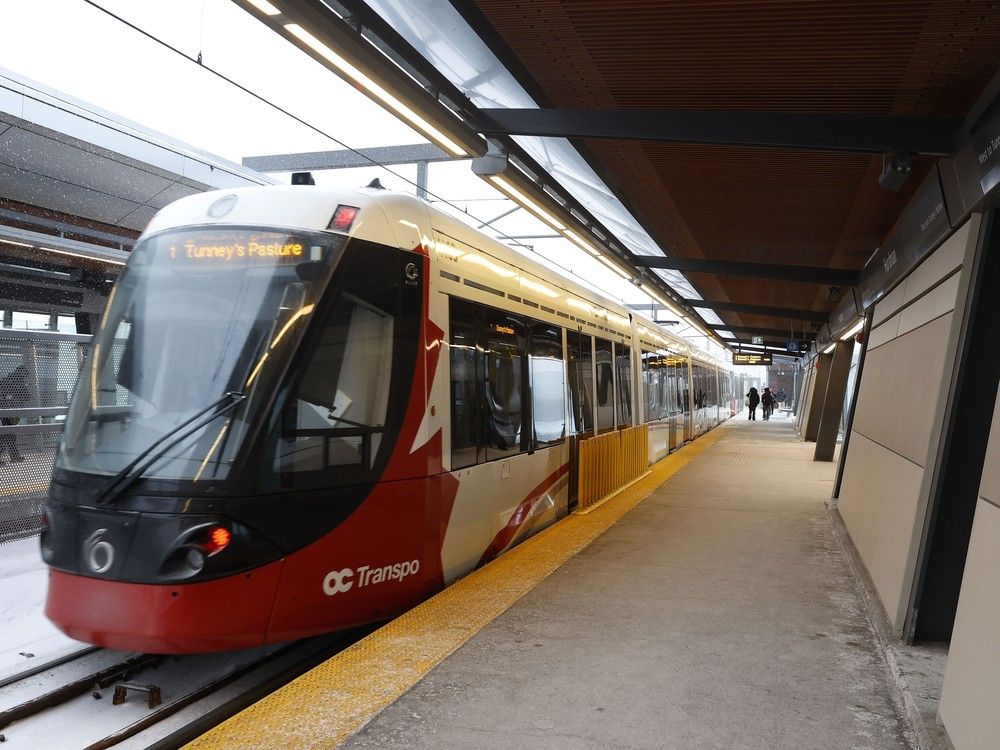
The O-Train’s partial shutdown over the Victoria Day long weekend was attributed to “staffing issues” that forced OC Transpo to suspend rail service on Line 4 to the Ottawa International Airport and on the east-west Line 1.
OC Transpo suspended Line 4 service on May 16 in the afternoon and ran replacement bus service to and from the airport.
The Ottawa International Airport Authority sent an advisory via social media around 5 p.m. on May 16 to notify travellers of the shutdown.
Line 1 service was suspended several hours later at 9 p.m. due to a shortage of available controllers at OC Transpo’s control centre on Belfast Road, “primarily due to illness,” according to a memo to council from OC Transpo general manager Rick Leary .
“We recognize this is disruptive for customers and appreciate everyone’s patience on Saturday,” Leary wrote. Rail service resumed normal operations on Sunday May 17, he noted.
Leary also acknowledged the error that led many Ottawa Charge fans to abandon hopes of riding shuttle buses to the PWHL playoff game at the Canadian Tire Centre on May 18.
The bus delays were caused by “an error in scheduling the correct start time for bus operators and buses required for the event,” according to Joel Lemieux, OC Transpo’s director of transit service delivery and rail operations.
Monday’s playoff game began at 6 p.m., while weekday PWHL games typically started at 7 p.m.
Leary said the 400-series shuttle buses “operated as scheduled” for the final Charge game on Wednesday.
Noah Vineberg, president of Amalgamated Transit Union (ATU) Local 279, said staffing pressures and difficulties filling overtime shifts likely played a role in the delayed shuttle buses on the holiday Monday.
Vineberg said in an earlier news release that shutting down two rail lines in the same weekend “is not acceptable.”
The rail lines have been “consistently understaffed,” Vineberg said, often operating below 75 per cent. “That did not happen by accident.”
Vineberg pointed to a dispute between the union and management over a “pay equity” clause for rail operators.
“Compensation our members were owed has not been paid. That is the core of this. Everything else flows from it,” Vineberg said.
“When experienced, certified (rail) professionals earn no more than bus operators despite greater responsibility and stricter federal rules, they make rational decisions. They return to bus. They leave transit. They stop pursuing rail roles. The operator pool shrinks. The controller pool, which draws from operators, shrinks with it,” he said.
“Then a Saturday night arrives where there are not enough controllers on shift to run Line 1.”
Leary said in the memo on May 21 that he has met with union leaders “to discuss how we can work together to support staffing levels during this period and hiring in the future.”
Leary, whose hiring was announced in late March, outlined his “action plan” to improve transit reliability at a transit committee meeting on May 14.
“One of the primary actions is to develop an integrated workforce strategy,” Leary wrote in the memo on May 21. “This strategy is a multi-year plan that harmonizes our workforce planning and captures future service requirements to provide detailed forecasts of our talent, training and hiring needs.”
Leary said he will present an “integrated strategy” to the transit committee in June, “outlining the current vacancies in critical frontline positions, including bus operators, diesel and electric rail operators, rail controllers, mechanics, special constables, as well as on-street supervisors.”
Leary told councillors to expect “incremental improvements to service as resources stabilize” in the coming months.
Related
- OC Transpo bus delays force Ottawa Charge fans into Ubers
- O-Train axle redesign could take years, transit commission is told

