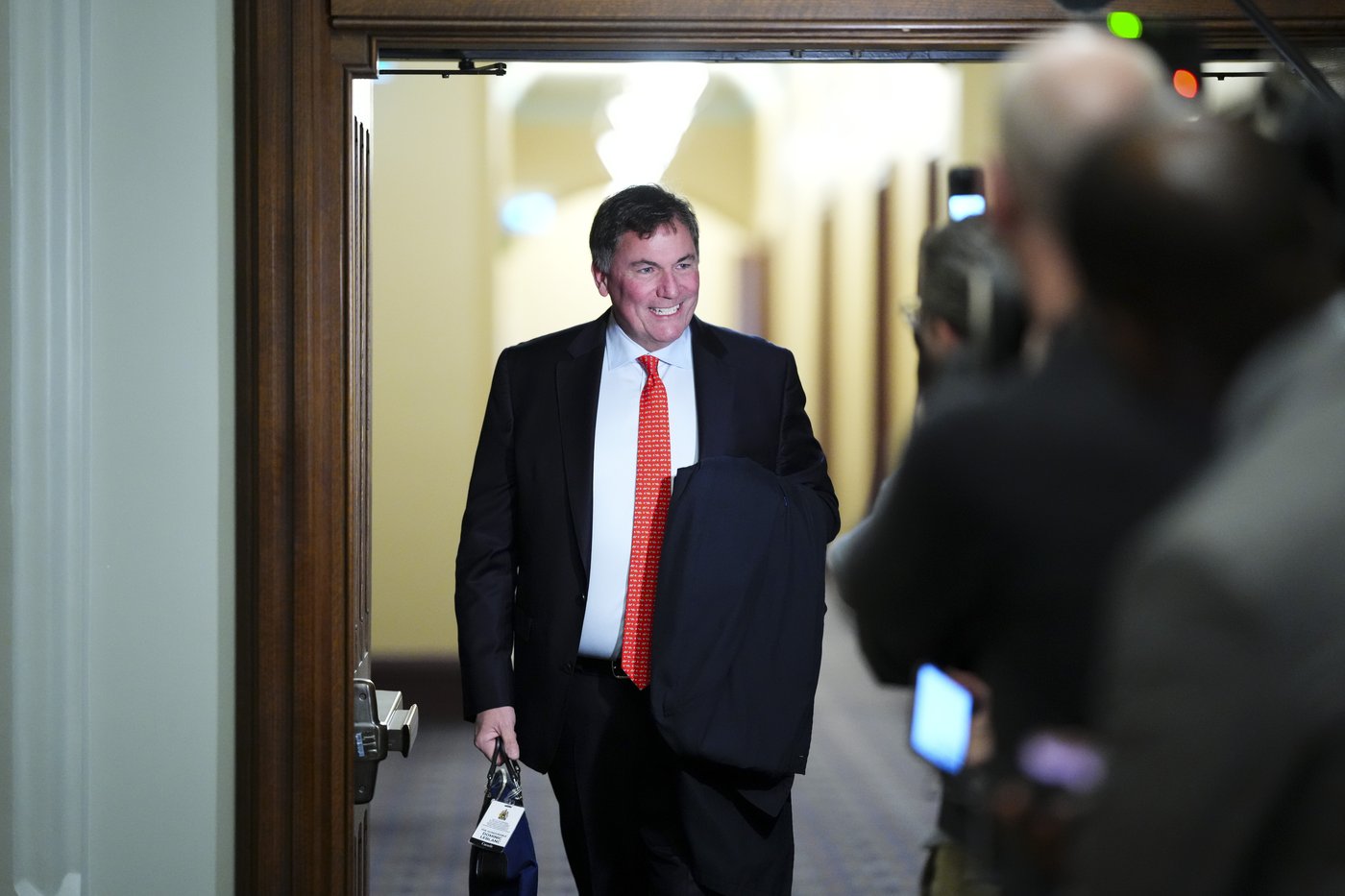
OTTAWA—Canada-U.S. Trade Minister Dominic LeBlanc travels to Washington Tuesday to try to kick-start trade talks with America’s top trade negotiator Jamieson Greer as his counterpart warns global critics of America in a new essay that U.S. tariffs are here to stay.
The U.S. and Mexico concluded on Friday their first bilateral round of talks related to the joint review of the United States-Mexico-Canada Agreement, known as CUSMA in this country. Their meetings focused on the auto sector and rules of origin, according to Greer’s office, with some media reporting the U.S. is demanding higher U.S.-made content.
Mexican and American negotiators meet again June 16-17 in Washington to talk about agriculture, and a third round is scheduled for the week of July 20 in Mexico City, while Canada has yet to have any formal negotiations.
LeBlanc continues to downplay that stalemate ahead of the July 1 deadline for the three trade partners to re-up, renegotiate, or annually review the trilateral deal.
The minister along with Canada’s lead trade negotiator Janice Charette, who will join LeBlanc in Washington for the one-day visit, and Canadian Amb. Mark Wiseman publicly say they believe the U.S. wants to reach a new trilateral agreement and does not intend to cancel or withdraw completely from the deal, which would require six months notice.
However, there is little sign of progress. And it is increasingly clear any new deal will not look like the CUSMA, which was the renegotiated North American Free Trade Agreement or NAFTA that U.S. President Donald Trump signed in 2018.
Greer, Trump’s top negotiator, in an op-ed penned for the International Monetary Fund’s Finance & Development Magazine June edition, stressed that tariffs will bring employment and manufacturing back to the U.S.
In the essay, Greer challenged tariff skeptics and economists to acknowledge the negative real-life impacts of “hyperglobalization” on industrial sectors and workers, especially men in sectors that faced intense competition from Mexico, for example, who he said face higher mortality rates.
“The damage was concentrated among working-age men and was distributed across most major causes of death,” wrote Greer, citing a study published by the National Bureau of Economic Research. “The authors found that this mortality impact more than erased the welfare gains identified in a leading economic analysis of NAFTA, making the agreement a deadly net loss for the people it was supposed to help.”
Greer said the U.S. will not stand by while countries and companies with trade surpluses with the U.S. reap gains from the free trade once advocated by economists in the post-Cold War era.
“We do not have time to wait. The United States is using tariffs and agreements on reciprocal trade to encourage inbound productive investment, increase incentives for domestic production, and open markets for U.S. exports,” wrote Greer.
“Without real pressure,” he said, any economy that enjoys a trade surplus “has no reason to act.” Hence, Greer said, the United States is taking “bold action to lay the foundation for an international economic system grounded in balance, reciprocity, fairness, and resilience.”
Greer’s essay reiterates the position the U.S. administration has argued for more than a year, yet it notably comes at a time when domestic economic pressures are growing on U.S. President Donald Trump with some hoping time is on the side of countries like Canada in the expectation Trump may be forced to ease tariffs.
Greer’s essay makes clear that’s not likely.
“In the heady days following the fall of the Berlin Wall, there was a rush to adopt the simplicity of hyperglobalization: Would it not be better for all the people of the world to eliminate barriers to trade all together? And so were born the World Trade Organization, the North American Free Trade Agreement (NAFTA), and our present predicament.
“It was thought that this approach would bring peace and prosperity, but it really just allowed multinational firms to chase subsidies and weak labour and environmental rules around the world,” Greer said, while Americans lost “millions of high-quality manufacturing jobs, more than 70,000 plants shut down, working-class wages fell behind, the industrial base weakened, innovation slowed, real productivity in manufacturing declined, and communities across the country were harmed.”
The Carney government says Canada is still protected from tariff damage because about 85 per cent of Canadian shipments to the U.S. that comply with the CUSMA rules requiring North American-made content are exempted from what Trump labelled “border emergency” tariffs (later declared unconstitutional by the U.S. Supreme Court) and from reciprocal tariffs.
But Canada’s efforts to persuade Trump to drop specific sectoral tariffs — that run as high as 50 per cent and slammed Canadian automotive, steel, aluminum, forestry and cabinetry workers — have failed to move that dial.
Prime Minister Mark Carney tried a new pitch last week to American investors and to the Trump administration, using Trump’s own political rhetoric. He said Canada can be part of a “fortress North America” in autos, steel, aluminum, critical minerals and on Arctic security. And Carney argued the Liberal government’s “Canada Strong” political agenda to diversify trade and build new export infrastructure at home will make Canada a better trade and defence ally for the U.S.
“Canada Strong will help make America great again,” Carney said at the Economic Club New York.
But John Weekes, Canada’s former chief negotiator for Canada on the original NAFTA agreement, told a senate committee that “fortress North America means a ‘fortress United States’ approach which would deny entry of Chinese goods and components into North American supply chains, and could perhaps also be extended to goods from other countries.”
Weekes warned it “would make it more difficult — or maybe impossible — to diversify Canada’s trade. A fortress approach would require the imposition of trade barriers to third countries and violate Canada’s obligations under the World Trade Organization” and under bilateral free trade agreements with other countries such as the Trans-Pacific partnership and the Canada-European Union trade deal.
Conservative Leader Pierre Poilievre told reporters Monday that Carney’s trade approach is contradictory and alternates between saying integration “made us subservient” and then saying that the Liberal government “wants more integration.”
Meanwhile, Poilievre said, “Mark Carney has been hiding from the negotiating table for the last six months while the Mexicans have been eating our lunch.”
In the Commons, Poilievre blamed the Carney Liberals for the country’s economy sliding into recession, as he slammed Carney for refusing to face media and Opposition questions.
“Where is he anyway?” asked Poilievre.
According to his official itinerary, Carney was absent from the Commons to tour a housing development in an Ottawa suburb ahead of a Toronto visit to outline steps to tackle antisemitism.
Poilievre, who argues Canada should create a national reserve of oil and critical minerals to use as “leverage” with the U.S. to obtain “a tariff-free trade arrangement,” said he had no expectations “for Dominic LeBlanc’s trip.”
“He does these trips where he goes and socializes and comes back empty handed. While the Mexicans have been in formal talks for six months, Mark Carney has been gallivanting around giving speeches filled with dazzling buzzwords that achieve nothing but the worst economy in the G7.”
LeBlanc, in the Commons, replied only briefly to Poilievre’s criticisms. “We are facing unjustified tariffs in the context of our free trade agreement with the United States,” LeBlanc said, adding he would discuss “that agreement” in the U.S. this week, while the government would continue to support affected workers and sectors.