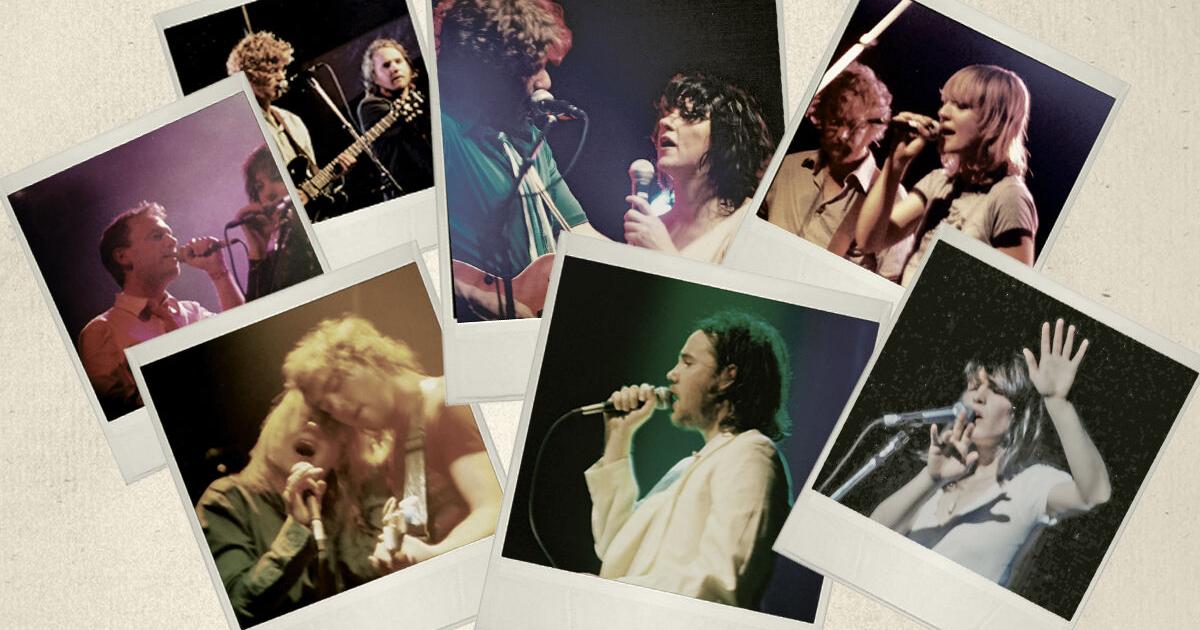
Talk to Toronto music fans of a certain vintage and their gaze will grow wistful as they reminisce about the good ol’ days of the early 2000s — a time before digital disruption, where community reigned and creativity thrived.
Many of the acts that emerged from that fertile era would become a vital part of the city’s cultural fabric — not least the shape-shifting indie-rock collective Broken Social Scene (BSS).
The band, initially started by Kevin Drew and Brendan Canning before evolving into the much larger group it is today, became known for its all-in-the-family vibe, with most members also busy nurturing projects of their own.
Emily Haines and James (Jimmy) Shaw had already begun experimenting with the synth-pop sounds of Metric; Amy Millan and Evan Cranley would go on to join dream-pop purveyors Stars; and Leslie Feist rode the strength of her cut-crystal voice and intricate guitar melodies to a breakthrough in Europe.
It’s been 25 years, and many albums, breakups and makeups — even a few marriages, including Stars’ Millan and Cranley, as well as longtime BSS guitarist Andrew Whiteman and vocalist Ariel Engle. Now, BSS, Metric and Stars have joined forces once again. Their aptly named “All the Feelings” tour closes out 23 dates across North America with a big hometown celebration at the RBC Amphitheatre on August 7. In the fall, the tour will continue through Europe, and a few more Canadian dates.
With the reunion about to reach its apex where it all first began, and new albums out from both BSS (“Remember the Humans”) and Metric (“Romanticize the Dive”) this past spring, the Star spoke with key members of BSS, Metric and Stars about their beginnings — and how far they’ve come.
The early connections
The ties that bind these three bands run deep. Many of their members met when they were music-obsessed teens, or as young budding musicians experimenting in Toronto’s early-2000s indie music and arts scene.
Amy Millan (Stars co-lead singer/guitars; BSS vocals): I met Emily on the very first day of Grade 11 at Etobicoke School of the Arts. We were both coming in midway through high school and were lost on our way to music class. The amount of metaphor is hilarious — like, being lost and looking for music. I feel like it was kind of the first day of my life — to this day, ours is the friendship that’s lasted the longest.
And I met Kevin that summer — and then later Evan, too, in Grade 12. He was carrying a trombone, and I was like, “Who’s that guy?” And now he’s the father of my kids. [laughs] But it was definitely a time when the fates were aligning to bring us our future lives.
Evan Cranley (Stars bassist; BSS instrumentals): I met Jimmy at 14, and we learned how to play guitar together. We sat in the park and learned all the Pink Floyd and Bob Marley covers, and really fell in love with songs together. Kevin was dating someone I had broken up with, so at first we were both sizing each other up.
It’s amazing how both Amy and I met these people so early in life. I have theories about why that is — I think Toronto really was a special place back then, filled with places to go see music, or parks to hang out in. We all came from funded artistic programs in schools. Art felt like it had a different value and was more ingrained in what the city was at the time.
The start of a social scene
BSS’s origin story lies in a serene ambient album recorded by Drew and Canning, 2001’s “Feel Good Lost,” which included contributions from many of their friends — a group that morphed into the collective that went on to release 2002’s breakthrough “You Forgot It In People.”
Charles Spearin (BSS co-founder; guitars/bass): Kevin and I had a project called K.C. Accidental, and at that point, we were doing mostly instrumental stuff, but some of the folks who went on to be part of BSS were already involved. I went on tour with (Toronto instrumental post-rockers) Do Make Say Think in Europe, and when I came back, Kevin had met Brendan and they had made this beautiful record.
There was an egoless-ness — no ulterior motives besides just the true joy of writing and playing together. Nobody really cared too much about virtuosity in terms of musicianship. It was just this really lovely, playful, honest energy that became contagious.
Brendan Canning (BSS co-founder; guitars/vocals): I knew Kevin from around town — I’d see him at Rotate This, or he’d give me flyers for his shows. He was doing gigs with Evan, Jimmy, Emily, Charles — and I never made it to any of them. [laughs]
But when I finally heard what he was doing with K.C. Accidental, I thought, ‘Oh, yeah — maybe I’ll make this kid a star.” Which is hilarious, and a very me thing to say at the time.
But I remember it being a very carefree time — we just wanted to hang out and make some cool music. And all of a sudden, all these different artists from different walks of life were being pulled in. It became the emotional road map of what BSS would become.
Leslie Feist (singer-songwriter; BSS vocals): We booked a bunch of shows at (tiny aughts-era College St. club) Ted’s Wrecking Yard over the winter of 2001, and I remember Kevin, Brendan, Andrew, Jason Collett and myself jamming in my kitchen at 701 Queen Street West, when I still lived with Peaches (electroclash musician/producer Merrill Nisker). Were we the first live iteration of BSS? Likely about a dozen other claims to that would say no.
Andrew Whiteman (BSS guitars and vocals): The first image I have is being at the 701, where Leslie and Peaches lived, and rehearsing in the kitchen-slash-hallway because it was so small. Right away, we got into a pattern of, “Oh, we just made up two new songs on the spot, and we’re gonna play them in two days when we go to Ted’s.” And after spending a lot of time with them, I quickly realized, “Oh, this doesn’t happen very often.” The vibe between us all was super-powerful, like we were developing our own language.
I’m not nostalgic at all, but there was a certain energy going on in the city for sure — it was a really unique time.
Kevin Drew (BSS co-founder; lead vocals, guitars and keyboards): I think back to “You Forgot It In People” — back when [influential visual artist and DJ] Will Munro was still alive and visiting us upstairs. We were surrounded by warehouses — the condos hadn’t come in yet. You were still able to go somewhere and eat for 12 bucks. The Starlight Hotel was what the Drake was then. And I remember thinking, “Man, this record sounds like a mixtape — I’m not sure how it’s going to go over.” And it turned out to be the thing that earned us the ears and hearts that came our way over so many years.
The growing pains
Thanks in part to a rave review from then-tastemaker music site Pitchfork, “You Forgot It In People” kicked off a wave of global success for BSS — and left the band scrambling to catch up with the glare of the spotlight.
Kevin Drew: Brendan, Andrew, Jason Collett — they had already circled through the industry a few times over by that point and recognized the limits of trying to build a career within that system.
Brendan Canning: The music biz in the ’90s was such a crazy time that kind of chewed me up and spat me out — Andrew, too. But then this chill thing [BSS] came along — like, nice afternoon jams where everyone’s kind of on the same page and working toward something that we all feel good about.
I remember feeling like we were always playing catch-up a little bit. We played South by Southwest after the big Pitchfork review, then got a U.K. record deal, then we had to go here and there, and do a followup record — it all felt like a whirlwind. It was like trying to grow into a new suit that you weren’t quite ready for. But 25 years later, whatever we did, it’s still going.
The evolution
Since its inception, BSS has been a multi-headed beast, with members coming and going as their primary bands or solo acts took off over the years.
Charles Spearin: There’s always been an evolutionary quality to BSS where we adapt to our environment. If any of the singers like Leslie, Emily or Amy can’t tour with us, then we’re going to keep inviting people that we admire and respect into the fold, and everybody understands that’s totally fair and kosher. So the band has this ecosystem to it that seems to be surviving like a little terrarium on wheels.
Leslie Feist: I feel that Broken was always a fluctuating open door — like one of those saloon half-doors that swings in, but also out.
Emily Haines (Metric lead singer and synths; BSS vocals): There’s nothing fake about what happened with this with this group of friends. Metric is very different from BSS — we’re like the leather jacket; they’re the fuzzy sweater. And Stars are the sparkly sequined party suit. When we started out, it was really fun and scrappy, with a sense of freedom.
The women of Broken Social Scene
Fans have dubbed BSS’ initial female vocalists — Feist, Haines and Millan — the “holy trinity” for their heavenly harmonies. As their careers took all three around the globe, the band had to pull in other singers over the years — currently including acclaimed singer-songwriter Hannah Georgas and Jill Harris of popular Toronto cover band Dwayne Gretzky.
Kevin Drew: The women that have been onstage with us have really been the backbone of the success of Broken Social Scene. There is a strong aspect to their voices that deeply burrows in — it’s like a sleeping bag that makes us feel safe.
Leslie Feist: Broken gave Emily and Amy and me a chance to sing alongside other musical alphas. As bandleaders, we may not have had the chance to flank each other without BSS. But of course, the chance to braid voices became less frequent as all three of us were concentrating on our own music.
Ariel Engle (singer-songwriter; BSS vocals): It’s not like I wasn’t aware of the incredible power of the women that had been, and were always going to be, in BSS — but what I was personally dealing with when I first joined the band was overcoming stage fright. Through BSS, I learned to be big and take up space, which is an incredible gift.
Since then, I’ve been so lucky to be able to sing with [all the female vocalists of BSS]. It’s always just a different kind of chemistry and magic — sisterhood within a brotherhood. I feel like we’re all witches stirring the pot. [laughs]
Amy Millan: The first show I ever did with BSS was the “You Forgot It In People” record release at Lula Lounge [in 2002]. Emily was living in England, and Leslie was in France — they needed someone to sing, and they asked me. And I was obviously thrilled to have made it into the cool kids’ club.
It was like going to acting school again. In a way, I got to “play” Emily and Leslie — I learned to jump around like Les, and to laser-focus like Em. It really changed the trajectory of the way I became a singer.
The 2026 tour
As they wrap up the “All the Feelings” summer tour dates in Toronto at RBC Amphitheatre, the longtime collaborators are reflecting on their decades of friendship amid an ever-changing industry.
Emily Haines: This tour really came about because Jimmy worked so hard on it for years — he’s really the connection between this group of friends. It’s so exciting that the timing worked out, especially with BSS also having a new album out — we’re all cued up at the same time.
It’ll be nice to reinhabit [fan-favourite BSS ballad] “Anthems for a 17-Year-Old Girl.” You do so much work throughout your life, and you never really know what will connect with people the most. That song is really special — it’s definitely one with a life of its own.
Brendan Canning: This tour is a testament to what got built over the years — and, remarkably, how all these bands are still relatively thick as thieves. It’s not like we all talk every day, but if there’s a Metric, Stars, or Feist gig, chances are I’m going to be there. It’s a little ray of hope for middle-aged, middle-class indie-rock — or what’s left of it, anyway.
Kevin Drew: I’m doing this because we’re still alive, and one day that’s not going to be the case. We’re three very different bands with different ways of doing things. But when we come together, there’s a history to it that is very much about growing up and growing old together. So maybe putting that triangle together — that Mighty Morphin Power Rangers trio — is going to create something that I hope brings people some joy.
Amy Millan: I love that Emily named the tour “All the Feelings.” You can’t get a group of these people who’ve known each other this long without it being like one big family reunion. You’re gonna have a lot of feelings. [laughs]
Leslie Feist: What’s kept the band going all these years is probably the generous tenacity of Kevi and Charlie and Canning. Kevi, though, really does champion everyone — perhaps to a fault. I know at times he’s frustrated that Broken is so, well, broken — but then also, it’s really not.
Interviews have been edited and condensed for length and clarity.