

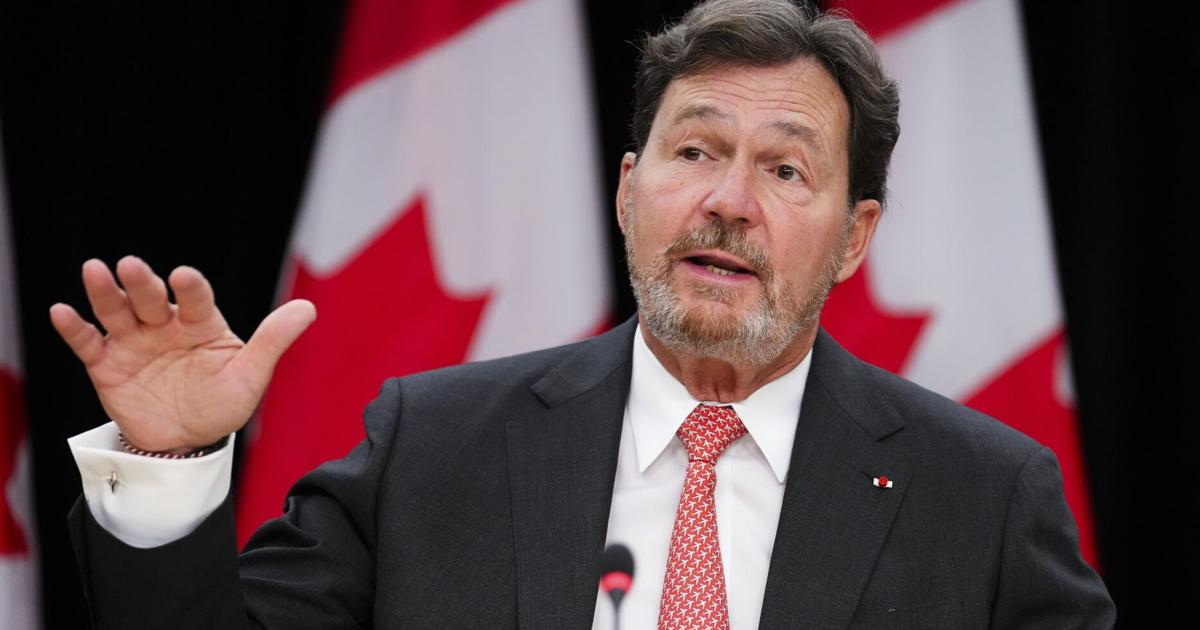
OTTAWA — Canada’s top judge says guardrails for how artificial intelligence can be used by judges and lawyers must evolve because the technology is changing so rapidly, and more and more self-represented litigants are taking shortcuts.
“Just a few years ago, ‘hallucinated’ legal cases were not something we imagined,” said Richard Wagner, chief justice of Canada, at a news conference marking the end of the court’s judicial season. “Today, they are part of our reality.”
That’s a reference to false or erroneous summaries of legal precedent or cases that may be generated by artificial intelligence platforms, which are then presented as a factual basis to argue in court about how a judge should decide the outcome of a criminal or civil case.
The top court adopted guidelines for the use of artificial intelligence issued in September 2024 by the Canadian Judicial Council, but Wagner said courts need to adapt “quickly and thoughtfully” on an ongoing basis. The promise of improved efficiency must be balanced against the need to distinguish “fact from fiction,” he said, “if we want to maintain public trust in the judicial system.”
Wagner said the high court judges are mindful of the advantages and the “major disadvantages” of the evolving technology, but he noted that in 2024, a survey found 224 “fake cases” cited in Canadian courts.
Damien Charlotin, a Paris-based legal researcher , has built a searchable database to track AI hallucinations in litigation, as determined by legal decisions. It documents 166 more cases in Canada since 2025, including 40 in Ontario.
Wagner said it is a bigger problem for lower courts where there is a higher number of self-represented litigants than the Supreme Court of Canada.
“The risk is increased when you consider that people without any legal background, for instance, the self-represented litigants, will usually use or often use AI to go before the court,” and because they don’t have “the knowledge, the experience, the expertise, they will put their problems in the machine, and something will get out, but very often it will include fake news. Not fake news — fake cases — and that’s a big risk now at the Supreme Court level.”
The Supreme Court of Canada — the final court of appeal — is also seeing a rising number of people who can’t or won’t hire lawyers and struggle to legally represent themselves.
In 2025, 37 per cent of people seeking leave to appeal at the Supreme Court were self-represented, and in the first months of this year the percentage has risen to 43 per cent, Wagner said, adding the proportion will likely increase.
It may be due to the high cost of professional legal advice to argue a case all the way up through backlogged courts, which is beyond the resources of most people; or a lack of education or knowledge that the top court only accepts a very few number of appeals to review — those where clarifying the law is in the national public interest or where there is a legal right of appeal.
Wagner said there’s no “magic solution” but he called on provinces, which are responsible for the administration of justice, to make “additional effort … to educate, to provide pro bono work, maybe for governments also to look at their legal aid budget to increase.”
He suggested the chances that “fake cases” would escape detection by the Supreme Court’s law clerks and legal branch, and find their way into a judgment, are “very low” and because “we read everything.”
AI might be used for summary of documents but it should “never be used in the analysis of the facts and the law with a view to obtain a judgment. That will be always the judge who will do that work,” said Wagner.
“That guideline is clear. It was sent to all judges in Canada,” he added.
“And it’s important that justice be rendered based on a real law, actual law, actual jurisprudence, and actual arguments, so it’s a work in progress” because the technology is evolving quickly, Wagner said.
The main responsibility “to make sure that what they raise in the court case that they refer to is real” falls to the self-regulating law societies in each province, because, said Wagner, “judges have to rely on the professionalism of lawyers.”
At the news conference, Wagner refused to speculate on the timing of a highly-anticipated ruling on a challenge to Quebec’s secularism law and the province’s use of the notwithstanding clause. He said it could come “next week” or closer to an October election but noted that the seven-judge panel which heard the case included the retiring Sheila Martin, who has until the end of November to be part of the decision.
He declined to comment on a range of other controversial questions such as: how he views the Alberta government’s demand the province have more say in federal judicial appointments; how he sees the court’s role when it comes to clarifying the Clarity Act which governs secession references (“We’ll see if there’s a case that comes to court,”) or why he does not recuse himself from an appeal on the federal invocation of the Emergencies Act during the 2022 “Freedom Convoy,” given published comments in Le Devoir where he said it suggested the convoy held Ottawa residents “hostage” and represented a “small start to anarchy.” He deferred on the latter, saying there is an ongoing legal challenge.
But Wagner said he does not regret the impact of the 2016 Jordan ruling which set out strict timelines for criminal court cases to be heard to reflect the Charter’s guarantee to a trial within a reasonable time. It has led to hundreds of cases getting tossed for unreasonable trial delays. “I still believe that Jordan is the right scheme, although I was in dissent when the decision was rendered,” said Wagner.
“I think that the elected officials got the message years ago. I think that governments invested more in technology, in resources. There are still a lot more to do, but I think we’re on the right path.”
Error! Sorry, there was an error processing your request.
There was a problem with the recaptcha. Please try again.
You may unsubscribe at any time. By signing up, you agree to our terms of use and privacy policy. This site is protected by reCAPTCHA and the Google privacy policy and terms of service apply.
Want more of the latest from us? Sign up for more at our newsletter page.

