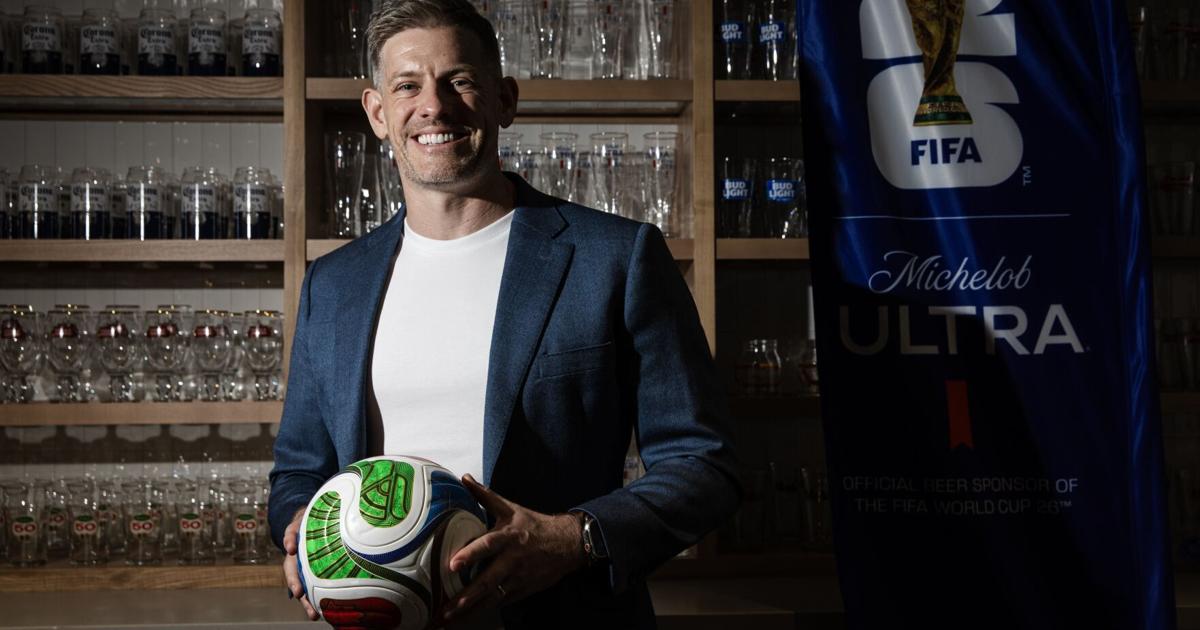
It’s hard to imagine a bad time to enjoy a beer with Labatt Breweries of Canada president Brian Perkins, but it’s hard to imagine a better time than at Toronto Stadium moments before the first ever World Cup match in Canada.
Not only is Labatt-owned Michelob Ultra sponsoring the home team and the tournament globally, but the day also marks the start of the biggest sporting — and beer drinking — event in human history.
“It’s not an exaggeration to say we’ve been preparing for this moment for years,” Perkins says. “The World Cup is always when people drink the most beer, and because this is the biggest World Cup yet — with the most teams, the most matches, and because of technology, the most opportunities to watch globally — it will be the biggest ever.”
After moving to London at age six, the South African earned an English degree from Cambridge and spent four years with a London-based consulting firm before earning an MBA at Harvard. There, he met his now wife, with whom he moved to New York in 2011 and took a job with beverage behemoth AB InBev.
He’s worked for the brand ever since, first in its innovation department in New York, then as a V-P of marketing for Budweiser in the U.S., then as the brand’s president of global marketing. Perkins later served as chief commercial officer for AB InBev in Europe and the Mideast, before becoming CEO of the Budweiser Group in the U.K., Spain and Ireland.
In March, Perkins was tapped to lead Labatt Breweries of Canada as the country prepared to host the World Cup, and as the brand responds to rapidly changing consumer preferences.
Founded in London, Ontario in 1847, Labatt’s 70 brands account for 40 per cent of the beer sold nationwide.
In 1995, the company was bought by Interbrew, which merged with AmBev in 2004, to create InBev, and then with Anheuser-Busch in 2008 to create the world’s largest brewing company. AB InBev now includes 400 brands, 170 breweries, 137,000 employees and nearly $60 billion in annual global sales.
The Star spoke with Perkins remotely from the Labatt Canada headquarters in Toronto, and then over a beer at Canada’s inaugural World Cup match, about his arrival in Canada at a pivotal moment for the country, the sport, the brand and the industry.
Did you grow up watching soccer?
South Africans love all kinds of sport. We also love beer, so I found the right job.
I grew up watching rugby, and when I moved to the U.K. there’s obviously a big football culture there, so it prepared me to run a beer company in the U.K. during the last World Cup.
So, you’ve done this before?
It’s funny to measure your career in World Cups.
I was very fortunate to be running the Budweiser brand globally when we sponsored the World Cup in Russia, and I was running our U.K., Ireland and Spain business during the last World Cup in Qatar.
This is a new twist, because I had the great fortune to land in Canada just prior to hosting.
As someone who attended Cambridge and Harvard, should I assume beer wasn’t a major part of your academic experience?
Quite the opposite. I’ve always loved our category, how it brings people together, how it enables connection and bonding.
Both university and business school were very social experiences. I’ve always worked very hard, but after a long hard day there’s nothing like getting together with your friends and having a few beers.
Is that why you joined AB InBev in 2011?
After University I spent four years consulting for big multinational consumer companies and went to business school knowing I wanted to work for a company that actually made something.
But I swore up and down that I would never work for a big consumer packaged goods brand. I found them too bureaucratic and slow, so I was looking to work for a smaller, more agile company.
Then a friend of a friend invited me to their happy hour at the headquarters in New York City, and I was immediately struck by the culture. This was the global headquarters of the biggest alcohol company on the planet, so I was expecting to see five thousand people and a separate executive floor, but it was about 100 people all on one floor. The CEO didn’t even have his own office.
It was all about fast decisions and serendipitous encounters. It also didn’t hurt to know that the company had a bar in the office.
Then someone at the table next to us from the global innovation team started chatting with me. He said they were expanding, and I might be a good fit.
How has your career progressed since?
I started in the global innovation group and then moved to the North American headquarters in St. Louis to run marketing for the Budweiser brand in the U.S., which was a dream job.
I spent three years in that role, and then was asked to return to the global headquarters in New York to run the Budweiser brand globally. I did that for three years, but I wanted to move into operations, so AB InBev moved me into sales.
I was also part of the founding team of our flagship B2B digital platform BEES. Then COVID hit and the world turned upside down. It was very hard on us with bars and restaurants closed.
During the crisis I received a call inviting me to come to Brussels for a new role that combined sales and marketing, and became the chief commercial officer for Europe and the Middle East.
Then after three years, the president of our U.K., Ireland and Spain business resigned, and I had the chance to move to London to replace them in 2022, which is where I was when I got the call inviting me to run the Canadian business in December.
What are your goals in Canada?
In a word, growth.
We have a very rich portfolio of brands, and we want to grow more aggressively and ambitiously than we have in the past.
You’re already the market leader. Is there room for growth?
Growth is not easy in a mature market and a mature category.
When you’re the market leader, there’s less low hanging fruit, but that gives me a lot of energy. The puzzle is trickier to solve, but that means that fewer people are going to solve it, so the prize is bigger.
My job is finding the pockets of growth based on what consumers are telling us they want today, while also trying to figure out what they might want next.
What do Canadians want?
We see the effects of the K-shaped economy, so more demand for premium products and value. The two fastest growing brands in Canada are Michelob Ultra, which comes at a premium price, and Busch, which offers great value.
We also see the health and wellness trend changing how people socialize. We’re seeing lower consumption of alcohol overall, but especially on weekdays. People are still going out for a beer on a Monday night, it’s just non-alcoholic.
That non-alcoholic beer category is growing by double digits, we’re the market leader, and we think that that’s going to be a much bigger feature of the category in years to come. That’s why we sponsored the Olympics with a non-alcoholic brand, Corona Cero, and why you see Michelob Ultra Zero on the boards at the World Cup.
We’re also seeing growth in the ready to drink category with brands like Cutwater, Nutrl and Mike’s Hard Lemonade.
What’s your favourite?
Having worked on Budweiser for six years that’s still my go-to.
Does it taste different here?
Ninety-nine per cent of our products in Canada are brewed locally with Canadian ingredients, even the international brands, which makes the beer fresher, supports the local economy and reduces emissions. Michelob Ultra, Budweiser, Corona, they’re all brewed with Canadian ingredients, by Canadian brewers, shipped in Canadian trucks.
All our beers have high quality standards, but Budweiser’s is probably the most stringent. It’s made in more than 50 breweries around the world and before they can sell it, they need to send a sample to St. Louis to be blindly tested by a panel of expert brewers. Only those that pass quality and consistency standards can be sold.
So no, it doesn’t taste different, by design.
What does Labatt have planned for the World Cup?
It’s not an exaggeration to say we’ve been preparing for this moment for years.
Not just the marketing campaign, but our inventories, because all those restaurants and bars will need to be replenished faster than usual, and we need to be ready for that.
We can spend all this money sponsoring the World Cup and building beautiful ad campaigns with Lionel Messi and Jonathan David, but it doesn’t count for much if you’re only left with warm beer. We’re taking temperature very seriously working with the stadiums, the Fan Fest, the bars and restaurants and retailers to make sure you have a great experience watching the games.
For those watching at home we have commemorative packaging and giveaways to invite more people into the experience.
This will be Michelob Ultra’s biggest summer ever. It’s already the fastest growing beer brand in Canada, and we can’t wait to see what it can do.