

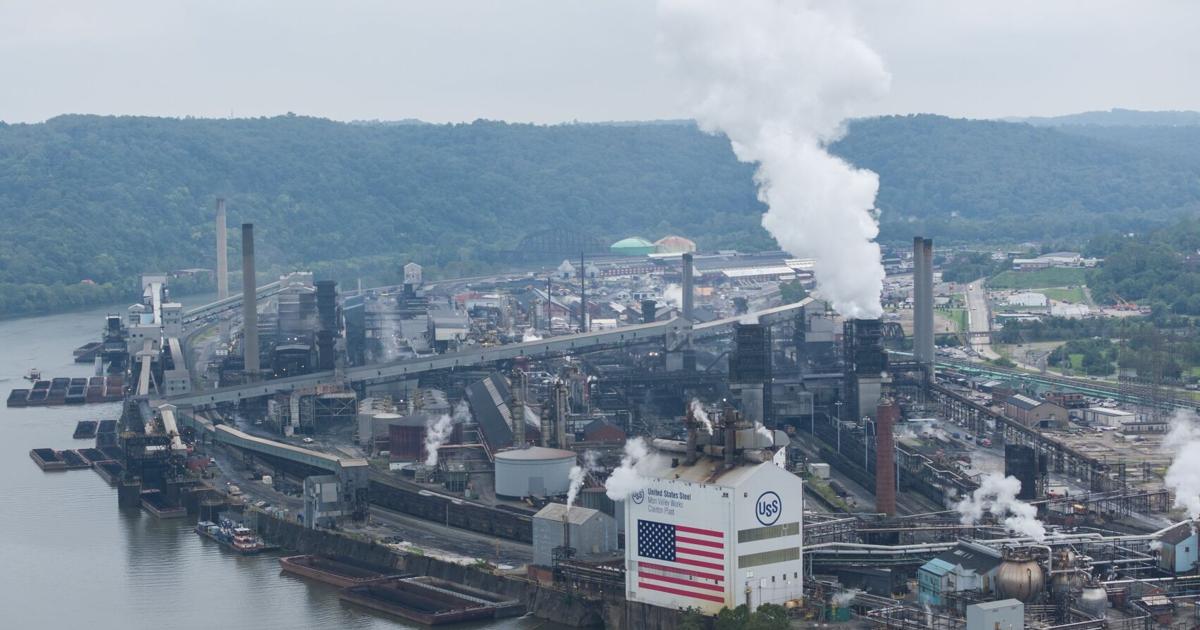
PITTSBURGH — An improbable show of support for Canada came recently, from amid the hollowed-out streets and rusting mills of Pennsylvania’s steel country.
The people who work at the few remaining steelmaking facilities in the Pittsburgh region’s Mon Valley have plenty to worry about closer to home. The decades-long contraction of their industry has left high unemployment and rampant poverty, and the recent Japanese acquisition of their employer U.S. Steel has them wondering about their future.
Nevertheless, the Pittsburgh-headquartered union that serves as their voice — the United Steelworkers (USW) — is proving a rare example of a U.S.-based organization that’s willing to speak out against Donald Trump’s tariffs on our country.
Along with a smaller union, the International Association of Machinists and Aerospace Workers (IAM), the USW issued a letter at the end of last month lamenting the harm done to the Canada-U.S. trade relationship and calling on Trump to return to co-operation, rather than making good on his threat to impose yet more tariffs next week.
Did the union leadership’s letter reflect a groundswell of concern among local members for Canada’s well-being? Why is the USW willing to stick its neck out for us when other unions like the United Auto Workers (UAW) have declined to do so?
I set out to the region earlier this week to try to find out.
I started by speaking with Steelworkers president Roxanne Brown, and it quickly became clear that a big part of the explanation is simply that the USW (along with the IAM) has a sizable Canadian membership. That sets it apart from the UAW and other unions, and its leadership seemingly felt compelled to show solidarity.
“We’re an international union,” Brown told me, “and we have each other’s backs.”
She also painted it as a matter of standing strong with a like-minded country against the real villains of international trade: China and other faraway countries that have long contributed to the industry’s decline by exporting underpriced steel, and actually deserve tariffs. Attacking integrated North American industries (including those like automaking which steel supplies) would only hurt those efforts, she suggested.
She asserted that few USW cardholders on either side of the border — who also span other tariff-afflicted industries, including forestry — would disagree. “Our members in the U.S. have been equally supportive as our members in Canada.”
But based on what I encountered through the rest of my day in the valley, I’m not so sure.
It wasn’t hostility that I encountered mostly, even from the sizable contingent of Trump supporters in the area. But it sure wasn’t an outpouring of neighbourly concern, either.
The three steel mills in Mon Valley are spread across three riverside towns — Clairton, Braddock and West Mifflin — and each has its own union local. There were no responses to my attempts to reach out to them by phone and email, so I tried dropping by.
The first union hall was locked up tight. The second was also closed when I first visited, but when I came back later, I let myself in and found one guy fast asleep. The third was busy, as I happened to come by during a meeting of its reps, but they all flatly declined to talk to me — beyond telling me this was the first they’d heard of their union leadership’s tariff letter defending Canada.
Among the rank and file, there seemed to be even less familiarity.
When I stood outside one of the mills, still reckoning with the aftermath of a deadly explosion a year ago, workers coming off 12-hour shifts understandably proved less than excited by the prospect of talking tariffs. Most just shook their heads and quickened their pace as the words “I’m a journalist from Canada …” were leaving my mouth.
Still, the conversations I did have were telling. Most seemed unaware there were tariffs on Canada or had no strong views on them.
Although one worker cryptically offered that countries which impose tariffs should expect counter-tariffs, most seemed broadly supportive of Trump’s broader tariff agenda. And there were signs of unrest with the union’s general position toward him.
“Those morons back the Democrats, but I knew Trump was going to be good for us,” said Dave Matty, an affable 20-year employee at the Clairton plant. “I would say probably 90 per cent of people in my mill here, we’re all Trumpers.”
That apparently includes the leaders of his local. Before leaving the one rep there to his slumber, I had time to notice a Trump poster — the one that says “Fight!” with a photo of him at the Pennsylvania rally where he got shot in the ear — on the door of the local president’s office.
Among those workers who are aware of — and support — USW’s plea to ease up on Canada, there was still some optimism that the message could penetrate anyway.
Keli Verb, a third-generation steelworker I connected with through the union’s headquarters, said she thinks most union members are naturally sympathetic toward Canada, given industries on both sides of the border have for decades faced similar threats from China and elsewhere.
Verb emphasized that cross-border co-operation is a message she and others are actively pushing right now. But she also tacitly acknowledged there’s a ways to go.
“I think our union needs to push a little more, educate a little more,” she said.
Not everyone in these communities seemed likely to be a receptive audience for that education.
When I left the mill to head to a nearby bar — one of the few local businesses that was open — I found the owner keen to engage in a little Canada-bashing. We’re ungrateful, he suggested, to the U.S. keeping us safe. He also said he’s abandoned Crown Royal in response to Canadians pulling American liquor off the shelves, and didn’t seem terribly interested when I gently pointed out that had itself been retaliation for the tariffs on us.
The bar owner also helped put me in touch with Brian Pavlack, an employee of the Clairton plant who has appeared at Republican rallies as the leader of a group called “Steelworkers for Trump.”
Pavlack said he doesn’t support his union’s position, though he didn’t display much animus toward Canada specifically. “I just don’t think any country should be exempt from the tariffs,” he said.
None of this should be mistaken for a comprehensive survey of steel country. Nor would any polling data back up Matty’s 90 per cent claim. (Pavlack put Trump support among local steel workers at more like 75 per cent, and even that was probably an overestimate.)
But what I saw and heard did lay plain the tricky balancing act that Brown is attempting, in standing up for Canadian members without running afoul of any U.S. members who might be paying attention.
As a Canadian, it’s hard not to appreciate her willingness to go out on that limb, with little to gain on her side of the border. Especially when many others — including U.S. Steel and its industry association, both of which declined my interview requests — are keeping their heads down.
The same goes for the machinists’ union, whose president, Brian Bryant, was more pointed when I spoke with him by phone this week. The reticence of companies that benefit from cross-border trade and integrated supply chains has been “a major source of frustration,” he said, and partly what prompted the USW and the IAM to speak up.
But if those calls from union leaders aren’t giving Trump too much pause, a little time in the valley underscored why.
It’s the rank and file who defected, in significant numbers, from the Democrats to his Republicans.
Those are probably the folks Canada would need to care deeply about this issue, for the message to penetrate the White House, and that’s no small ask.
As their jobs and communities continue to remain under siege, it feels like an uphill battle to convince them that Trump’s unfairness to their northern neighbour is their problem.

