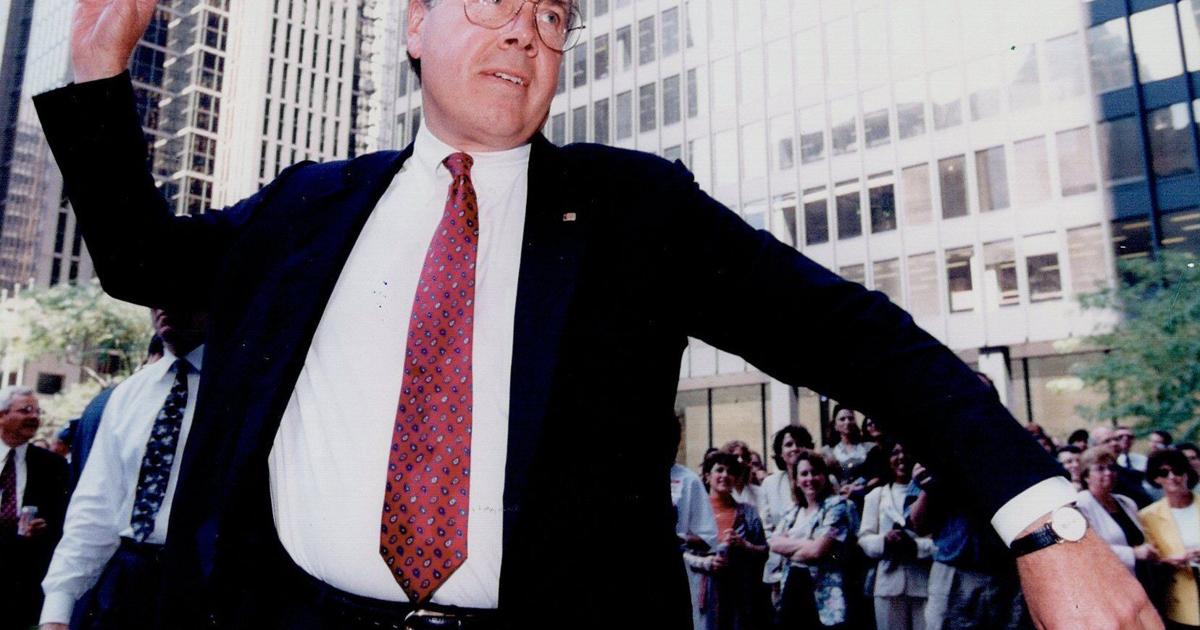
No one took more pot shots at John Cleghorn than me.
I don’t say that with pride, it’s just the truth. When the former chairman and chief executive of Royal Bank of Canada once delivered a speech that he billed as a “visionary seminar,” I found that it failed to identify any unique selling proposition to set Royal apart from its competitors. I know it sounds smart-ass now, but in response I wrote a column in the National Post that took the form of the speech he should have given.
Unsurprisingly, despite my repeated requests, Cleghorn would not consent to an interview.
Finally, I got so far as an off-the-record breakfast meeting that was supposed to lay the foundation for an on-the-record session, but nothing came of it. Maybe cutlery went missing that morning and I was somehow blamed. Whatever the reason, he never warmed to me.
One time, when I saw him at a reception while he was still in office, I tried and failed to strike up a conversation. I swear, he was shaking with anger at the very sight of me.
But such personal slights were mere blips on the radar screen of a bank that was founded in the 19th century. The root questions were: Did a CEO’s beliefs about marketing make any difference? Did it really matter whether or not he had a declared vision? The answer to both, apparently, was “No.” The bank prospered despite what I saw as Cleghorn’s lack of anything much to say and a poor podium presence.
After all, a bank CEO doesn’t possess the office so much as hold it in trust for the next in line. Every Royal leader was part of a corporate continuum that went back through the ages. Cleghorn had inherited the job from Allan Taylor.
Born in Prince Albert, Saskatchewan, Taylor joined the bank as a junior at sixteen and worked his way up by making his name as an international banker who could accurately judge country risk at a time when too many nations teetered on the brink of bankruptcy.
Prior to Taylor was my favourite, Rowlie Frazee. I once spent several days travelling with him in Atlantic Canada as he met employees, businesspeople, and politicians. He also spent time with a group of army cadets at the Combat Training Centre in Gagetown, New Brunswick.
Among the many helpful thoughts he passed along to the young trainees was the best description I’ve ever heard for leadership. “After forty years, I have to confess to you that I’m not exactly sure I know what makes a leader,” Frazee told the cadets. “I think I know when I see it. Leadership is like sex appeal. It’s easier to recognize in action than it is to describe in the abstract.”
Before Frazee, came Earle McLaughlin. He’s remembered for saying in 1976 that he was unable to find a woman suitable to be a director on Royal’s all male forty-eight-member board.
“We have looked for such a woman, but we have not been able to find one with the qualifications in the areas we need,” he told a journalist. “For example, a simple housewife may represent women, but she could make no contribution to the running of the bank.” There was an uproar, and two women were quickly appointed: Mitzi Steinberg, a Steinberg’s vice-president; and Dawn McKeag, president of a Winnipeg-based investment company.
Those were the days when even cabinet ministers were cowed by the powerful McLaughlin who took it upon himself to speak not just for the Royal but for the entire banking industry. During his time as finance minister in the Pierre Trudeau government, Donald Macdonald was asked if McLaughlin had offered his views on some matter. Said Macdonald, “We have not yet been summoned to the throne.”
Today, it seems to me that bank leaders find themselves in a whole new quandary.
In August 2022, for example, with the pandemic subsiding, Royal CEO Dave McKay sent an internal memo to the bank’s 89,000 employees pleading with them to work from home less and come into the office more.
In his missive, he didn’t say exactly how often he wanted them showing up at work, but soon after the word went out that he meant two or three times a week. I can’t imagine any of his forebears putting up with such a lily-livered approach to leadership. Even so, a few months later, ROB Magazine named McKay CEO of the year.
Through it all, although it baffles me how, Royal manages to retain its standing as the biggest bank in Canada. By definition a bank is all about lending a buck, making a buck, and keeping a buck safe. And where the buck stops. These days the buck seems to stop in some hybrid worker’s home office.