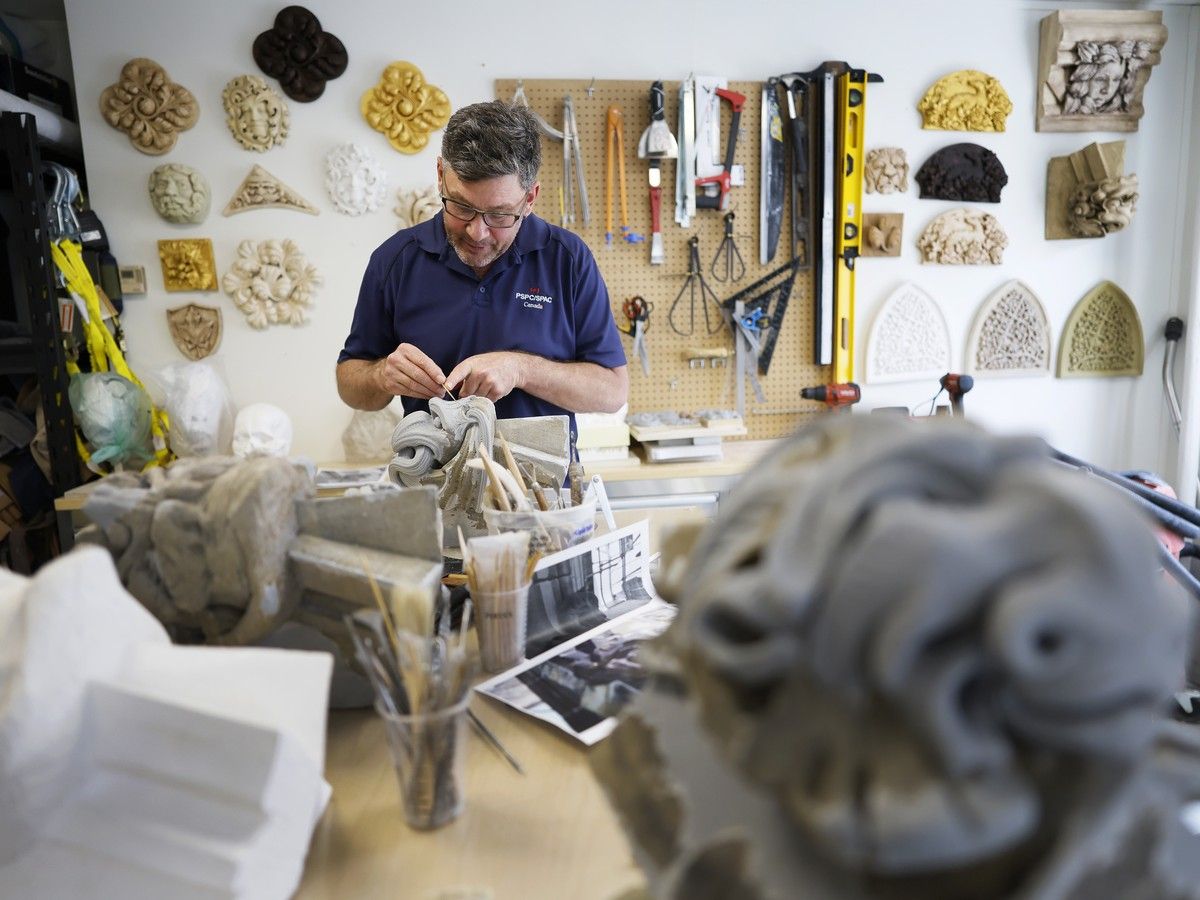
Parliament Hill has about 700 exterior carvings — plenty to occupy the small team of artisans working under Canada’s Dominion Sculptor.
For three weeks, Danny Barber made an office out of the scaffolding high up on the walls of Centre Block.
Normally, the carver works out of a small studio in a government building a short walk down the street from Parliament Hill.
This job, however, had to be done on site.
Barber was working on a grotesque, or decorative stone figure, flanking the arched windows set high in the wall behind the Speaker’s Chair in the House of Commons.

When construction crews dismantled the windows as part of the ongoing Centre Block rehabilitation project, blank stones for the grotesques were inserted as a placeholder before they could be carved.

The Evening Citizen
So, Barber chiselled directly into the building. “You don’t get to do that very often.”
Working on the building itself — or “in situ” as Barber calls it — comes with a unique set of challenges.
For one, he had no access to power tools, meaning all the carving had to be done with traditional methods.
He was also at the mercy of his environment. A vertical scaffold pole stood directly in front of the stone he was carving, forcing him into some “really awkward positions.”
“If it’s on your bench, you can turn the stone around,” he said. “But you can’t flip the building.”
All told, the building has about 700 exterior carvings — plenty to occupy Barber and the rest of the small team of artisans working under Canada’s sixth Dominion Sculptor, John-Philippe Smith.
As Canadians throng Parliament Hill on Canada Day, they’ll be gathering under sculptures carved and maintained by a succession of Dominion Sculptors, one of the many unheralded jobs that have helped keep Parliament running for 159 years.
Typically, decorative stones in need of restoration are removed from the building entirely, temporarily leaving behind an empty pocket where the replacement carving will be inserted once it’s complete.
The largest chunk of stone Smith’s team has transported back to the studio was a carving of a bison.
“Not the size of a bison,” he said. “The size of, I guess, a medium-sized dog.”
In Canada, the role of Dominion Sculptor stretches back to 1936. Much of the original carving on Centre Block was done decades earlier, by a team of European carvers under Walter Allen, an expert in Gothic design who worked on some of England’s most iconic cathedrals.
The hundreds of carvings on the exterior of the building run the gamut from realistic depictions of Canadian wildlife to representations of medieval beasts, such as wyverns and cockatrices.
“There’s a grim reaper,” Smith said. “There’s a scene with wolves that’s a bit macabre.”
But the carvings all fit within three broad categories, according to Smith: “Humour, humiliation and turpitude.”