The end credits for “Jackass: Best and Last” are the longest part of a short movie. They consist — predictably — of outtakes showcasing Johnny Knoxville and company further brutalizing themselves and what must be the most extended list of thank-yous since “The Lord of the Rings.” One name stands out amid the roster of friends, family members and fellow Gen-X figureheads (we see you, Tony Hawk), suggesting an artistic lineage closer to the Criterion Closet than a bungee-corded porta-potty: Buster Keaton, the pioneering and daredevil silent-era director famed for maintaining a stone face while risking life and limb.
“Buster’s always been with me and always will be with me,” said Knoxville in 2018. “In our stunts, there’s no fudging. The guy doing the stunt is doing it for real. (Keaton) felt very strongly about that, and I feel very strongly about that.”
Strong feelings — pain, nausea, outrage, exhilaration — are part of the “Jackass” legacy. In a modern entertainment landscape where irony and CGI rendered viewers comfortably numb, the most successful MTV original of all time plunged headfirst into full-bodied — and often full-frontal — slapstick. Some of the appeal was visceral: the vivacious, almost sacrilegious thrill of watching somebody else suffer for our sins.
But there was also a sly intelligence at work. By threading the needle between Evel Knievel, skateboard culture and underground zine esthetics — all packaged with the gritty immediacy of reality TV — Knoxville and co-creators Spike Jonze and Jeff Tremaine devised a viable franchise out of thin air: a primal scene for a lo-fi, high-impact style of comedy as old as Keaton but also calibrated for internet-era virality.
The controversy over the show’s content when it premiered on MTV in 2000 became a marketing strategy in and of itself. Here was something genuinely dangerous, conjuring up a perfect media storm of parental anxiety, morality policing and sincere concerns about copycat homages by impressionable young viewers. The prevailing wisdom was that the crudely packaged stupid human tricks were lowering the collective IQ — the pop-cultural equivalent of a concussion.
The criticisms were predictable. What was harder to see coming, like a giant spring-loaded hand to the face, was how “Jackass” would gradually become, if not respectable on the order of Keaton, then certainly relevant as a millennial text: an op-ed writer’s dream; the subject of university lectures and dissertations about shifting modes of masculinity.
When the New York Times opined that 2002’s “Jackass: The Movie” was “like a documentary version of ‘Fight Club,’ shorn of social insight,” the reviewer was the one being obtuse. Any given episode of the show said at least as much about the conjoined desire for connection and penance as David Fincher’s film. (Brad Pitt himself turned out to be a fan, cameoing in a vignette dramatizing his own — faked — abduction on a busy Los Angeles street, included here in the latest theatrical iteration).
The crassness of “Jackass” was always counterbalanced by its sense of camaraderie — superficially similar to but crucially distinct from the frat-boy hijinks that dominated so much early-aughts comedy. Knoxville and his collaborators were many things — brave, impulsive, idiotic, irresponsible — but they weren’t cool. They had more in common with freaks and geeks than the proverbial big men on campus. Their revenge-of-the-nerds shtick was abject in a way that belied its basic good nature and not-so-stealthy sense of inclusivity. The rainbow-coloured umbrella that Knoxville twirls during the opening credits of “Best and Last” scans as a signal to the series’ legion of queer fans.
“One might venture to say (“Jackass” is) homoerotic in a way that doesn’t mock being gay, which was surprisingly ahead of its time,” wrote critic Jess Thomson in 2022. “In ‘Jackass,’ laughter is never aimed at someone because of who they are, rather how they react to whatever ridiculous prank is being pulled.”
There is a lot of laughing onscreen in the “Jackass” series, and it can be contagious: the funniest moments often involve the stars breaking one another up before, during or after the stunts, sometimes as a defence mechanism or a means of defusing tension. The flip side to all that giggly stupidity, though, is a barely sublimated melancholy, especially in recent instalments, which feature tributes to the late original cast member Ryan Dunn, who died in a drunk-driving accident in 2011.
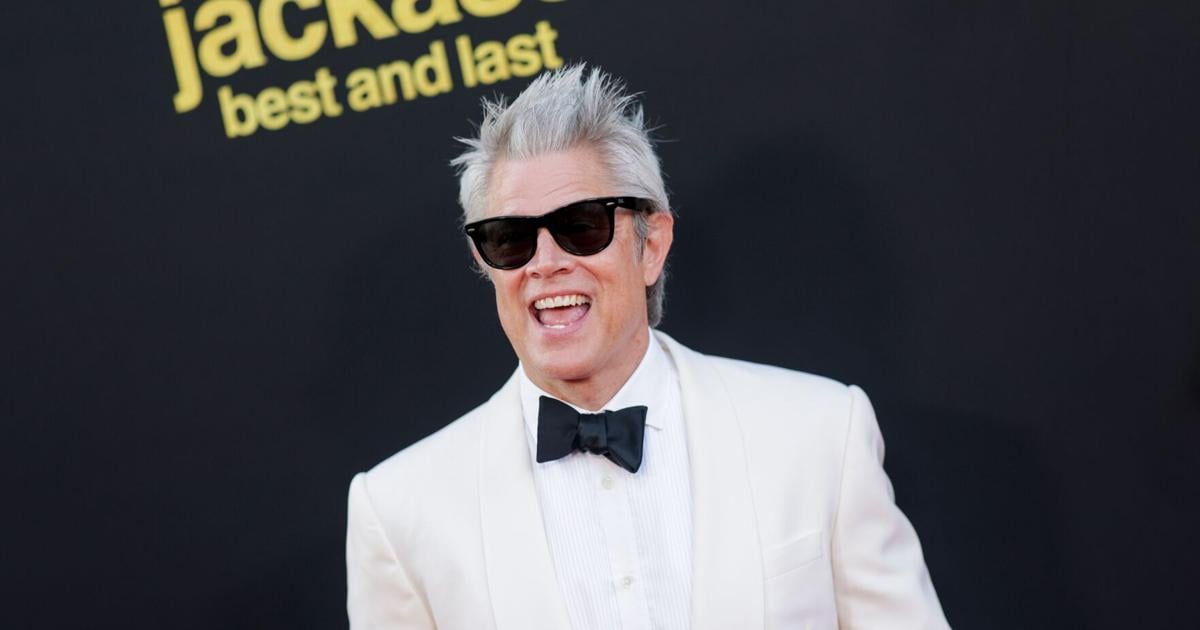
It’s one thing to make a spectacle of cheating death, as Knoxville did in the very first — and before now, unseen — segment, involving a loaded pistol and a bulletproof vest. It’s another to see bodies once defined by their springy resilience start to sag and soften, or to hear Steve-O implore older men to schedule a colonoscopy, or to watch Knoxville — strikingly handsome now in his mid-50s, and visibly hobbled by a series of head injuries, spine surgeries and bone breaks — start to cry when he realizes that “Best and Last” really is going to be the series’ swan song.
“Jackass: Best and Last” concludes with a stylized sequence framing its stars as action heroes, barrelling serenely through a desert landscape straight out of “Mad Max,” somehow indestructible as explosions erupt all around them. The images are suggestive but it’s the song on the soundtrack that’s truly key: a nod across the decades from one Rat Pack to another. “Jackass” is over. They did it their way. Please, don’t try it at home.