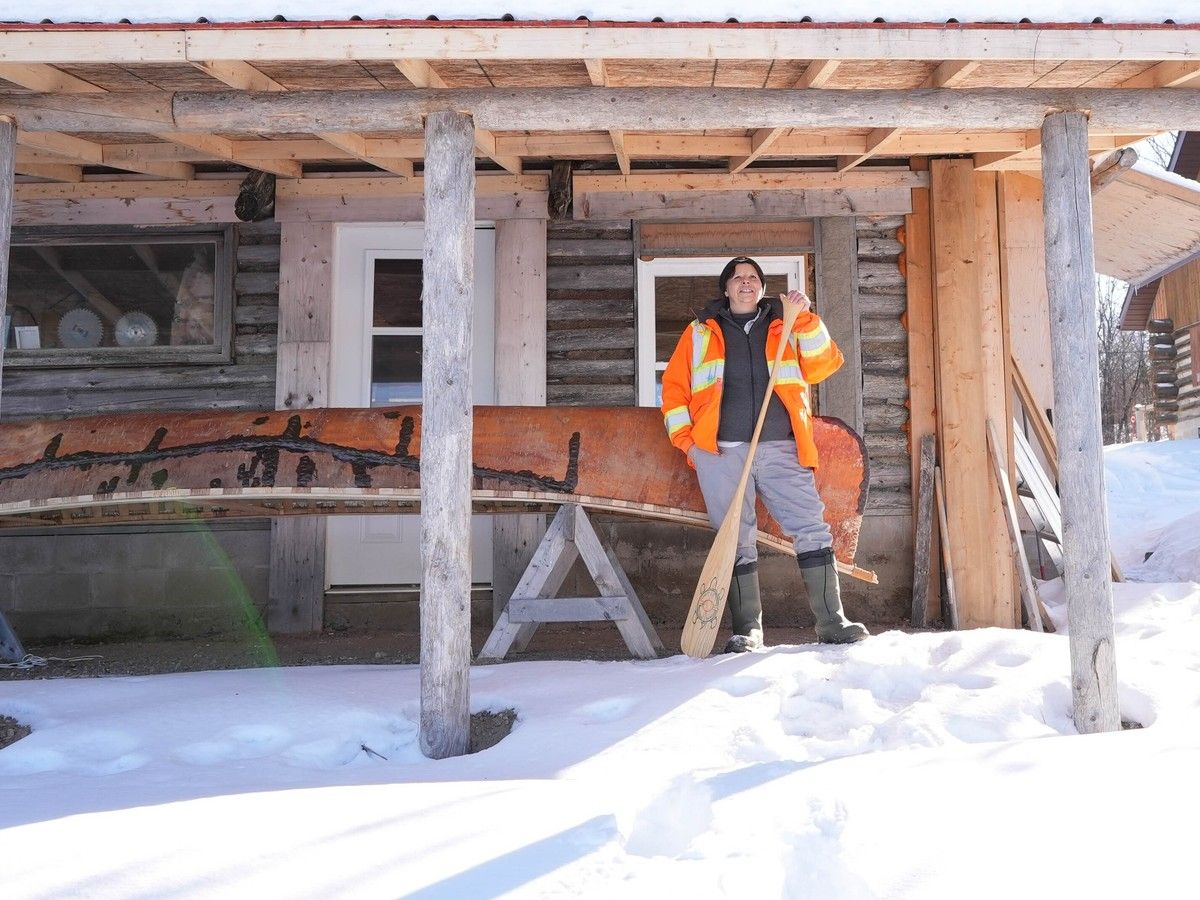
A journey on the Ottawa River by canoe involves myriad challenges like rapids, headwinds and swarms of bugs. But on this odyssey, as part of a group of more than 30 paddlers, the moments Janet Kohoko cherishes the most are the quiet ones.
“No one’s talking. You can hear the water dripping off your paddle,” says Kohoko, a member of the Algonquins of Pikwakanagan First Nation, located about halfway between Ottawa and Algonquin Park, on the shores of Golden Lake
Those reflective moments were part of the Pinesi Paddle, an annual summer canoe journey now entering its third year of travelling traditional Algonquin routes in the watershed, all with the aim of reasserting a historical presence in the area and connecting communities.
The trips were the brainchild of Kichi Sibi Trails, a volunteer-led organization working to map and revitalize traditional trails and portages. With a membership made up of a mix of Indigenous and non-Indigenous canoeists, historians, and community members, the organization’s efforts culminate each year in the Pinesi Paddle. This year, from July 5-10, they’re headed from Ottawa to Kahnawake, Que. (near Montreal), with invitees from the Mohawk community on board as well.
For Kohoko, her past Pinesi Paddles brought her closer to the history of her ancestors.
“Everything revolves around [the Ottawa] River for us,” Kohoko says, speaking of the waterway known to the Algonquins as the Kichi Sibi (“Great River”).

Trails and river routes a reminder of ongoing and historic Algonquin presence
The land now occupied by the national capital has always been a significant meeting point for Algonquin people.
It was also the hunting grounds of Constant Pinesi, Grand Chief of the Algonquins at the time of Bytown’s establishment. The paddling trip named in his honour retraces routes he would have been familiar with, especially as his people were displaced by European settlers in the 1820s.
In 1842, the superintendent of the Indian Department for British North America wrote that the Algonquin tribes “could no longer procure a livelihood” from hunting in their territory, which had been “entirely ruined” by settler incursions.
An 1857 petition from a group of Algonquins requested lands for a settlement on the shores of Golden Lake, where Pikwakanagan is today and where they had already been residing for several generations.
Wendy Jocko , president of Kichi Sibi Trails and a member of Pikwakanagan, says the connection to traditional routes particularly impactful for her as a direct descendant of Chief Pinesi.
“Two hundred years [ago] they were going up and down the Kichi Sibi in canoes. And we’re still going up and down the Kichi Sibi in canoes. Although we’re 200 years later, we’re still floating around,” she says.
Marking “invisible footprints” and pathways in Ottawa
Using features in the landscape and clues in archival maps, Kichi Sibi Trails historians have plotted a likely route for Chief Pinesi’s portage around Rideau Falls.
“Our footprints have been invisible,” says Jocko of the trails. “They’ve been paved over at certain spots,” .
To that end, the organization has installed trail markers along the Rideau portage route, graced by motifs by Kitigan Zibi artist Simon Brascoupé.
“When I first started years ago, people thought we were extinct, the Algonquins. Public art is a way to change those attitudes,” says Brascoupé.
To continue walking on those trails is particularly impactful for her as a Land Guardian, Janet Kohoko says. “The river’s alive .. To our people, it would be like our veins, it’s that close to us.”
While their journey follows traditional routes, the land and waters traversed by the Pinesi Paddlers has been irrevocably changed, particularly by hydroelectric projects. There are 43 major dams in the Ottawa River watershed, complicating the process of finding trails.
Jim Stone, a non-Indigenous historian and vice president of Kichi Sibi Trails, says one method of locating historical portages is through clues embedded in traditional place names. For instance, where rapids bottleneck the river, researchers can infer the existence of portage trails. But thanks to dams, some of that of whitewater — and any portages — are now 40 to 60 feet underwater.
Coming up to one of the dams, Kohoko says, was “one of those moments that everyone goes quiet, because you know the damage is irreversible … It’s like losing your limb, [coming up] on a mountain of concrete that’s changed your river.”
Kohoko also noted the presence of pollution in the waterway.
Pikwakanagan’s Guardian program hopes to soon take an active role in monitoring ecosystem health and water quality in its part of the watershed. Seeing the impacts of pollution “ignites a fire to later address these issues,” Kohoko says.
Building bridges, community and camaraderie
Fast forward to today, and the diverse Pinesi Paddle crew is united by “love for the Ottawa River,” says Kohoko.
That camaraderie is built through physically gruelling days on the water, navigating rapids, headwinds, sweltering sun and driving rain.
Bonding as a team helped the paddlers work together, and sometimes, support came in unexpected ways. At significant historical gathering spots, Janet Kohoko says, “you could just see your people standing there.”
She recalls an especially potent moment on the river when, passing through a narrow, cliff-lined channel, “our hair stood up all over.”
“You felt like there was people up there looking down and kind of cheering. It was really odd and hard to explain […] And I know everybody felt it because we all had more energy, and were really excited.”
She’s looking forward to more moments of connections on this summer’s paddle, when the group is hoping to add a traditional birchbark canoe, recently built by the Guardians, to their fleet.
The trails revitalization, cultural aspect and the canoe journey are all leading towards one goal, Kohoko feels. “It’s just connecting to your land and realizing what you’ve lost and trying to move on and trying to live in the world that we live in today.”
This story was produced in partnership with the Reporting in Indigenous Communities course at Carleton University’s School of Journalism and Communications.