

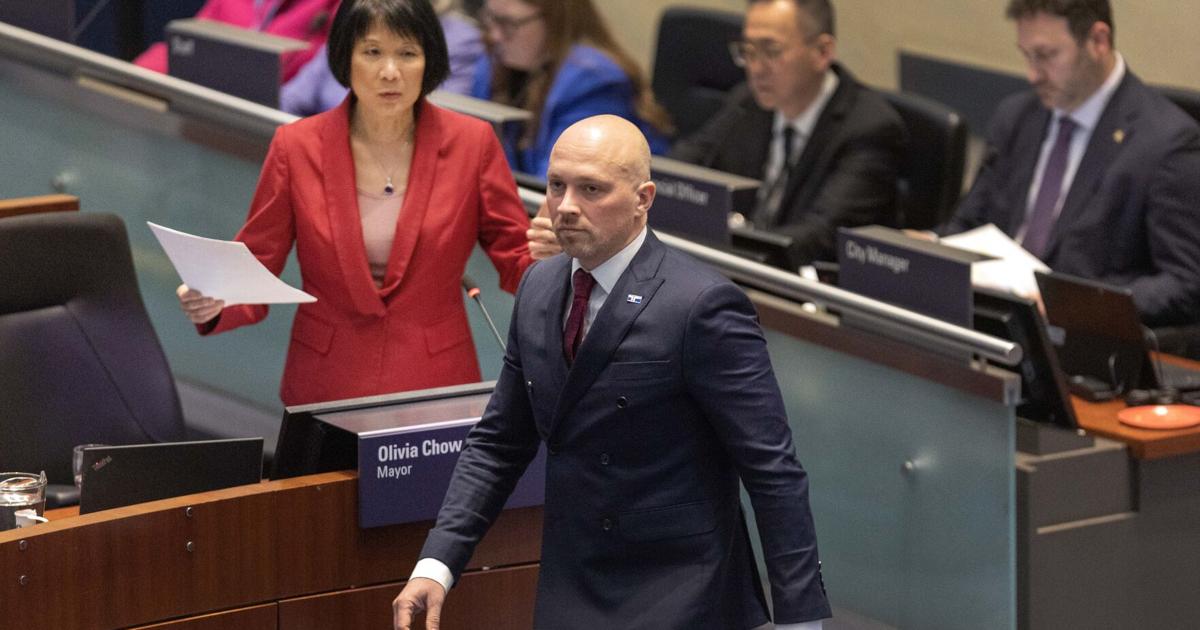
The race for Toronto mayor appears to be tightening, with polls suggesting the main challenger to incumbent Olivia Chow is gaining ground.
A survey released Tuesday by Liaison Strategies was the second in less than a month that showed Brad Bradford could give Chow a tough fight this fall.
It found that Chow still held about a nine percentage point lead over Bradford, the Beaches-East York councillor who registered May 1 to run for mayor. About 49 per cent of decided or leaning respondents said they would vote for Chow if the election were held today, while 40 per cent said they would support Bradford. One in 10 said they would vote for someone else.
How much the lead has narrowed
But Chow’s lead has narrowed from the 13-point advantage she had over Bradford in the municipal poll Liaison released in May. At the time, 50 per cent of decided voters said they would back Chow, while 37 said they would support Bradford.
Bradford is “inching closer and closer,” said Liaison principal David Valentin. He attributed the councillor’s rise to his campaign focusing on issues that are resonating with voters, such as concerns over public safety.
He said Bradford is also benefiting from so far being the mayoral contest’s only high profile centre-right candidate. Headed into the campaign, many observers thought the easiest path to re-election for Chow, a veteran progressive, would be to face a crowded field that would split the more conservative vote.
Why Olivia Chow’s favourability rating has slid
However, just as striking as Bradford’s rise in the polls is Chow’s sliding favourability rating, Valentin said. The latest survey found 51 per cent of respondents approved of the job she was doing, while 43 per cent disapproved, and six per cent were not sure. Her approval figure has gone up and down since falling from the lofty mid-70s she achieved in the fall of 2023 in the first months of her term, but has been dropping since March, when it was at 58 per cent.
It’s now at its second-lowest point since September 2025, according to Liaison’s data. Valentin attributed the decline in part to the challenge Chow is facing in handling Premier Doug Ford, who continues to intercede in city issues like the expansion of the island airport. While Chow has pushed back on the proposed expansion, she may not have been forceful enough for members of her base who are steadfast against operating jets at the facility. Meanwhile, if she’s seen to pick a fight with him over the issue it could turn off centrists and swing voters, Valentin said.
About half of respondents still believe Chow is doing a good job and Valentin said her team doesn’t need to hit the panic button yet. But the numbers are “not the kind of movement that you want so close to the election,” he said. Voting day is Oct. 26.
The results from Liaison come two weeks after Mainstreet Research released a poll that also suggested Bradford has put himself in a strong position to take on Chow. That snapshot found about 44 per cent of decided voters would re-elect Chow, and about 38 per cent would support Bradford. That was a major improvement for the councillor, who was polling at about 17 per cent in a February Mainstreet survey that still included former mayor John Tory. Tory announced in March he wouldn’t attempt a comeback bid.
The new Liaison poll suggests a particularly tight mayoral race in the key battleground of Scarborough. The eastern borough was crucial to Chow’s victory in the 2023 byelection to replace Tory, when she won five of its six wards. The poll shows decided Scarborough respondents evenly split between the the mayor and Bradford, with about 45 per cent backing each. Another 10 per cent said they would vote for someone else.
Tuesday’s Liaison poll surveyed a random sample of Toronto residents from June 28 to 30 using interactive voice recording technology. The margin of error is plus or minus 3.1 percentage points, 19 times out of 20, and higher for subsamples.

