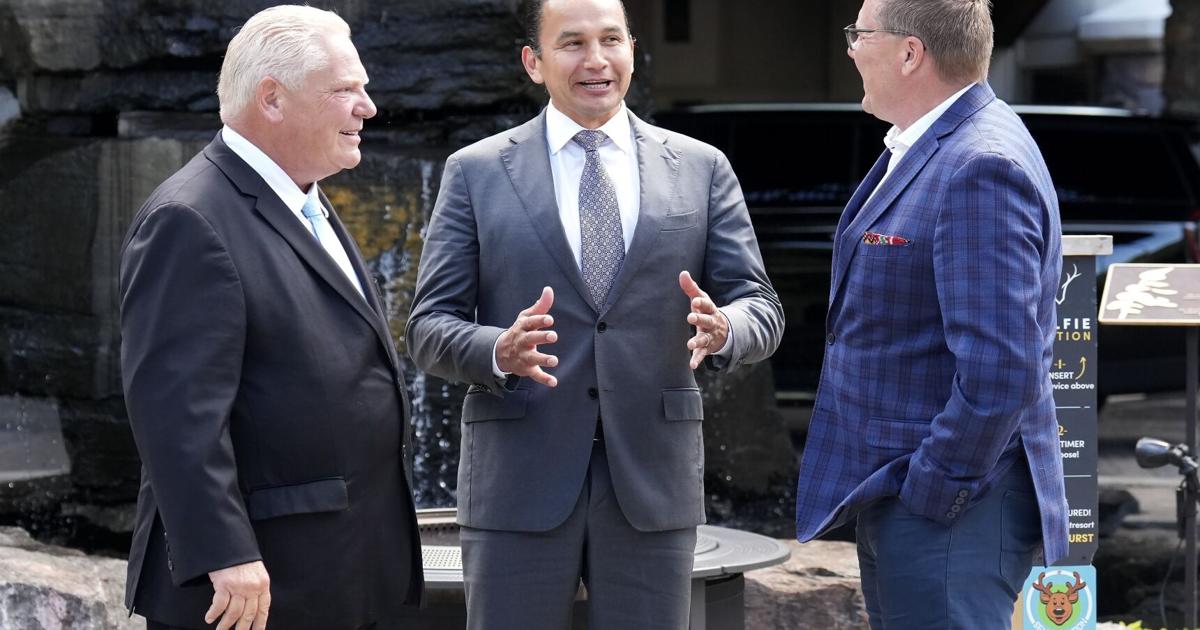
CHARLOTTETOWN — Tensions are tugging at the ties of national unity as Doug Ford, fellow premiers and territorial leaders gather in the birthplace of Confederation for their annual conference this week.
With a referendum on Alberta separatism looming and polls suggesting a resurgent Parti Québécois could be competitive in Quebec’s fall election, premiers will be tackling issues including pipelines, energy development and further reducing internal trade barriers amid continued pressure from U.S. President Donald Trump’s tariff war.
The American threat had premiers singing from the same songbook last July when Ford hosted the Council of the Federation and Prime Minister Mark Carney at Deerhurst Resort in Muskoka, but harmony could be more elusive in a waterfront hotel here from Tuesday through Thursday.
“This is an opportunity for provinces and territories to come together to strengthen our partnerships and advance solutions to the challenges facing Canadians,” said Prince Edward Island Premier Rob Lantz.
The meeting comes days after Assembly of First Nations chiefs vowed to fight Carney’s reforms to streamline approvals for major projects if they weaken environmental protections or ”limit meaningful consultation.” First Nations leaders are meeting in Charlottetown on Tuesday as premiers arrive and are scheduled to meet again with the premiers and the prime minister in late October.
Carney is scheduled to drop in again this year and security officials will be on alert after protesters in Nova Scotia blocked the vehicles of Premier Tim Houston and his staff from leaving Acadia University in Wolfville after a speaking engagement last week.
The RCMP said one person climbed atop Houston’s vehicle and smashed the windshield while he was inside with aides, The Canadian Press reported.
Also on the agenda for the 13 leaders are health care, affordability, public safety, economic growth, sovereignty and national security.
Premiers discussing energy corridor plans
Ford is playing those last three cards in his plan with Alberta Premier Danielle Smith for a “Northern Shield energy corridor” from her province’s oil hub of Hardisty, a two-hour drive southeast of Edmonton, to refineries in Sarnia.
But the idea has raised eyebrows in Manitoba as Premier Wab Kinew — who clashed last year with Ford over the latter’s threats to ban Gimli-made Crown Royal from LCBO shelves — pushes for a pipeline to Churchill for shipping oil out through Hudson Bay.
“Major nation-building projects have to be built the right way,” Kinew said, in a blunt statement after Ford and Smith announced their proposal during the Calgary Stampede earlier this month. Ontario has suggested the pipeline could include a branch up to Churchill.
Ford hailed his 3,300-km plan — now the subject of a feasibility study due by year’s end — as “a critical next step in building a more united, more prosperous and more resilient Canada.”
Proposed pipeline could create thousands of jobs
In Windsor on Thursday, the premier boasted that the pipeline and expanded refining capacity could bring 10,000 jobs to southwestern Ontario and noted Michigan has tried to shut down an existing pipeline under the Straits of Mackinac.
“Never again will we be held hostage,” Ford said at a hospital groundbreaking in the border city.
Michigan’s concerns centre on the risk of a rupture in the oil and natural gas pipeline, which began operating in 1953, beneath the straits connecting lakes Huron and Michigan.
From Edmonton, Smith’s office said her province needs more ways to get its oil to market.
“Alberta will … continue to advocate for policies that remove federal barriers to trade and investment, so that we can get major nation-building projects built, get more of our resources to market, and drive generational economic growth as a world-leading energy superpower,” her director of communications, Sam Blackett, told the Star.
Northern Shield project faces criticism and hurdles
Facing criticism because the proposed Northern Shield project lacks a private-sector proponent and could cost taxpayers $33 billion, Ontario Energy and Mines Minister Stephen Lecce polished the sales pitch for a “sovereign” energy corridor last week in Sarnia.
He warned a reliance on pipelines through the United States — the way Ontario gets much of its oil from the west — is folly.
“We can and we ought to be refining, manufacturing, mining, processing more here at home,” Lecce added in an appearance with longtime Sarnia Mayor Mike Bradley, who also hit the national-unity angle.
“It produces wealth for every part of the country,” said Bradley, who is up for re-election in October and keen on the promise of more local jobs. “We’re having an adult discussion about this industry and treating it with the respect it deserves.”
Environmental concerns raised about oil infrastructure
Oil pipelines, however, are getting blowback from groups concerned about climate change.
“It is darkly ironic that on a day when wildfire smoke turned Ontario’s sky orange and Toronto ranked among the worst cities in the world for air quality, the Ontario government chose to make a sales pitch for more oil refining and a massive new pipeline,” said Emily Hunter of Environmental Defence.
“It’s clear that the provincial government is completely out of touch with the climate crisis unfolding outside our windows.”
The focus at recent premiers’ conferences has been on taking down more and more internal trade barriers as Canada looks to boost its economy to offset the negative impacts of Trump’s tariffs.
In the last year, Ford has signed a number of agreements with other provinces doing just that on products like alcohol and food and issues like labour mobility and joint recognition of credentials for skilled workers.
Discussions on renewing the Canada-United States-Mexico trade agreement, known as CUSMA, are also on the agenda as federal officials talk with their counterparts in Washington, D.C.