NIAGARA-ON-THE-LAKE—The satirical tragicomedy “Heartbreak House” is subtitled “A Fantasia in the Russian Manner on English Themes.” It was Bernard Shaw’s wordy way of acknowledging that his 1920 play, though thoroughly rooted in England, draws upon the sense of domestic ennui perfected by Russian writers like Chekhov and Tolstoy.
However, the Shaw Festival’s seventh staging of the work, now running at the Jackie Maxwell Studio Theatre, should instead be subtitled “A Fantasia in the Manner of Bertolt Brecht.” That’s the only way to describe artistic director Tim Carroll’s revival, which plays willy-nilly with the original text and adds a head-scratching, Brechtian alienation device.
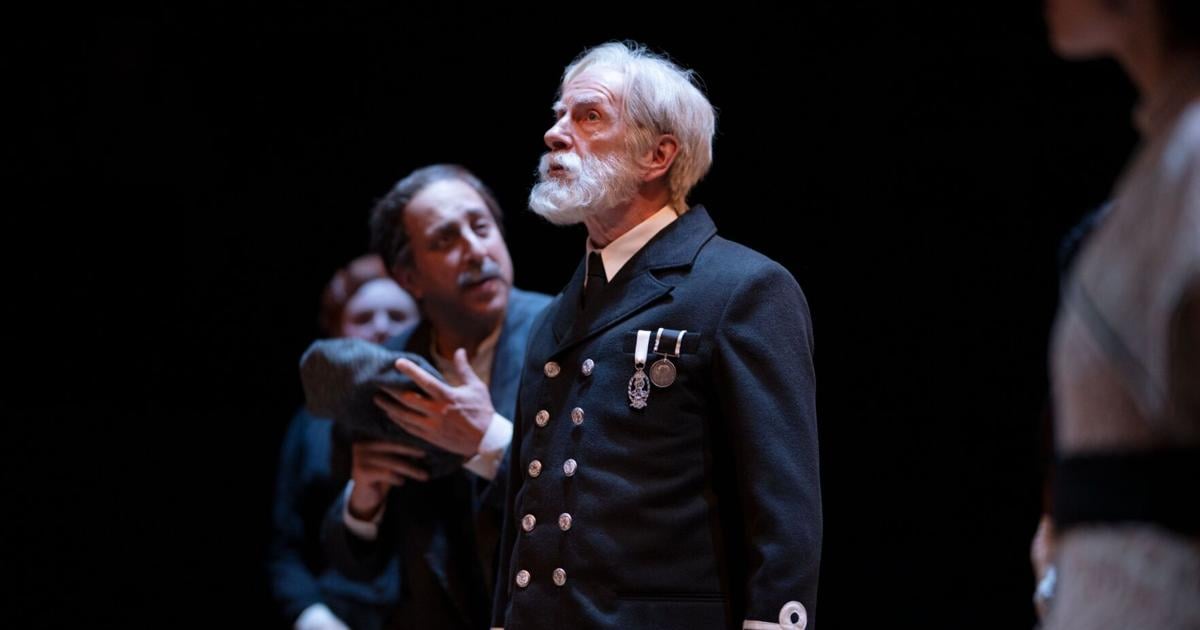
Shaw’s central story remains more or less the same: Set at the home of the retired naval commander Captain Shotover (Tom Rooney), the play follows the various romantic entanglements of the captain’s two daughters, Hesione (Julia Course) and Ariadne (Sochi Fried), along with several visitors, including Hesione’s friend Ellie (Allison Edwards-Crewe).
The show’s big revelation arrives in the third act. As Shotover’s family and their guests gather in the garden after dinner, the quietness of the night sky over England is broken by the cries of air-raid sirens and the sounds of German warplanes flying overhead.
It’s in this final act that Shaw, like a sly magician, finally reveals his hand. The story’s setting, initially ambiguous, now comes into focus: We’re in England during the First World War. And though much of the play, at least initially, deals with the trivial affairs of Hesione, Ariadne and their guests, what “Heartbreak House” is really about is the indifference and ignorance of the upper-middle class toward the world around them, even if it’s crumbling apart.
“Heartbreak House” is a story that feels especially resonant today. After all, aren’t Hesione, Ariadne and Ellie like the navel-gazing, well-to-do elite in the U.S., completely apathetic as their nation sleepwalks into fascism? Aren’t they also a lot like us Canadians, who scoff at our American counterparts with our holier-than-thou attitude, yet are completely oblivious to the very real national issues here at home?
Shaw’s prescient satire should serve as a wake-up call. Its third act, in particular, should hold up a mirror to its audience. But instead of a mirror, Carroll’s production erects a barrier — a metal barricade that distances the audience from the story at hand. And instead of implicating us, this revival of “Heartbreak House” ultimately, and most disappointingly, absolves us.
Carroll does this by writing in two new characters, a butler (Michael Therriault) and a maid (Kristi Frank), who are not directly involved in the action, but orbit around it.
Before the performance and during intermission, Therriault and Frank break the fourth wall to interact with the audience. Then, during the show itself, they occasionally linger around the perimeter of the stage, reading out certain stage directions and introducing each character when they first enter.
What Carroll employs here is a classic, Brechtian alienation device — never letting his audience fully immerse themselves in the story.
It’s an intriguing concept on paper: that the butler and the maid possess heightened self-awareness, able to slink in and out of the story while the other characters cannot, certainly supports the play’s central theme of how the rich live in their own delusion. (Ximena Pinilla’s spare set, made up of several plain wooden chairs, adds to this sense that they’re living in a la-la land of their making.)
But practically, Carroll’s framing device doesn’t quite work. Instead of forcing the audience to see themselves in the play’s characters, he others them, treating them like clinical specimens to be analyzed and judged from a safe distance.
As well, the added dialogue, comprised of stage directions and other descriptions, is mostly redundant, especially since Ximena Pinilla’s costumes already do a fine job of conveying each character’s personality and status.
There are also more fundamental issues with Carroll’s in-the-round staging. Performers often have their backs turned to large swaths of the audience for long periods of time. Crucial scenes that should be played centre stage are instead treated as throwaway asides, haphazardly relegated to the corners.
The actors make the most of what they’re handed. As Ellie Dunn, Edwards-Crewe carefully threads the needle between her character’s initial naïveté and, later, a more selfish pragmatism. Course, meanwhile, plays Ellie’s friend Hersione as a mercurial, shape-shifting figure, who holds her cards close to her chest.
But despite these performances, Carroll’s revival never leaves a lasting impression. Shaw’s play, which begins as a light absurdist comedy, should descend into something darker, more insidious. Instead, this production leaves us feeling much like the inhabitants of Heartbreak House: indifferent and coldly apathetic.
Error! Sorry, there was an error processing your request.
There was a problem with the recaptcha. Please try again.
You may unsubscribe at any time. By signing up, you agree to our terms of use and privacy policy. This site is protected by reCAPTCHA and the Google privacy policy and terms of service apply.
Want more of the latest from us? Sign up for more at our newsletter page.